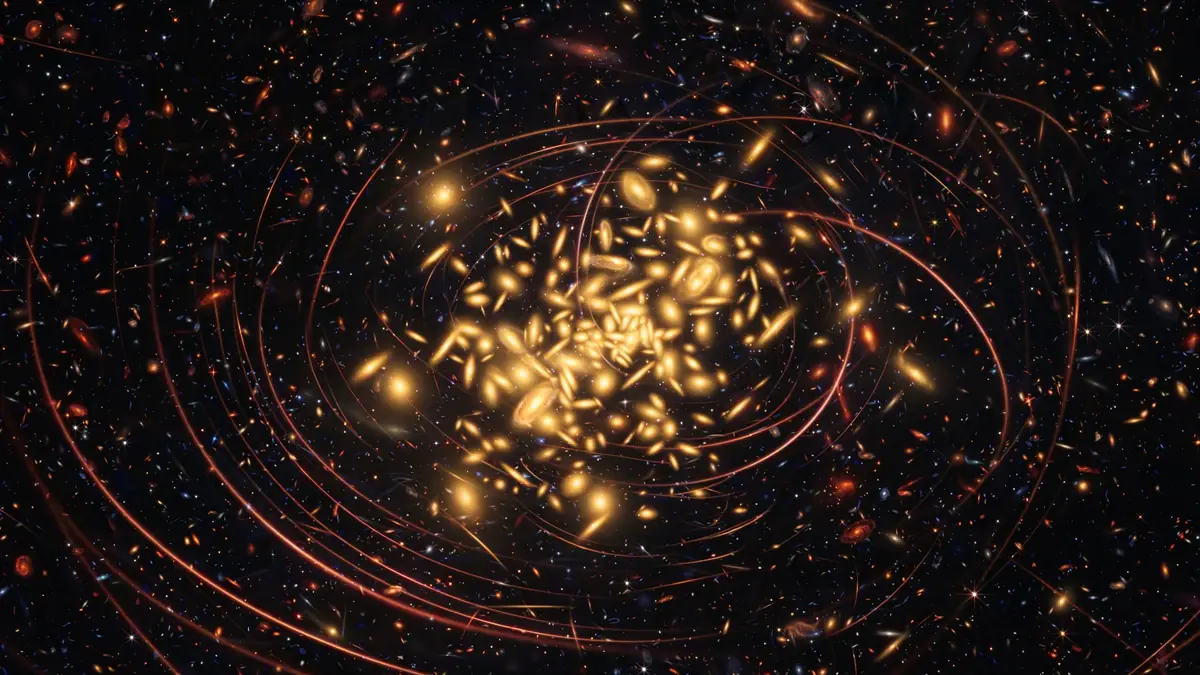
A crowded patch of sky
Some of the most beautiful images in astronomy are also the most deceptive. This week, the European Space Agency released a new Picture of the Month from the James Webb Space Telescope that shows a crowded patch of deep space where galaxies refuse to keep their usual shapes. Some appear stretched into narrow streaks. Others curve into reddish arcs or seem to show up more than once. Hundreds more fill what once looked like relatively empty darkness. The agency's caption describes it as galaxies warped and multiplied "like they've stepped into a house of mirrors" — and the science behind the illusion is as remarkable as the image itself.
The brilliant golden galaxies splashed across the frame belong to a galaxy cluster called MACS J0454.1-0300, one of the most massive structures in the known universe. The orange galaxies concentrated toward one side of the cluster are not actually part of it at all: they sit much farther away and only appear near the cluster from our point of view. And some of the most scientifically valuable objects in the scene lie farther still — their light bent, magnified and duplicated by the immense gravity of the cluster in front of them.
Looking 8 billion years into the past
Even the foreground cluster is remarkably distant. The light from MACS J0454.1-0300 has been traveling across space for so long that we are seeing the cluster as it was when the universe was about 8 billion years old — more than half the age of the cosmos. Astronomers have determined the cluster's mass to be around 180 trillion times the mass of the Sun, based on earlier observations. Each of the bright golden spots in the image is an entire galaxy, home to millions or billions of stars, bound together by gravity into one of the largest structures nature builds.
The cluster itself is a valuable scientific target. But some of the most scientifically useful objects in the image are the background galaxies — the ones whose appearance has been transformed by the cluster's gravity. Look carefully at the small reddish galaxies scattered throughout the picture: even at the very edges of the frame, there are galaxies whose images have been bent into tiny arcs by the gravity of MACS J0454.1-0300.
How gravity becomes a telescope
The phenomenon at work is gravitational lensing, one of the most elegant predictions of Einstein's general relativity. The enormous mass of a foreground object such as a galaxy cluster warps the fabric of spacetime around it, bending and magnifying the light traveling from more distant objects behind it. The cluster becomes, in effect, a natural cosmic magnifying glass — one with a light-collecting area vastly larger than anything humans could build.
That natural telescope allows astronomers to observe galaxies, star clusters and even individual stars that are too far away and too faint for our telescopes to see under normal conditions. Webb's image of MACS J0454.1-0300 shows the effect at several scales. Some galaxies are stretched into sweeping arcs, dramatically elongated by the cluster's gravity. Others appear as multiple images of the same object — the galaxy's light taking several different bent paths around the cluster to reach us, so that we see it repeated across the frame. A few show up in the reddish background population that Hubble, in earlier observations of the same cluster, could only hint at.
The lensed regions reveal galaxies from epochs of the universe that are otherwise extraordinarily difficult to study: a group of galaxies seen as they were just 2 billion years after the Big Bang, apparently going through a merger that is driving an enormous burst of star formation, and a single galaxy seen just 800 million years after the Big Bang. These are windows into the universe's youth — eras when the first galaxies were assembling and the cosmic structures we see today were still taking shape.
Why Webb sees what Hubble couldn't
MACS J0454.1-0300 is not a new target. Hubble imaged the same cluster years ago, and those observations were themselves celebrated for the dramatic lensing arcs they revealed. But Webb sees further and deeper. Its larger mirror collects more light, and its infrared instruments are tuned to the wavelengths at which the most distant galaxies shine brightest — their visible light stretched by the expansion of the universe into the infrared by the time it reaches us.
The result is an image where the background population explodes in number. What once looked like relatively empty darkness between the cluster's golden galaxies is now crowded with hundreds of distant galaxies, many of them invisible to Hubble. Each of those faint smudges is a galaxy in its own right, and each one that happens to sit behind the cluster's lensing zone gets a gravitational boost that brings it within Webb's reach.
This is why lensing clusters are among the most valuable real estate in observational astronomy. Building a bigger telescope is enormously expensive and slow; nature provides the magnification for free, in precisely the regions of sky where the most distant objects happen to line up behind the most massive clusters. Webb's observing programs deliberately target these fields because they offer the deepest possible views of the early universe for a given investment of observing time.
The science hidden in the distortions
The warped shapes are not just pretty — they are data. The precise way a background galaxy is stretched and multiplied encodes the distribution of mass in the foreground cluster, including the dark matter that makes up most of its weight. By modeling the lensing distortions across hundreds of background galaxies, astronomers can map the cluster's total mass in detail, testing theories of how the largest cosmic structures form and evolve.
The magnified background galaxies are data of a different kind. The group of galaxies seen 2 billion years after the Big Bang, caught in the act of merging, offers a direct look at how galaxy interactions drove star formation in the early universe — a process that built up the stellar populations of the massive galaxies we see today. The single galaxy seen 800 million years after the Big Bang comes from an era when the universe was still emerging from its dark ages, when the first stars and galaxies were ionizing the gas around them and making the cosmos transparent to light.
Every multiply-imaged galaxy in the frame is also a laboratory for cosmology. The multiple images arrive at slightly different times, because the light paths around the cluster have different lengths. Measuring those time delays — something that becomes possible when a lensed galaxy hosts a variable object like a supernova — gives an independent measurement of the expansion rate of the universe, one of the most contested numbers in modern astrophysics.
A picture of the month, and a method
ESA's choice to feature this image as its Picture of the Month reflects something beyond its beauty. Gravitational lensing with Webb has matured from a showcase technique into a workhorse method: the telescope is now systematically mapping lensing clusters to build censuses of the faintest, most distant galaxies ever seen. The MACS J0454.1-0300 image is one field in that campaign, and there will be more.
For the public, though, the image works on a simpler level. It is a reminder that the universe does not look the way our intuition expects — that gravity can smear galaxies across the sky like paint, that a single object can appear in several places at once, and that some of the most profound science begins with an image beautiful enough to stop you scrolling. Hundreds of galaxies, hidden in what looked like empty darkness, revealed by a telescope that is still, four years into its mission, changing what we thought the sky contained.
Sources