A planet that shouldn't exist
Five hundred light-years from Earth, a giant planet is giving astronomers two puzzles at once. Using the James Webb Space Telescope, a team led by the University of Maryland has detected ammonia in the atmosphere of HATS-6 b — a gas rarely found on a planet beyond our solar system — and found that the planet appears to be far cooler than it has any right to be. The findings, published this month in the Astronomical Journal, raise new questions about how giant planets form and evolve, and about whether the giants that orbit small stars are a chemically distinct population from the ones we thought we understood.
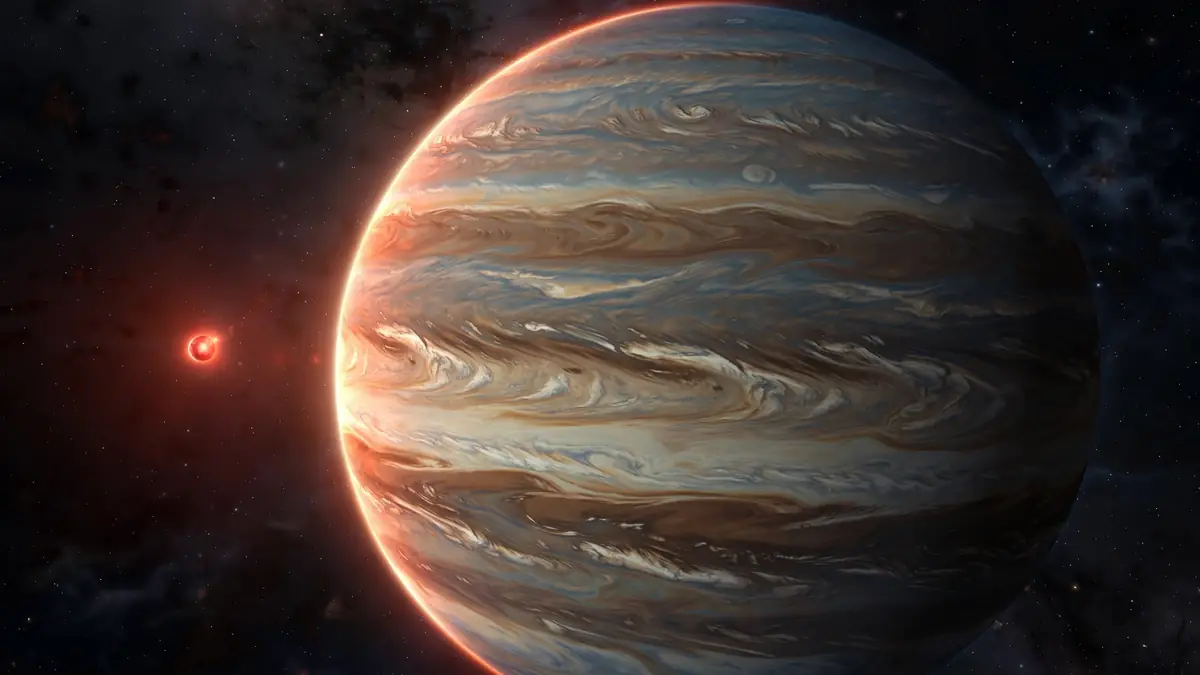
HATS-6 b was already unusual before anyone looked at its atmosphere. It is roughly the size of Jupiter but completes an orbit every three days around an M dwarf — a small, cool, reddish star. Planets are built from the leftover disk of gas and dust that surrounds a young star after its formation, and a smaller star leaves behind only a small disk. "These smaller stars don't have enough material or enough time to create planets as big as Jupiter and as big as Saturn," explained the study's lead author, Giannina Guzmán Caloca, an astronomy Ph.D. candidate at the University of Maryland. "So, the fact that HATS-6 b can exist is really interesting because it shouldn't be possible with what we know."
Astronomers know of only about 40 such planets — gas giants orbiting M-dwarf stars — out of the thousands of exoplanets discovered to date. Each one is a challenge to the standard story of how planets are built.
Reading a planet's air from 500 light-years away
The team studied HATS-6 b with a technique called transmission spectroscopy: watching the planet pass in front of its star and measuring the tiny amount of starlight that filters through the planet's atmosphere on its way to the telescope. Different gases absorb different wavelengths of light, so the missing pieces of the starlight spectrum reveal the atmosphere's chemical fingerprints.
The researchers observed two transits, on January 15 and January 21, 2024, using Webb's Near Infrared Spectrograph in its PRISM mode. Each observation lasted about 5.6 hours and covered wavelengths from 0.6 to 5.3 microns. In that data they identified four molecules: water, methane, ammonia and carbon dioxide.
Ammonia was the exciting find. Scientists have detected water, methane and carbon dioxide in the atmospheres of other giant exoplanets, but ammonia has been much harder to spot with this method — this is only the second time the technique has detected it on a distant world. The reason matters: nitrogen-bearing molecules like ammonia are expected to be more abundant in cooler giant planets than in scorching-hot Jupiter-like ones. Finding it on HATS-6 b supports the theory that giant planets orbiting M-dwarf stars may be a chemically distinct population, built — or altered — by different processes than the hot Jupiters around sun-like stars.
The mystery of the missing heat
The planet's temperature presents a separate and arguably stranger mystery. A widely used calculation puts HATS-6 b's expected temperature near 425°C (about 713 kelvins), based on its orbit and the energy it receives from its star — assuming the planet redistributes heat efficiently around itself and reflects none of the incoming starlight. But the team's analysis of the atmospheric spectrum pointed to a substantially lower temperature: repeated analyses put the retrieved temperature nearly 200 kelvins below the expected value, with some estimates landing closer to 120°C.
That is remarkably cool for a giant planet that circles its star in just three days, baked by stellar radiation at close range. The gap suggests that the planet's relationship with its star may be far more complicated than previously thought. Possible explanations are still being worked through — the data also contain an unexplained feature around 3 microns that may be related to additional chemistry, haze, stellar activity, or differences between the planet's two observed limbs — but whatever the cause, the standard calculation is missing something important.
One possibility is that our models of how these planets handle incoming heat are incomplete for this class of world. Another is that the atmosphere's chemistry or cloud structure is doing something unexpected. A third is that the star itself — M dwarfs are famously active, with flares and starspots — is complicating the measurement. The team will need more observations to narrow it down, and that is precisely the point of the program this study belongs to.
The GEMS program: seven outliers under the microscope
HATS-6 b is one of seven giant planets being studied in a Webb program called "Giant Exoplanets around M-dwarf Stars," or GEMS. The program is designed to compare these outliers with the better-understood giant planets circling stars like our Sun, asking a fundamental question: were these planets built the same way, or is something different going on?
"Every one of these planets is a challenge to formation theory," Guzmán Caloca said. "By measuring what their atmospheres are made of, we can start to ask whether they were built the same way as the hot Jupiters around sun-like stars or whether something different is going on."
The question cuts to one of the biggest open problems in planetary science. The standard model of giant planet formation — core accretion, in which a rocky core grows massive enough to gravitationally capture a huge envelope of gas — works well for planets around sun-like stars. Around M dwarfs, the disks of raw material are smaller and disperse faster, and the standard model struggles to produce Jupiter-sized worlds at all. Yet the giants are there: about 40 of them and counting. Either the models need revision, or these planets formed through a different mechanism entirely — perhaps disk instability, in which a massive disk fragments directly into planet-sized clumps — or they formed farther out and migrated inward.
Atmospheric chemistry is the way to tell these stories apart. A planet built by core accretion should have a different elemental fingerprint than one born from disk fragmentation, because the two processes sample the disk's material differently. Measuring water, methane, ammonia and carbon dioxide on HATS-6 b is the first step in reading that fingerprint — and the ammonia detection, in particular, may turn out to be a signature of the cooler, chemically distinct population these M-dwarf giants represent.
Why M dwarfs matter so much
There is a broader reason this program matters beyond the puzzle of 40 oddball giants. M dwarfs are the most common stars in the galaxy — roughly three out of every four stars are M dwarfs. If our theories of planet formation cannot explain the planets around the most common stars, then our theories are incomplete in a way that affects almost everything we think we know about how planetary systems are built.
M dwarfs are also the stars around which astronomers are most likely to find potentially habitable rocky planets in the near future, because their habitable zones are close in and their planets are easier to detect. Understanding the chemistry and evolution of giant planets around these stars is part of understanding the whole system architecture — how the giants that shape a system's dynamics came to be, and what that implies for the smaller worlds that share their stars.
What comes next
The GEMS program still has more targets to observe, and HATS-6 b itself deserves a closer look. Follow-up observations could pin down the temperature discrepancy, identify the source of the unexplained 3-micron feature, and refine the abundance measurements of the detected molecules. Each additional giant around an M dwarf that Webb characterizes will sharpen the comparison with hot Jupiters around sun-like stars — and sharpen the question of whether these worlds were built the same way or not.
For now, HATS-6 b stands as a reminder of how much the exoplanet revolution still has to teach us. A Jupiter-sized world around a star that shouldn't have been able to build it. An atmosphere laced with ammonia, the second such detection ever made this way. And a temperature nearly 200 degrees cooler than the textbooks predict. The universe, as usual, is under no obligation to match our models — and the most interesting planets are the ones that refuse to.
Sources