An update long overdue
On Thursday, September 24, 2026, NASA Administrator Jared Isaacman stood before attendees at Payload's Off World event in Houston and made a promise the space community has been waiting for. In early October, he said, the agency will deliver an "Artemis acceleration" update describing the timing for upcoming missions to return humans to the Moon — and the briefing might even coincide with the launch of the Crew-13 mission to the International Space Station. "There's a lot of ingredients — so many ingredients — that need to come together for that landing, and we owe everybody an update," Isaacman said.
The announcement lands at a moment of unusual candor about where the Artemis program stands. A memorandum attributed to Isaacman, described in reporting on September 20, said Artemis III was approximately 90 days behind schedule while retaining a best-case summer 2027 launch scenario — a striking admission of slippage from an agency that has historically guarded its schedules. Together, the memo and the promised October briefing signal a NASA that is trying to be more transparent about a program whose complexity has outgrown its original timelines.
What Isaacman outlined in Houston was not just a schedule update. It was a statement of priorities: what NASA is trying to become, who it is racing, and what victory looks like.
The race that defines the urgency
Isaacman tied the renewed urgency around lunar goals in part to international competition — and he named the competitor plainly: China. Both nations are investing heavily in lunar infrastructure and operating on aggressive timelines, and the administrator was blunt about what is at stake. "It's the flag on the suit of the next person to step foot on the Moon," he said. Assessments of which nation has operational bases or demonstrated technologies on the lunar surface, he added, will shape perceptions well before any ladder is descended.
The framing is a departure from the cooperative tone that has defined much of NASA's public messaging about the Artemis Accords and its international partnerships. It is also a reflection of reality as the agency sees it: China has its own crewed lunar landing ambitions on a timeline that overlaps with Artemis, and the contest for the next human footsteps on the Moon is, in Isaacman's telling, the contest that matters most.
That competition is also the context for NASA's shifting architecture. Under NASA's current September 2026 schedule, Artemis IV is targeted for early 2028 as the first planned crewed lunar landing of the Artemis program. Four astronauts will travel to lunar orbit aboard the Orion spacecraft; two will transfer into a commercial Human Landing System, descend to the Moon while their crewmates remain in orbit, and conduct a surface expedition lasting approximately one week near the lunar South Pole before ascending to reunite with the crew and returning to Earth.
Notably, NASA's latest Artemis IV launch information does not commit the actual crewed landing to a single company. Instead, the agency says lander readiness will determine which commercial provider carries the crew to the surface and back — a more competitive arrangement than older descriptions of the program, and one that puts pressure on providers to demonstrate their hardware on schedule.
The Moon base: NASA's three-phase plan
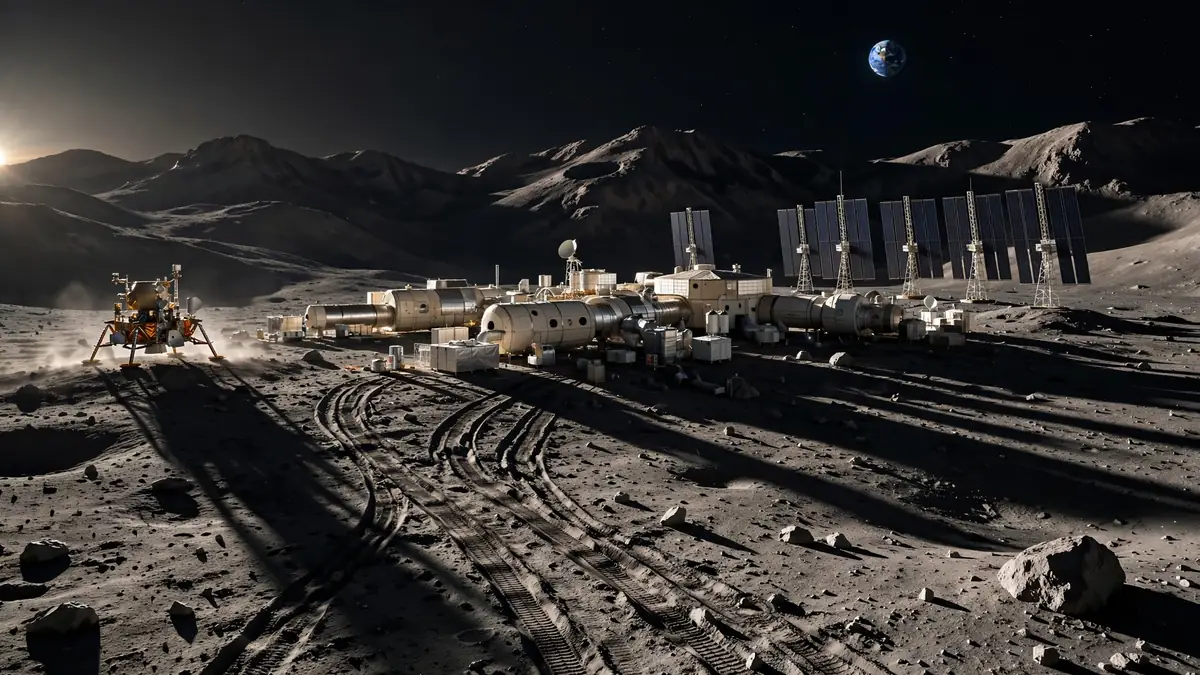
The more ambitious vision behind the schedule shuffling is NASA's Moon Base plan, developed under the agency's "Ignition" strategy, which redirects Artemis toward a lasting human presence near the lunar South Pole. This is planned future infrastructure, not an occupied settlement — NASA's published architecture begins with robotic exploration and technology demonstrations, then adds power, communications, cargo and mobility systems, and only then moves toward extended human operations.
The agency's timetable divides the work into three phases:
- Phase One (now through 2029): robotic access to the surface, scientific experiments, technology demonstrations and site characterization — learning what the South Pole environment actually demands.
- Phase Two (2029–2032): building the infrastructure that makes sustained operations possible — power systems, cargo delivery, communications networks, logistics and mobility.
- Phase Three (2032 and beyond): extended human operations and assembly of a permanent lunar outpost.
The sequence matters because NASA is not treating a lunar landing as the final objective. The plan is to build the capabilities that make repeated surface operations possible, with missions deeper into the solar system — including Mars — as the longer-term purpose. The South Pole is the target for a reason: its rugged terrain, difficult lighting conditions and permanently shadowed craters hold water ice and other resources that could sustain a presence there, and its peaks enjoy near-constant sunlight for power generation.
The hardware being built right now
While the schedule is debated, metal is being cut. On September 17, technicians at Kennedy Space Center integrated the left forward booster segment for NASA's Artemis III SLS rocket onto the mobile launcher in High Bay 3 of the Vehicle Assembly Building. The SLS twin boosters, each made up of five segments manufactured in Utah, will provide more than 75 percent of the rocket's total thrust at launch. Artemis III will launch astronauts into Earth orbit aboard Orion atop the SLS to test rendezvous and docking capabilities between Orion and commercial spacecraft — a vital step toward landing Artemis IV astronauts on the Moon in 2028.
And this week's Starship orbital flight was itself a data point for Artemis. The lunar landing architecture depends on a series of Super Heavy-Starship tanker launches to refuel the lander in orbit — a capability, autonomous in-space refueling at massive scale, that has never been demonstrated. SpaceX's successful orbital insertion and satellite deployment on September 28, followed by a controlled deorbit, moves the program one step closer to the refueling tests that must happen before any lander can be ready.
Culture change as the real metric
One of the most striking passages from Isaacman's Houston remarks concerned how he measures his own success. Rather than using mission milestones alone, he said he is focused on achieving culture change at NASA: concentrating the agency's time and resources on a few "near impossible" missions and giving the workforce flexibility to pursue work "no one else is doing." He characterized establishing a Moon base within his tenure as a matter of "luck" — dependent on the right policy, Congressional support, budget and flexibility converging at once — rather than a direct reflection of his personal leadership.
It is an unusually humble framing from a NASA administrator, and it reads as both an appeal and a warning: the agency's ambitions are bounded by politics and money as much as by physics. The "near impossible" missions get the focus; everything else waits.
The crew that set the stage
The acceleration briefing is expected to build on the momentum of Artemis II, the mission that proved the crew transportation system works. NASA astronauts Reid Wiseman, Victor Glover and Christina Koch, along with Canadian Space Agency astronaut Jeremy Hansen, launched on April 1 and splashed down in the Pacific on April 10, becoming the first crew to fly on the SLS rocket and the Orion spacecraft — and the first humans to travel beyond low Earth orbit since Apollo.
On Wednesday, September 30, the four astronauts will appear at the University of Houston's Fertitta Center for a free public event hosted by industry and community partners — the first public event in Houston following their lunar mission, and the conclusion of their post-flight campaign. The National Aeronautic Association will recognize the crew for surpassing the record for the farthest distance traveled in human spaceflight, previously set by Apollo 13 in 1970: the Artemis II crew traveled 252,756 miles from Earth, farther than any humans have ever gone.
That record is the foundation everything else is built on. The question now is whether NASA can convert the Artemis II success into a cadence — and whether the early-October update will give the program the clear schedule Isaacman says the public is owed. The ingredients are many. The update, at least, is coming soon.
Sources