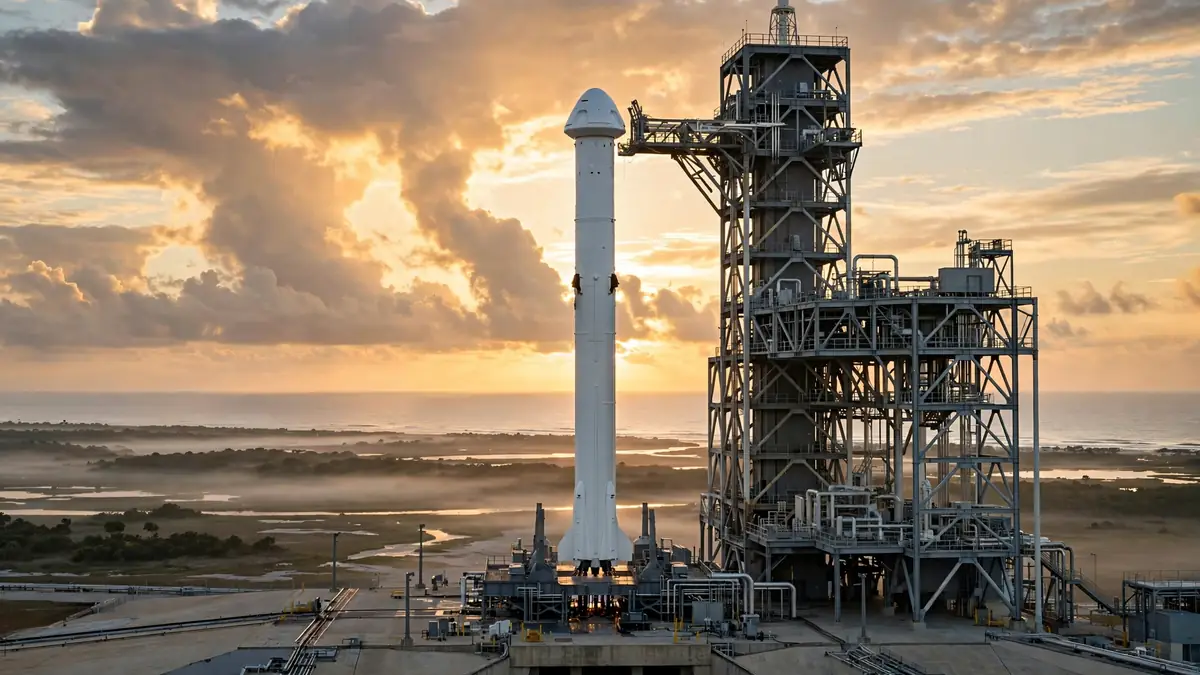
The six-month wait is over
Six months have passed since any astronaut launched from American soil. The last crew to leave Earth behind after a liftoff in Florida was the four-person team of NASA's Artemis II, who rode the agency's Space Launch System around the Moon and back on April 1. Now, the long gap is about to close. NASA's SpaceX Crew-13 mission — a joint undertaking between the space agency and SpaceX — is scheduled to lift off no earlier than 11:10 a.m. EDT on Thursday, October 1, from Space Launch Complex 40 at Cape Canaveral Space Force Station, carrying four astronauts to the International Space Station for a multi-month stay.
The past three days have been a study in final preparations. On Sunday, September 27, the SpaceX Falcon 9 rocket and Dragon spacecraft rolled out to the launch pad and were raised to vertical position. At the pad, engineering teams conducted an integrated static fire of the Falcon 9, followed by detailed data reviews. On Tuesday, September 29, the four-person crew participated in a dry dress rehearsal — donning their spacesuits at Kennedy Space Center's Neil A. Armstrong Operations and Checkout Building, completing air leak checks, boarding vehicles, traveling to the pad and climbing into the Dragon spacecraft that will take them to the station. The U.S. Space Force's 45th Weather Squadron predicts a 60 percent chance of favorable weather, with the cumulus cloud rule and flight through precipitation as the primary concerns.
If all goes to plan, Crew-13 will mark the return of routine American human spaceflight after an unusually long pause — and the beginning of another long-duration science expedition aboard the orbiting laboratory.
Meet the crew
Crew-13 carries an international team of four: NASA astronauts Jessica Watkins and Luke Delaney, Canadian Space Agency astronaut Joshua Kutryk and Roscosmos cosmonaut Sergey Teteryatnikov. They will conduct scientific research aboard the space station aimed at preparing for human exploration beyond low Earth orbit — and at returning benefits to life on Earth.
The mission will be a milestone for its commander. It is the second spaceflight for Jessica Watkins, and it will make her the first NASA astronaut to launch aboard a SpaceX Dragon spacecraft twice — a small but telling marker of how thoroughly the Commercial Crew Program has changed the way NASA flies. For Delaney, Kutryk and Teteryatnikov, it will be their first trip to space. The crew mix reflects the station's enduring international character: an American commander, a Canadian colleague flying for the CSA, and a Russian cosmonaut flying under the long-standing arrangement that keeps Russian and American seats on each other's spacecraft — a practical arrangement for a partnership that has survived even difficult geopolitics on the ground.
When Crew-13 arrives, the crew of NASA's SpaceX Crew-12 will help familiarize the newcomers with ongoing science and station maintenance for a smooth handover. Following the brief transition — and pending weather — Crew-12 will board its SpaceX spacecraft and head for a splashdown off the coast of California. That crew includes NASA astronauts Jessica Meir and Jack Hathaway, European Space Agency astronaut Sophie Adenot and Roscosmos cosmonaut Andrey Fedyaev, who will be returning to Earth after their own long-duration mission.
Why the mission was delayed
Crew-13 was originally slated for a mid-September launch. NASA and SpaceX pushed the date after detecting an issue with the spacecraft selected to carry the astronauts: an oxidizer leak in the propulsion system of the Dragon capsule. The leak was found during pre-flight preparations, the kind of fault that ground crews would rather find on the ground than discover in orbit. Engineers worked through the problem, and the rollout to the pad on September 27 — followed by a successful static fire — signaled that the vehicle was cleared for the next steps.
The delay explains part of the six-month gap in American launches. The gap is not a sign of trouble in the broader program so much as a convergence of scheduling: Artemis II flew in April, and the next crewed flights on the manifest were Crew-13 and the commercial missions that follow it. Still, for an agency that has spent the last few years flying astronauts from Florida roughly every six months like clockwork, the pause was noticeable — and the return is being watched closely.
What the crew will do aboard the station
Like every long-duration station expedition, Crew-13's science program spans disciplines. NASA describes the mission's research as preparing for human exploration beyond low Earth orbit — the kind of work that tests life-support systems, studies the effects of long-duration spaceflight on the human body and develops technologies for the Moon and Mars — while also producing results that benefit life on Earth, from materials science to medical research.
The mission also matters for what it represents about NASA's Commercial Crew model. In a statement this week, NASA noted that its Commercial Crew Office "has delivered on its goal of safe, reliable, and cost-effective transportation to and from the International Space Station from the United States through a partnership with American private industry," adding that the partnership "is opening access to low Earth orbit and the International Space Station to more people, more science, and more commercial opportunities." Crew-13 is the thirteenth operational crew rotation mission under that model — and each one deepens the track record on which the transition to commercial space stations will eventually depend.
The road to the station — and back
The journey itself is well rehearsed by now. After liftoff, the Falcon 9's first stage will return for recovery while the Dragon capsule continues to orbit, performs a series of phasing burns and docks with the station roughly a day later. The crew will spend months living and working about 250 miles above Earth, running experiments, maintaining the station's systems and supporting visiting vehicles.
The dry dress rehearsal on September 29 was the final full walkthrough of launch day. The crew suited up, confirmed their suits were sealed, traveled the same route they will take on launch day and strapped into the same seats they will occupy at 11:10 a.m. on Thursday. It is a ritual by now — but one that NASA and SpaceX perform with deliberate care, because every successful dress rehearsal is a rehearsal for a launch that cannot afford mistakes.
What this launch means for the station's future
Crew-13 arrives at a moment when the International Space Station's future is under active discussion. The station is currently expected to operate through about 2030, with a controlled deorbit planned at the end of its life, and NASA is working to ensure that commercial successor stations are ready before the ISS retires. Every successful crew rotation buys time and builds the operational experience — in long-duration science, in international crew coordination, in the rhythm of launch and return — that the post-ISS era will inherit.
For Canada, Kutryk's flight continues the country's long participation in human spaceflight. For Russia, Teteryatnikov's seat is another chapter in the crew-exchange arrangement that has kept at least one Russian cosmonaut on the ISS and one NASA astronaut on Soyuz flights. For NASA, the mission is business as usual in the best sense: the thirteenth operational crew flight of the commercial era, carrying science that will inform the agency's next great leap.
The launch window opens at 11:10 a.m. EDT on October 1. Weather is 60 percent favorable. The rocket is on the pad. The crew has rehearsed. After six months of waiting, American human spaceflight is about to resume.
Sources