A decade of testing, one historic morning
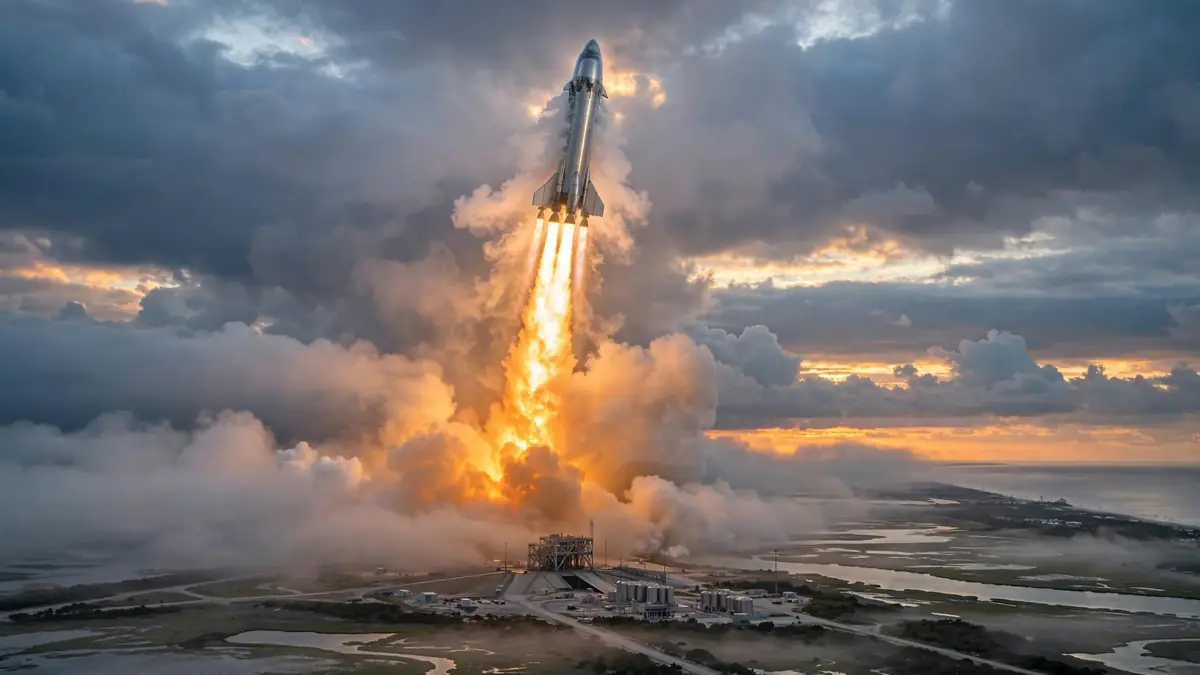
At 7:50 a.m. Central Time on Monday, September 28, 2026, the largest and most powerful rocket ever built did something it had never done before. SpaceX's Starship — all 407 feet (124 meters) of stainless steel, powered by a combined 39 methane-fueled Raptor engines — lifted off from the company's Starbase complex on the Texas coast and climbed all the way into orbit. Fourteen test flights into the most closely watched rocket program in history, the ship that has exploded, burned, belly-flopped and splashed down in various states of disrepair finally reached the one milestone that had eluded it: orbital velocity.
"Starship is orbital," Mission Control announced to cheers from SpaceX employees watching the live video feed, according to coverage of the flight. The call marked a genuine turning point, not just for the company but for the entire architecture of human spaceflight in the decade ahead. Starship is the vehicle NASA has chosen to land astronauts on the Moon, the machine SpaceX hopes will one day carry people to Mars, and the only launcher currently flying that can deploy the next generation of Starlink satellites — a job Falcon 9 physically cannot do.
The mission was anything but smooth, and that is precisely what makes it worth examining in detail. An engine failed on the way up. Controllers spent tense minutes debating whether to press on. The planned ten-hour flight was cut to three. And the ending, captured in dramatic footage, was a fireball. Yet by every measure SpaceX set for itself, Flight 14 was a success — and it may be remembered as the flight that turned Starship from a prototype into a working rocket.
The ascent that almost ended the mission
The trouble began early. On its way up, one of the 33 Raptor engines on the Super Heavy booster shut down prematurely. Shortly after stage separation, one of the six engines on the upper stage — the vehicle known simply as Ship — also experienced an early shutdown. For a few minutes, flight controllers faced a stark choice: attempt the orbital insertion burn that would take Starship the rest of the way into orbit, or abort the attempt and end the test flight early without deploying its satellite payload.
The team decided to go ahead, and the 19-second burn proceeded smoothly, performed by a single Raptor sea-level engine at roughly 25 minutes into the flight. The maneuver placed the spacecraft into an orbit roughly 262 by 277 kilometers above Earth at a 32-degree inclination — the first time Starship had ever achieved the roughly 17,500 miles per hour needed to stay in space rather than fall back to Earth. SpaceX later noted that the spacecraft compensated for the lost engine by running its remaining five engines longer than originally planned, and that controllers confirmed the three sea-level engines needed for later maneuvers were healthy before giving the go for orbital operations.
The 13 previous Starship flights since the program began in 2023 had all remained suborbital. Some were spectacular failures; others were steady incremental successes. But none had carried the vehicle's full promise. Flight 14 was the first test designed to prove the system could operate in orbit — and after a wobble that nearly scrubbed the attempt, it did exactly that.
A working rocket: 26 satellites, the first real payload
The centerpiece of the mission was what happened once Starship was safely in orbit. The spacecraft's satellite deployer — described in coverage as working like a giant Pez dispenser — pushed out 26 next-generation Starlink V3 satellites, one after another, at an altitude of about 160 miles (270 kilometers). The deployment sequence took roughly half an hour, and SpaceX subsequently confirmed it had made contact with all 26 satellites through laser links, ground stations and Starlink user terminals.
This was the first time Starship had delivered an operational, revenue-generating payload to orbit. The distinction matters enormously. Every previous Starship flight had been a test of the vehicle itself; this one was a test of the vehicle doing its job. "Payload deploy complete. All 26 Starlink V3 satellites are in orbit," the company said.
The V3 satellites are a different class of hardware from the Starlink spacecraft Falcon 9 carries today. Each weighs about two metric tons at launch, carries larger solar arrays and upgraded antennas, and can add approximately one terabit per second of network capacity — about ten times the capacity of older Starlink satellites. The 26 deployed on Monday together add 26 terabits per second to the world's internet infrastructure, roughly a one percent bump in total global capacity in a single launch. SpaceX eventually expects Starship to carry as many as 60 V3 satellites on one mission. Falcon 9 cannot launch them at all: they simply do not fit inside its payload fairing.
SpaceX had previously flown V3 satellites on a Starship test in July, but that mission followed a suborbital course and the satellites re-entered the atmosphere and burned up after a series of tests. Monday's flight was the first time the company could put them into an orbit where they could join the constellation. The new spacecraft are expected to expand broadband capacity and strengthen Starlink's direct-to-device service, and future V3 satellites could also support Starshield, SpaceX's government-focused satellite business. SpaceX said the new satellites could begin service within weeks, after on-orbit checks and a gradual raising of their orbits.
Why the flight ended early
SpaceX had been aiming for a ten-hour flight spanning six full laps around Earth — a long-duration orbital test designed to prove the vehicle's readiness for NASA's Artemis moon program. Instead, the company cut the mission short at the first scheduled decision point and brought Starship home after approximately three hours.
The reason was the engine anomaly during ascent. In a statement carried by technology press, SpaceX explained its reasoning:
"Out of an abundance of caution given the engine issue experienced during ascent, the flight control team decided to limit the duration spent on orbit and proceeded with de-orbiting Starship to a splashdown location in the northern Pacific Ocean." — SpaceX
Starship re-entered over the Pacific, enduring temperatures of up to 2,600 degrees Fahrenheit, descended belly-first through the atmosphere, flipped upright for a landing burn and splashed down north of Hawaii roughly three hours after liftoff. The vehicle tipped over and broke apart after reaching the water — caught fire on camera, in fact — but SpaceX had expected that outcome for an ocean landing.
NASA Administrator Jared Isaacman congratulated the company publicly. "Gorgeous launch, getting Ship to orbit and managing every step in a safe, responsible, and especially inspirational way," he wrote. NASA, he added, is excited to help where it can and for Starship missions to become routine — a significant statement from the head of the agency that is depending on Starship to return astronauts to the lunar surface.
The booster's own quiet success
Lost in some of the drama around the upper stage was what happened to Super Heavy, the giant booster. After separation, it performed a directional flip and began its boostback burn, relighting 31 of the planned 33 engines. The burn was deliberately designed to use the remaining liquid oxygen in the booster's main tank — a data-gathering exercise meant to help prepare the vehicle for future attempts to return directly to the launch site rather than splashing down at sea.
Super Heavy later began its landing burn and splashed down in the Gulf of Mexico. After the landing burn ended, the booster triggered its flight termination system as part of a demonstration of its safety hardware. It was, in its own way, as much a test as the orbital phase: every maneuver generated data SpaceX will feed back into the design.
What it means for the Moon
The flight's significance extends well beyond one morning in Texas. After 13 suborbital test flights, Flight 14 represented a pivotal moment for both SpaceX and NASA. A successful orbital flight — even a shortened one — strengthens confidence that SpaceX can prepare the system in time to support NASA's planned lunar missions, which are expected to use a Starship variant as the crewed lander.
That lunar mission will depend on something never demonstrated at scale: a series of Super Heavy-Starship tanker launches to refuel the lander in orbit before its trip to the Moon. In lunar orbit, the lander would dock with a NASA Orion crew capsule, collect two astronauts and transport them to the surface before bringing them back. A successful orbital flight paves the way for additional tests of autonomous in-space refueling — the capability on which the entire lunar architecture hinges. The shortened Flight 14 did not test long-duration orbital operations or refueling, but it proved the vehicle can reach orbit, deploy a real payload and come home in one piece. Those are prerequisites for everything else.
What comes next
SpaceX has not said how quickly it will fly again, but the program's cadence has been accelerating, and the company now has a vehicle that has proven the core of its mission profile. The next tests are likely to push further: longer orbital stays, more payload deployments, recovery attempts that bring Ship back intact, and eventually the first demonstrations of propellant transfer between two Starships in orbit.
There is also a commercial clock ticking. Starlink's constellation needs the V3 satellites to expand capacity, and only Starship can carry them. Flight 14 was, by multiple accounts, the giant rocket's first revenue-generating commercial mission — the moment the program stopped being purely an expense and started being a business. That changes the economics of everything that follows.
For the rest of the space industry, the message of Monday's flight is simple: the biggest rocket ever built now works in orbit. The failures taught the lessons; Flight 14 proved them. What remains — routine operations, lunar landings, Mars — is harder than anything demonstrated so far. But the hardest first step, getting to orbit, is behind it.
Sources