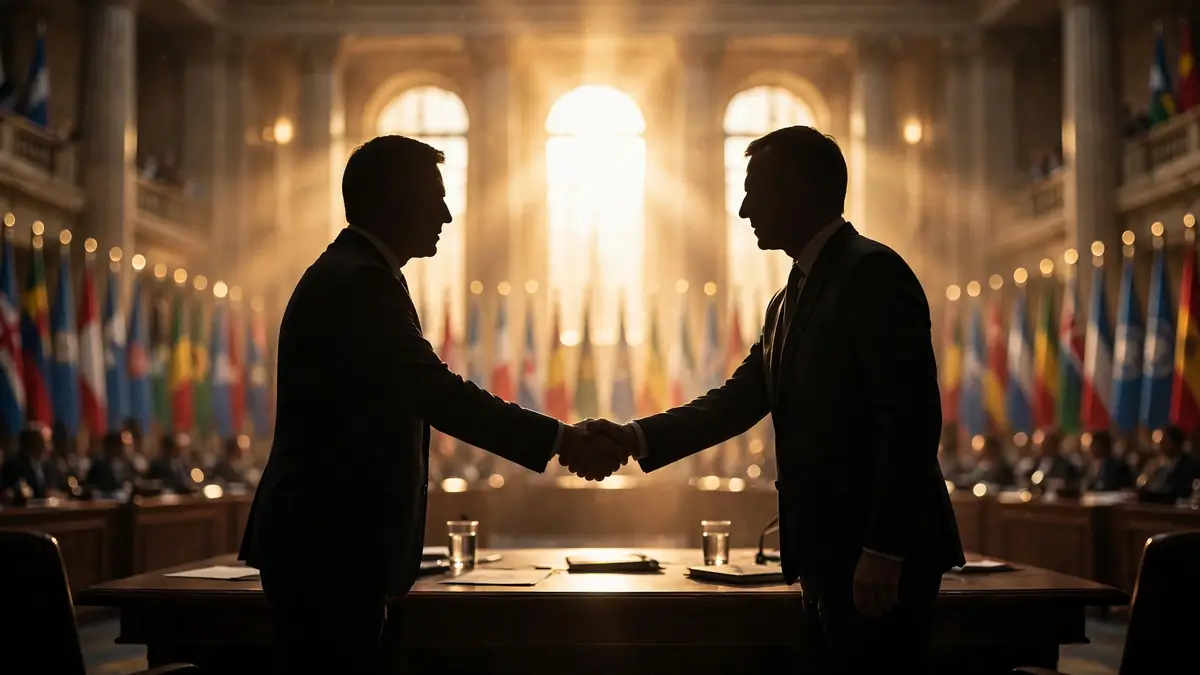
The meeting that mattered
On the sidelines of the 81st session of the United Nations General Assembly in New York, Ukrainian President Volodymyr Zelensky sat down with US President Donald Trump for a bilateral meeting that produced the most significant development in the Ukraine war's diplomatic track for months: an American commitment to license Ukraine's domestic production of Patriot air-defence missiles.
"There are concrete agreements regarding Patriot licenses," Zelensky posted on X after the meeting. "At our meeting, President Trump stressed that he had made his final decision: Ukraine will receive licenses to produce Patriot missiles."
The move is, by Zelensky's account, game-changing. The Patriot system is the backbone of Ukraine's defence against Russian ballistic missiles, and until now Kyiv has depended on the United States and other allies to supply both the launchers and the interceptors. In addition to the US, only Japan, Germany and Poland currently have the ability to produce the air-defence systems. One of Zelensky's military advisers had recently met with defence contractor Raytheon and an Israeli company about the licences, and Zelensky asked Trump to help move the process along.
"There's a big deficit for everybody," he told reporters of the Patriot supply chain. "We will work also with other countries." The licensing deal, if implemented, would give Ukraine a sovereign production capacity that no previous Western commitment has offered — a shift with implications for the war's long winter ahead.
An energy truce on the table
The second strand of the diplomacy concerns energy infrastructure. Zelensky confirmed after the meeting that Ukraine is ready to agree to an energy ceasefire — a mutual pause in strikes on energy, electricity and heating infrastructure, as well as water supplies — on the condition that Russia does the same.
"President Trump, our teams, and I spoke about how to end the war. This is the priority. We are ready. I'm not sure Russia is ready as of today, but anyhow, we spoke about an energy ceasefire," Zelensky said in a roundup of his comments to reporters at the General Assembly.
The proposal has been taking shape for weeks. After a phone conversation with Trump days earlier, Zelensky hailed "an important conversation" and cited "ideas for de-escalation steps and for addressing fundamental security issues — energy security, food security, and the protection of human life." The two leaders had already discussed a mutual Ukrainian-Russian pause in strikes against energy infrastructure and on shipping in the Black Sea and Sea of Azov.
Trump has floated the idea of a truce covering oil infrastructure, partly to ease pressure on energy markets. On September 21 he wrote on Truth Social that "Russia has unfortunately lost control of its Diesel Oil Industry due to its War with Ukraine." Zelensky, speaking in New York, responded in kind: "It is hard to imagine a more humiliating loss for a country that has a permanent seat on the UN Security Council and takes so much pride in its oil exports."
Yet the proposal faces an obvious obstacle: Moscow's response. US officials have been seeking an energy ceasefire to calm markets for months, but Russian President Vladimir Putin has so far rebuffed it.
The envoys' marathon week
The Trump-Zelensky meeting was only one part of a dense week of back-channel diplomacy. US special envoys Steve Witkoff and Jared Kushner held what they described as marathon meetings throughout General Assembly week, sitting down with Ukraine's delegation, Russia's envoy Kirill Dmitriev, newly elected British Prime Minister Andy Burnham, and Iranian mediators.
"I sense a sort of feeling of hope and promise. When all these nations come together and they can talk face to face — that's what drives progress," Witkoff told the New York Post. "We are all working together to tackle some of the toughest problems and confront challenges head-on that have faced our nations for decades."
The envoys also joined Trump for a meeting with leaders of the Gulf Cooperation Council — Saudi Arabia, the United Arab Emirates, Bahrain, Kuwait, Oman and Qatar — and hosted France, Germany and the UK for a dinner with Ukraine's delegation. On September 23, Witkoff, Kushner and former British prime minister Tony Blair attended a Board of Peace high-level briefing in New York.
The meetings with Zelensky and Dmitriev have not yet yielded a permanent truce. But the structure of the talks has widened: this is no longer bilateral shuttle diplomacy between Washington and Moscow, but a multi-party effort involving European capitals, Gulf states and Kyiv itself.
The Moscow channel
Parallel to the New York diplomacy, the Washington-Moscow channel has been active. Witkoff and Kushner met Putin in Moscow earlier in September, and this week Putin's envoy Dmitriev — who also heads Russia's RDIF sovereign wealth fund — travelled to Washington for talks with US officials on ending the war, including discussion of possible US-Russia energy initiatives in the postwar period.
Dmitriev was in Washington "to continue constructive discussions on a peaceful resolution to the Russia-Ukraine conflict and possible U.S.-Russia energy initiatives after the war ends," a US official said. The explicit linkage of peace talks to postwar energy cooperation is a striking feature of the current diplomacy — and a reminder that economic interests are woven through the negotiating positions of all sides.
Zelensky's case from the podium
From the General Assembly podium on September 23, Zelensky made the case for continued Ukrainian strikes on Russian territory as a matter of survival. He said he understood the frustration and anger the war provoked — admitting, in passing, that he sometimes shared Trump's exasperation. Trump had written days earlier on Truth Social: "This ridiculous and never ending War with Ukraine must be ended."
Addressing the chamber, Zelensky detailed the Russian dead and wounded recorded over eight months of fighting: precisely 248,964. "To add another 1,000 square kilometers, Putin is paying with 248 lives for every square kilometer," he said — framing the invasion, launched in 2022, as an exercise in strategic futility. Ending the war? "Can you even imagine him without war?" he added, alluding to Putin.
Two days earlier, from the same podium, Trump had asserted that the conflict would end "more quickly than people understand," without offering details. The billionaire, concerned by rising gas prices squeezing household incomes at home, has been pressing for the oil-infrastructure truce to ease markets.
What comes next
Zelensky set a clear timetable for the next phase. In his Friday post, he said his negotiators would brief European officials while the US discussed next steps with the Russians: "and in ten days, we will come back with views and results in some shape or form." He also called for a trilateral meeting of Trump, Putin and himself, saying leaders need to move "as quickly as possible" to end the war.
The Patriot licensing decision and the energy-ceasefire proposal together mark the most substantive diplomatic movement of the war's fourth year — yet both remain promises rather than realities. Production lines cannot be built overnight, and an energy truce requires the one party that has so far refused it.
For now, the diplomacy of the 81st General Assembly has produced something the previous two years of negotiations have often lacked: a concrete, near-term agenda — missiles, energy, and a ten-day deadline — against which progress, or its absence, can be measured.
Sources