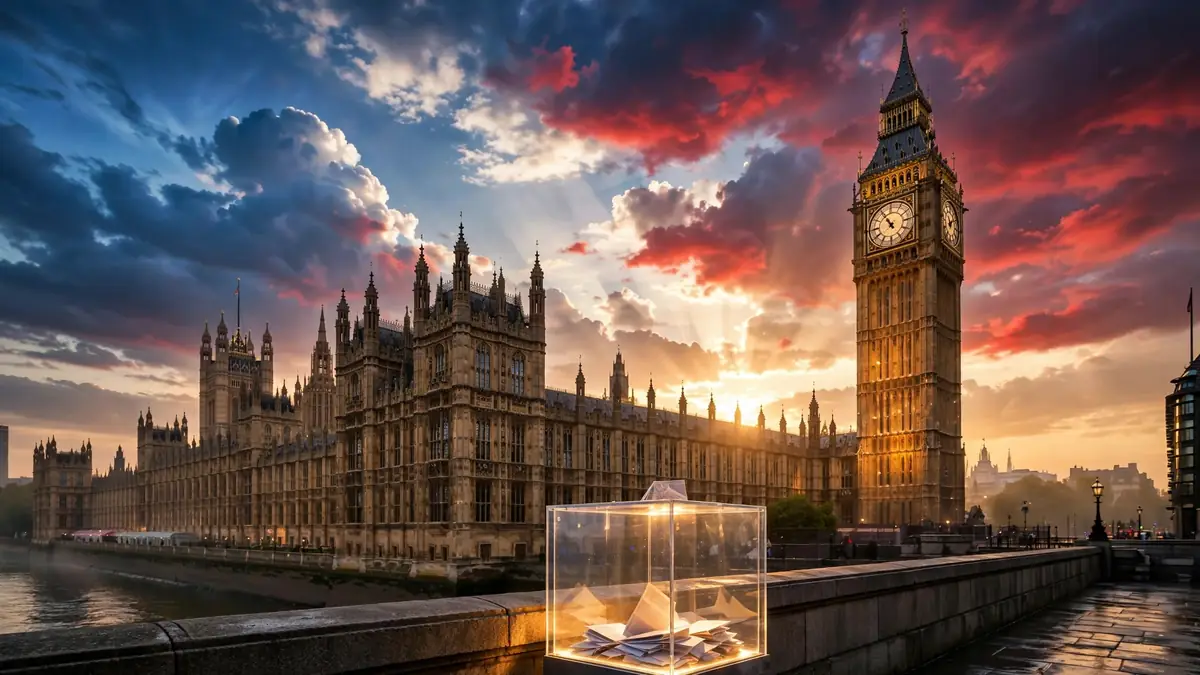
A conference for the history books
Andy Burnham has been Prime Minister for barely two months. Yet at his first Labour Party conference as leader, he used his keynote address to promise nothing less than a transformation of British democracy: a manifesto commitment to scrap the first-past-the-post electoral system, a national commission to design its replacement, and — for good measure — new laws to bring water companies back toward public ownership and a fresh attempt at an EU reset.
The electoral reform pledge was the headline. "We will contest the next election with a manifesto commitment to change the electoral system," Burnham told delegates, announcing that he would establish a national commission to examine reform and invite all political parties to take part in its work, seeking cross-party backing for change.
The next general election is due in 2029. By putting proportional representation in the manifesto now, Burnham is asking voters to endorse the reform before it happens — a strategy designed to answer the charge that a government would be rigging the rules in its own favour.
Why first past the post is in the dock
Britain's electoral system requires a party to win at least 326 of the 650 seats in the House of Commons to secure a majority. Its defenders say it delivers decisive government and a clear constituency link. Its critics say it distorts the national vote, disenfranchises millions, and rewards the two largest parties at everyone else's expense.
Burnham has long favoured ditching the system in favour of proportional representation. In his conference speech he framed the case in blunt terms: the current system is divisive because a party can find itself in government with 30 per cent of the vote or less.
"I want to underpin our plan for Britain with a new politics," he said, acknowledging that the changes would be difficult and not universally liked, but arguing that they were needed after a decade of political turbulence. Burnham is the seventh prime minister in ten years — a churn that has become a byword for the instability of modern British politics.
The May local elections provided the immediate backdrop. They underlined the fracturing of Britain's traditional two-party system, with the once-dominant Labour and Conservative parties losing votes to right-wing Reform UK, the left-wing Green Party, and nationalists in Scotland and Wales. Under proportional representation, that fragmentation would translate into parliamentary arithmetic rather than wasted votes — a fact that reform's supporters cite and its opponents fear.
History counsels caution. In a 2011 referendum, Britain rejected a proposal to introduce the alternative vote, a preferential voting system — the country's only recent test of electoral change, and one that campaigners on both sides of today's debate still study.
Reopening the European question
If electoral reform was the headline, the European Union was the undercurrent. Burnham told the conference he would seek to find consensus around a reformed alliance with the EU — a bid that risks reopening the Brexit debate in a country still scarred by its tumult.
The pursuit of closer ties is in line with the direction set by his predecessor Keir Starmer, whom Burnham replaced in July, but the explicit search for consensus will test his political skill. Burnham has previously said he wants Britain to rejoin the EU in his lifetime, but said recently he was not proposing such a step and that he respected the result of the 2016 referendum.
The geopolitics have moved in his favour. The threat of a wider war in Europe and Donald Trump's influence on trade, defence spending and wider geopolitics is reshaping alliances around the globe. Trump has pushed Europe to take responsibility, and foot the bill, for increasing its defensive strength to deter Russia — while using tariffs aggressively to protect the US economy.
In that context, Britain has tried unsuccessfully to join a collective European defence investment programme, and is lobbying Brussels to include it in a broader "Made in Europe" manufacturing programme. The EU has reportedly urged the UK to place tariffs on Chinese autos to gain favourable terms within that drive, and one EU official has said "a customs union would solve most of the problems of 'made in Europe'".
Former prime minister Tony Blair weighed in ahead of the conference, urging Burnham to abandon the "red lines" on an EU customs union and single market return set out in Labour's 2024 election manifesto, and to work towards rejoining the EU over the next decade.
The reaction from Reform UK was swift. "Andy Burnham has barely been prime minister five minutes and he's already trying to sneak us back into Brussels via the back door," said Richard Tice, the party's deputy leader. "Reform UK will never let this betrayal go unchallenged."
Water: the symbol of a failed privatisation
Burnham's third big announcement concerned water. He said he would legislate to repeal the ban on the public ownership of water companies, promising a ten-year route to "a very different water system" for the country.
Water suppliers in England and Wales were privatised in 1989, but a string of failures — sewage spills, rising bills, executive pay — has made the sector the emblem of a privatisation model in which, in Burnham's words, "profit has been prioritised over the environment and affordable bills."
"Water is a symbol of what has gone wrong with Britain. A service where the shareholders never lose and the public never win," he told the conference.
Under the planned changes, mayors would gain new powers to hold water companies to account. A strengthened Water Bill would allow greater public control of water companies in future — stopping short of immediate renationalisation, but opening the legal door to it.
The markets noticed. Shares in Severn Trent, Pennon and United Utilities traded down by 0.9 to 1.6 per cent after the announcement. The development will be watched closely by investors in Thames Water — Britain's biggest supplier, with 16 million customers and billions of pounds of debt, facing mounting fines for polluting rivers with sewage. The government and regulators are currently considering whether to approve a creditor-led rescue plan for the company.
The politics of it all
Taken together, the three announcements amount to a defining statement of intent from a new prime minister — and a calculated gamble. Electoral reform energises the left and the Liberal Democrats but alarms those who remember 2011. The EU push courts business and younger voters but hands Reform UK its favourite line of attack. The water move is popular with the public but spooks investors.
The polling backdrop is tight. Recent surveys have put Labour marginally ahead of Reform UK, with the official opposition Conservatives several percentage points behind — a three-way contest that makes the electoral system itself a live political weapon.
Burnham's calculation is clear: that Britain's voters are tired of instability and ready for a "new politics." Whether the commission, the consensus bid and the Water Bill survive contact with parliament, the markets and the electorate will define the rest of his premiership.
Sources