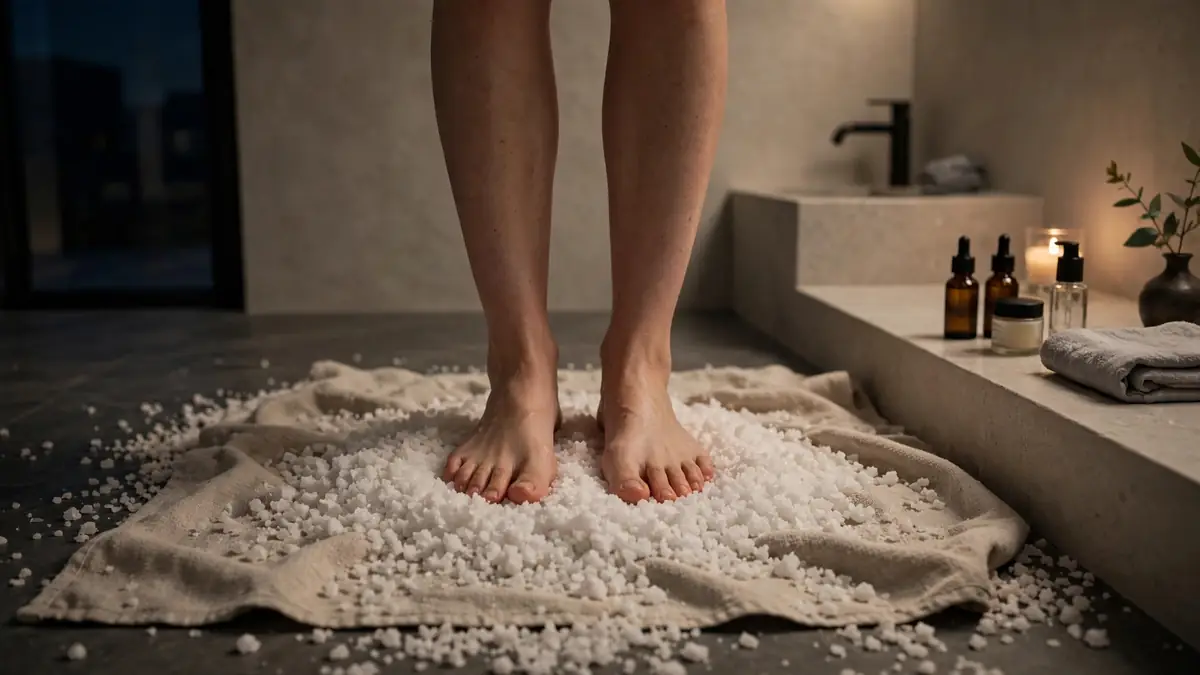
The bedtime routine of 2026 might be the strangest one yet. Across TikTok, wellness creators are filming themselves pouring coarse Epsom or Himalayan salt onto a towel, a baking sheet or the shower floor — then standing barefoot on the crystals for around ten minutes before bed. The practice has a name, “salt stepping” (also called “salt stomping”), and its devotees make remarkable claims: lower cortisol, higher serotonin, a nervous system shifted into “rest mode,” and the best sleep of their lives.
The trend’s breakout star is wellness creator Tammy Weatherhead, whose videos show her shuffling her feet over a salt-covered baking sheet while insisting that “if you are not standing on salt before bed, you are missing out.” She credits the ritual with exfoliating her feet, reducing inflammation and preparing her body for deep sleep. Thousands of imitators have followed, folding salt stepping into their nightly skincare routines — brush teeth, apply serums, stand on salt, sleep.
It is the latest entry in a long lineage of viral sleep hacks, from the “sleepy girl mocktail” to mouth taping. But does standing on salt actually do anything — or is the benefit somewhere else entirely?
What the trend claims
The theory, as presented by its proponents, blends two wellness concepts: grounding (direct physical contact with natural materials, said to connect the body to the earth’s energy) and magnesium therapy. Epsom salt is magnesium sulfate, and magnesium does play a genuine role in the nervous system — which is why the claim feels plausible. Devotees argue that the magnesium is absorbed through the soles of the feet, calming the nervous system, lowering the stress hormone cortisol and raising the mood-related neurotransmitter serotonin.
It is an appealing story: a ten-minute, nearly free ritual that fixes modern sleeplessness at its root. The problem is that the individual links in the chain do not hold up to scrutiny.
What the experts say
Physicians and sleep specialists who have weighed in are strikingly consistent: there is no solid evidence that standing on salt changes your hormones or your sleep architecture.
Doreen Zarfati, a New York-based psychiatrist and chief medical officer at the health company Fountain, told Harper’s Bazaar that there is no data showing that standing on salt crystals changes serotonin or cortisol levels, and no evidence that magnesium is absorbed through the soles of the feet in a way that resets the nervous system.
Jacqueline Geer, MD, an assistant professor of pulmonary, critical care and sleep medicine at the Yale School of Medicine, told Vogue that whatever benefit people feel likely comes from a different source: the trend demands focus and disconnection from a busy environment. Non-stimulating, calming activities before bed, she noted, are genuinely linked to falling asleep more easily.
Susan Jacob, a physiotherapist at Aster Cedars Hospital and Clinic in Dubai, made a similar point about Epsom salt foot soaks — the closest well-established cousin of salt stepping. “Many people find soaking their feet or lower legs in warm water with Epsom salt for 10 to 15 minutes before bed to be relaxing,” she said. “From a physiotherapy perspective, the main benefit is likely from the warm water, which helps muscles relax, improves local circulation and creates a calming bedtime routine.” On the magnesium-absorption claim, she was direct: “There isn’t strong scientific evidence that significant amounts are absorbed through the skin or that it directly improves sleep. However, if it helps you unwind and you enjoy it, it can be a safe part of your bedtime routine.”
“Take the information with a grain of salt. There is no solid scientific evidence that standing on Epsom salt can increase serotonin levels or lower cortisol levels.” — Dr. Yoshua Quinones, internist, speaking to the New York Post
Dr. Quinones added that while salt grounding cannot influence hormonal levels, it can exfoliate the skin — and that the soothing sensation “may promote relaxation and mindfulness, and help some people unwind before bedtime. Any calming effect is likely due to the sensory experience and the relaxation ritual itself rather than a chemical reaction occurring in the body.”
Why it might “work” anyway
Here is the interesting part: the experts are not saying salt steppers are imagining their better sleep. They are saying the mechanism is psychological rather than chemical — and that this does not make it worthless.
Consider what ten minutes of salt stepping actually requires. You put your phone down. You stand still. You focus on a mild, unusual physical sensation. You do it at the same time every night, usually while completing other wind-down tasks. In sleep-medicine terms, that is a textbook wind-down ritual: consistent, screen-free, mildly sensory, and clearly signalling to the brain that the day is over. As neurologist and sleep specialist Dr. Chris Winter has noted of such rituals, the common denominator is “slowing down, focusing on a calming ritual, and signaling to your body that it’s time for sleep.”
Australian sleep expert Olivia Arezzolo offers the most generous reading: the science behind magnesium itself is solid — magnesium acts as the “brakes” of the nervous system — even if this particular delivery method is unusual. The ritual, in other words, may be accidentally brilliant: not because of the salt, but because of the pause.
The caveats
Salt stepping is not risk-free for everyone. Dr. Winter lists skin irritation, worsening of existing cracks under the foot, and tiny cuts that could allow bacteria to enter as potential downsides. Dr. Quinones cautions that people with cuts, wounds, cracked skin, diabetic foot conditions or neuropathy should avoid it, as it can cause irritation or discomfort.
There is also a subtler risk: the wellness-rabbit-hole effect. When a ritual “works,” devotees tend to escalate — more salt, longer sessions, additional hacks stacked on top — until the relaxing routine becomes another source of performance anxiety. Sleep, the experts remind us, tends to arrive when you stop chasing it.
The verdict
Salt stepping sits in a familiar category: a viral ritual whose claimed mechanism lacks evidence but whose actual practice contains something genuinely useful — ten unhurried, phone-free minutes at the end of the day. If you enjoy the sensation and it helps you unwind, there is little reason not to try it, provided your feet are healthy and your expectations are honest.
But if better sleep is the goal, the evidence points to less exotic interventions: a consistent bedtime, dim lights in the evening, a cool dark bedroom, and — as Dr. Winter notes — the well-documented sleep-promoting effect of a warm bath, where the post-bath drop in body temperature helps trigger the body’s natural sleep processes. The salt is optional. The ritual of slowing down is not.
Take it, as Dr. Quinones suggests, with a grain of salt — preferably not under your feet.
Sources