A discovery announced on the International Day of Peace
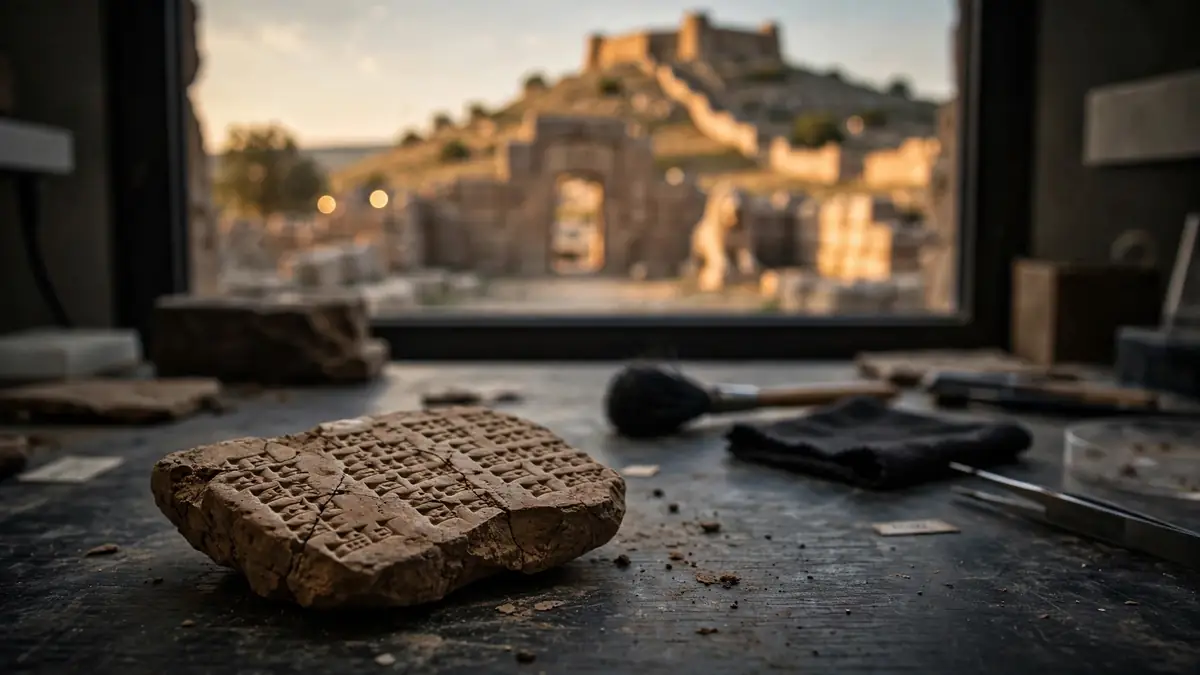
On 21 September 2026 — the International Day of Peace — Türkiye's Minister of Culture and Tourism, Mehmet Nuri Ersoy, announced the identification of a new fragment of the world's oldest known surviving international peace treaty. The piece, a clay fragment inscribed with Akkadian cuneiform, was excavated at Büyükkale, the royal citadel of Hattusa, the ancient Hittite capital in what is now Çorum province in central Türkiye. It was found near a structure known as Building E.
The fragment is small — only one face of the clay survives — but its significance is large. After roughly a year of scientific and textual analysis, researchers confirmed that it belongs to a Hittite copy of the peace treaty concluded in the 13th century BCE between the Hittite king Hattusili III and the Egyptian pharaoh Ramesses II: the agreement that ended the long rivalry between the ancient world's two great superpowers.
The oldest peace treaty in recorded history
To understand the fragment, you have to understand the war. For some two centuries, Egypt and the Hittite Empire of Anatolia competed for control of Syria and the Levant, the rich lands between them. Around 1274 BCE, the rivalry exploded into the Battle of Kadesh, in what is now Syria — a clash involving tens of thousands of soldiers and some of the largest chariot battles ever fought. It ended, effectively, in a draw. Both sides went home and claimed victory.
About fifteen years later, in the mid-13th century BCE, Ramesses II and Hattusili III — who had succeeded his brother Muwatalli, the Hittite commander at Kadesh — sealed a formal peace. It is the oldest international peace treaty whose text has survived. The originals were written on silver tablets, which have been lost to history, but the text endured in copies: hieroglyphic versions carved on the walls of Egyptian temples at Thebes, and Akkadian cuneiform versions on clay tablets at Hattusa — Akkadian being the diplomatic language of the Late Bronze Age, much as French would be for early modern Europe.
The treaty promised what the United Nations has summarised as eternal friendship, lasting peace, territorial integrity, non-aggression, extradition and mutual help. A copy of the treaty text is displayed at the United Nations headquarters in New York — a 3,200-year-old document honoured as the ancestor of modern international law.
What the new fragment says
The surviving text of the new fragment corresponds to Articles 12 through 20 of the treaty and concerns a strikingly human subject: fugitives — people who fled from the lands of Egypt to the land of Hatti, or the reverse. The legible lines set out the rules for their return and include provisions protecting their homes from destruction.
Modern readers should not mistake this for asylum law. The treaty's fugitive clauses were mutual obligations between kings: runaways were to be sent back, not sheltered. But the provisions reveal something important about the Late Bronze Age world — that the movement of people across imperial borders was significant enough to require regulation in the highest diplomatic instrument of the age, and that the two kings found common ground even on the handling of each other's deserters and displaced subjects.
Researchers stress an important distinction: the fragment documents the legal terms the two states agreed to apply, not necessarily how consistently those terms were enforced or how the fugitives themselves experienced them. It is evidence for the treaty's wording and its transmission across copies — a textual witness, securely located at the Hittite royal citadel — rather than a direct record of every crossing between the kingdoms.
A text with a long archaeological afterlife
The Kadesh treaty has been turning up in pieces for more than a century. The Egyptian hieroglyphic version was copied by scholars at Karnak in the 1820s. The Hittite clay copies began emerging during the earliest German excavations at Boğazköy — the modern village beside Hattusa — between 1906 and 1912. Fragments are now held in Istanbul, Ankara, Berlin and St. Petersburg. Each new piece helps scholars reconstruct the Hittite versions of the text more completely and understand how the treaty was copied, stored and used at the Hittite court.
A full transcription of the newly identified fragment has not yet been published; ministry officials have so far described only its general contents — the fugitive clauses and the protection of homes. Specialists will now work to place its exact lines within the known text, a painstaking process of matching broken cuneiform signs against the established copies.
Why a 3,200-year-old treaty still resonates
There is a reason this announcement was timed for the International Day of Peace. The Kadesh treaty is routinely invoked as proof that diplomacy is not a modern invention — that even the warrior-kings of the Bronze Age, fresh from one of the bloodiest battles of antiquity, could negotiate limits on war, regulate the movement of people and commit, in writing, to peace.
The new fragment adds a coda to that story from the Hittite side of the table. It was found in the royal citadel, near the palace — the working archive of an empire. Some scribe, more than three millennia ago, pressed a stylus into wet clay to copy out the terms under which two great powers would live side by side. The silver original is gone. The clay, against all odds, remains.
What Articles 12–20 reveal about Bronze Age statecraft
The fugitive clauses may sound like administrative fine print, but they sit at the heart of what made the Kadesh agreement revolutionary. Earlier Near Eastern treaties were typically instruments of domination — a great king dictating terms to a vassal. The Egyptian–Hittite treaty is different: it is a parity treaty between equals, and its detailed provisions on extradition, non-aggression and mutual assistance treat both kingdoms as sovereign partners with reciprocal obligations.
That people fleeing across borders merited several articles of the highest diplomatic instrument of the age tells us the Late Bronze Age was a world in motion — of deserters, displaced villagers, traders and envoys moving between empires. The kings' answer was not open borders but managed ones: runaways returned, homes protected from reprisal, and each side bound to aid the other against threats from within and without. It is, in embryo, the logic of the modern extradition treaty — negotiated in cuneiform, more than three thousand years before the phrase existed.
Sources