A school 2,400 years in the making
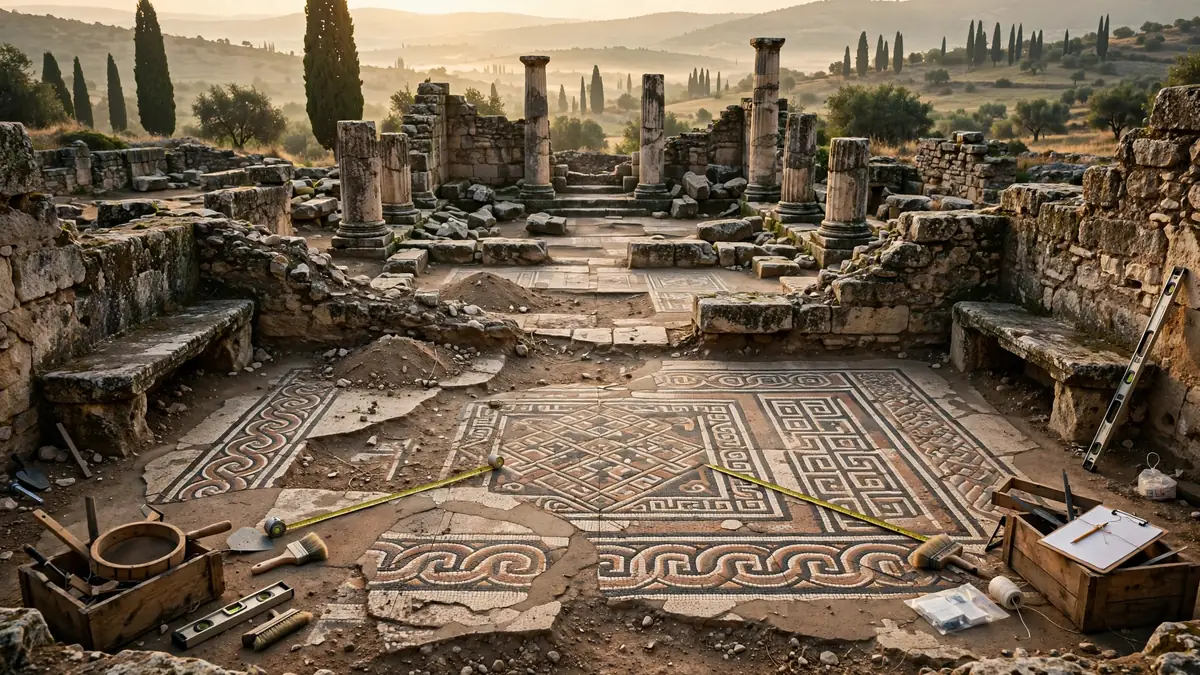
In the rolling country of northern Greece, near the modern town of Naousa, archaeologists are peeling back the layers of a place where history's most famous education took place. The Hellenic Ministry of Culture announced in early September that the latest excavation season at Mieza — the ancient Macedonian city where, according to ancient accounts, the philosopher Aristotle tutored a teenage Alexander the Great — has uncovered ornate, mosaic-decorated halls that may have formed part of Alexander's school.
The finds are the newest chapter in a three-year project, begun in 2024, to excavate the royal gymnasium of Mieza: a sprawling, roughly 30-acre complex where young Macedonians of the elite studied, trained, dined and lived. Earlier seasons had already revealed a palaestra, or wrestling ring; a stadium; arcades; and a xystus — a covered, 200-metre-long running track where athletes could train regardless of the weather. This year's dig, focused on the eastern side of the complex, may be the most revealing yet, offering the first clear picture of where the teaching itself happened.
The Didaskaleion: where lessons were taught
The 2026 season concentrated on the palaestra and the Didaskaleion — literally, the "teaching place". There, archaeologists identified lecture rooms fitted with stone benches, the plain furniture of ancient instruction. The centrepiece is a three-part complex of more than 1,700 square feet within the teaching area: a central entry room flanked by two banquet rooms, their mosaic floors still surviving, with raised platforms that once held dining couches.
To a modern eye, banquet rooms inside a school may seem odd. To a Macedonian of the fourth century BCE, they would have made perfect sense. The symposium — the communal drinking party with conversation, music and debate — was a core institution of elite Greek life, and education did not stop at the lecture bench. That the school's grandest surviving rooms are places for reclining, eating and talking tells us something important about what this education was for: not the transmission of facts, but the formation of a ruling class — young men learning to speak, argue, command and belong.
What Alexander learned
What, precisely, did the most consequential student in history study here? Ancient writers record that Philip II of Macedon invited Aristotle — then the most famous thinker in the Greek world — to tutor his son, and set aside a sanctuary of the nymphs at Mieza for the school. Alexander was in his early teens; the tutoring lasted several years before he took up the business of conquest.
The curriculum, as far as the ancient sources describe it, was the full programme of a Greek gentleman's education with a philosopher's edge: Homer above all — Alexander is said to have carried a annotated copy of the Iliad on campaign — along with rhetoric, politics, ethics, natural science and medicine. Aristotle's influence is often traced in Alexander's later behaviour: his curiosity about the natural world, his founding of cities as instruments of civilisation, his uneasy relationship with the absolute power he wielded. Whether the mosaics now emerging at Mieza were walked by the young prince himself cannot be proven stone by stone — but this is the ground the ancient accounts point to, and the archaeology is now giving that ground a shape.
A gymnasium, not just a school
It is worth remembering what a Greek gymnasium was. The word gives us "gymnasium" in the modern sense, but the ancient institution was far broader: a walled complex combining athletic training, intellectual instruction, bathing, dining and social life. The palaestra trained the body; the lecture rooms trained the mind; the banquet halls trained the citizen. Mieza's complex, at 30 acres, was a royal version — a place where the sons of the Macedonian aristocracy were shaped together into a cohesive elite, loyal to the crown and to each other.
The 200-metre covered xystus is a telling detail. A roofed running track represents serious investment in year-round training — this was not a casual playing field but a state institution, built to produce men who could march, fight and endure. The young Alexander who would one day lead his army from Greece to India was, quite literally, trained on these grounds.
Destroyed by Rome, surviving in stone
The buildings did not survive antiquity intact. According to the culture ministry, the complex was destroyed by the Romans after the second Battle of Pydna in 148 BCE, when Rome dismantled the Macedonian kingdom and reorganised the region. Yet, as officials noted, "significant architectural remains have survived" — enough, two millennia later, to reconstruct lecture rooms, trace mosaic floors and map the flow of students from entry hall to banquet chamber.
That survival is itself a historical argument. Roman destruction in Macedonia was systematic, aimed at breaking the institutions of the old kingdom. That the gymnasium's teaching rooms can still be read in the ground suggests a complex built to last — thick walls, careful masonry, the confidence of a kingdom at its height under Philip II in the fourth century BCE.
Why it matters now
There is a temptation to treat this as a celebrity excavation — the school of Alexander, the classroom of Aristotle — and it is partly that. But the deeper value is what it tells us about education as an instrument of power. Philip II did not hire the greatest mind of his age to teach his son poetry for its own sake. He was building a kingship: a ruler trained in rhetoric to persuade, in ethics to legitimise, in science to understand the world he intended to conquer.
As the excavation continues, Mieza is becoming one of the few places in the world where the abstract history of ideas meets the concrete history of stones. We have Aristotle's writings and the legends of Alexander. Now, room by room and mosaic by mosaic, we are getting the building where the two met.
Sources