The dead arrived in pieces — until now
For three decades, everyone who has worked at Göbekli Tepe knew the same puzzle. Since excavations began in 1995 at the hilltop site in southeastern Türkiye, archaeologists have recovered 928 fragments of human bone from the rubble filling its great stone circles and from the soil between them. The fragments were scattered across some 3,000 square metres of the main excavation area, through every stratigraphic layer and down to a depth of several metres. Skulls and cranial pieces outnumbered other bones. Some bore deep, deliberate cut marks. No intact burial had ever been found — only pieces, impossible to assign to any individual.
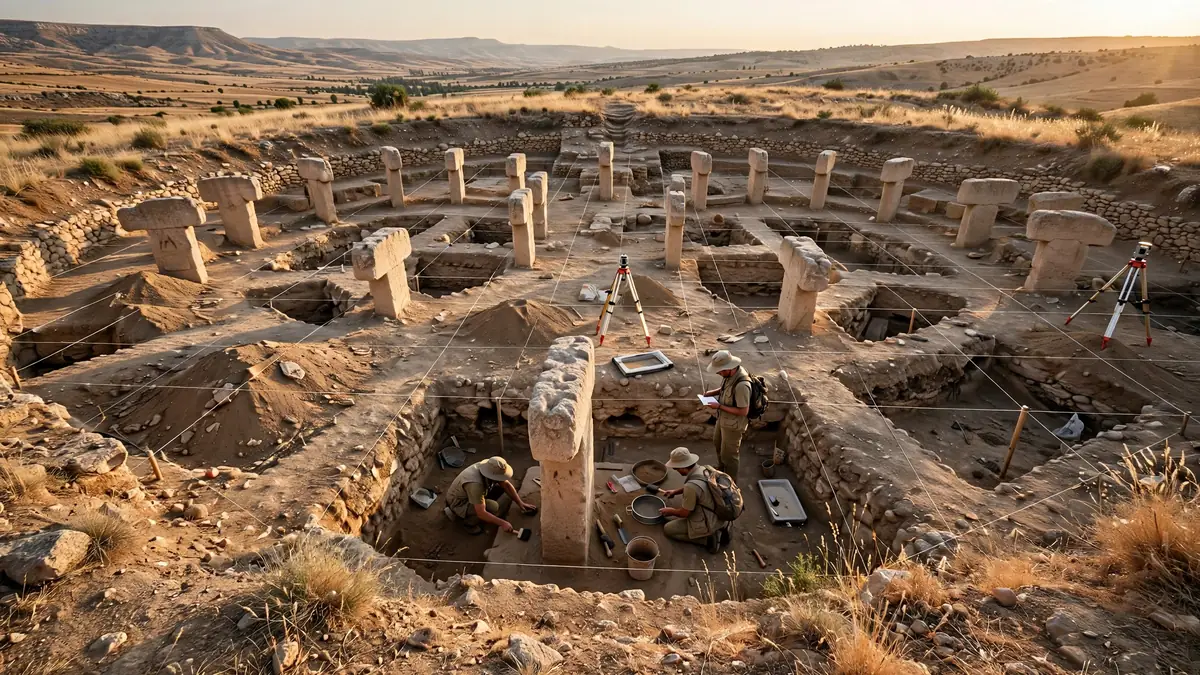
The site itself is extraordinary. Göbekli Tepe was raised by hunter-gatherers roughly 11,500 years ago — thousands of years before writing, before the wheel, before Stonehenge and the Egyptian pyramids. Its rings of massive T-shaped limestone pillars, some carved with foxes, lions, vultures and abstract symbols, are the oldest known monumental architecture on Earth. And the smashed, scattered bones inside those circles fed a stark interpretation: that this was a place of a Neolithic "skull cult", where the dead were processed, defleshed and displayed in ritual.
A study published on 22 September 2026 in the journal PLOS One now offers a strikingly more ordinary explanation — grounded in the first two intact burial contexts ever excavated at the site. The authors argue that at least some of those scattered bones were never placed in the stone circles at all. The hill itself moved them there.
Two graves on the upper slope
The research comes from Julia Gresky, an osteologist with the German Archaeological Institute in Berlin who has analysed the site's human remains since 2009, and Lee Clare of the institute's Istanbul department. Their paper, "First burials give insights into mortuary rites at Göbeklitepe, Early Neolithic Türkiye", describes two burial contexts dating to the Pre-Pottery Neolithic B period, between 8,700 and 8,000 BCE.
The first is a group burial in a kidney-shaped pit: the remains of an adult woman, a young man and an adolescent girl, found together in a single grave. The second, discovered in 2012 beside one of the monumental buildings and not fully excavated until 2022, held a single young woman in her twenties or early thirties. She had been laid on her left side with her legs bent and her face turned eastward, resting on a bed of fist-sized stones, her skeleton still largely in its original anatomical position.
What struck the researchers was how familiar the damage looked. The bones in both graves were heavily fragmented by soil pressure, coated in thick calcium deposits and gnawed by rodents — precisely the condition of the 928 loose fragments recovered from the monumental buildings over the past three decades. The newly documented graves showed that people at Göbekli Tepe were buried within the settlement itself, and their bones suffered exactly the kind of post-mortem battering seen in the scattered pieces.
A hillside on the move
The decisive clue was location. Both intact burials lay on the higher ground of the mound — above the monumental buildings, not inside them. Gresky and Clare propose that the settlement's inhabitants buried their dead beneath the floors of their own dwellings on the upper slopes, a practice well documented across Neolithic Anatolia and the Levant, and that over 11,000 years of rain, settling and collapse, erosion and landslides carried soil, building debris and fragmented human remains downhill into the monumental structures below.
Gravity, in other words, did what ritual was supposed to have done. The bones ended up inside the stone circles not because mourners carried them there as offerings, but because the hill itself moved them there across millennia. The authors tested this against the main alternative — that selected bones, especially skulls and long bones, were deliberately deposited in the special buildings as part of a ritual — and concluded that slope processes are the more likely explanation for much of the scattered assemblage.
It is a cautionary tale for archaeology as much as a discovery: natural processes can mimic ritual with unsettling precision. A concentration of broken, calcium-crusted bones inside a ceremonial building looks like deliberate deposition. But once the actual graves were found upslope, the same evidence read differently — as taphonomy, the science of what happens to bodies after burial, written by a restless hillside.
What about the skull cult?
The new study does not erase the stranger evidence, and its authors do not claim it does. In 2017, Gresky and colleagues published three skulls from Göbekli Tepe bearing deep grooves cut along the midline of the cranium — described in Science Advances as evidence of a previously unknown form of Neolithic skull cult. Five such carved skulls are now recognised at the site. Deliberate modification and ceremonial treatment of human skulls remain part of the record, and the 2026 paper explicitly leaves that possibility open.
The emerging picture is therefore a both-and story rather than a simple reversal. Ordinary people appear to have been buried beneath house floors on the upper slopes, their graves later disturbed and dispersed by erosion. At the same time, certain skulls were selected, carved and handled in ways that still demand a ritual explanation. The carved skulls were not an invention of over-eager excavators — but the 928 scattered fragments may not all have been ritual deposits either.
A town, not just a temple
Beyond the bones, the burials strengthen a quieter revolution in how Göbekli Tepe is understood. The site was long framed as a ceremonial gathering place — sometimes called the world's first temple — visited periodically by bands of hunter-gatherers who came to feast and worship and then left. The intact graves point the other way: toward a permanent settlement where people were born, lived, died and were buried under their own floors.
That reframing has been building for years, as excavations have uncovered domestic structures, food-processing areas and evidence of year-round occupation alongside the great stone circles. The first graves add the most human piece of evidence yet. A place where families bury their dead beneath their homes is not a pilgrimage stop. It is a town.
Why this changes the story
Göbekli Tepe has always been a mirror for our assumptions about the deep past. A generation ago, the standard story held that complex ritual — and the social organisation it requires — could only follow agriculture. The site's great stone circles, raised by people who still hunted and gathered, helped overturn that sequence. Now the bones are doing similar work on a smaller scale: reminding us that not every pattern in the ground is a pattern of belief.
For visitors and readers, the lesson is a useful one. The carved skulls remain genuinely strange and genuinely unexplained. But the hundreds of broken fragments that once seemed to confirm a site-wide cult of the dead may turn out to be, in large part, an accident of geology — ordinary Neolithic funerals, scattered by an ordinary hillside, across an extraordinary span of time.
Sources