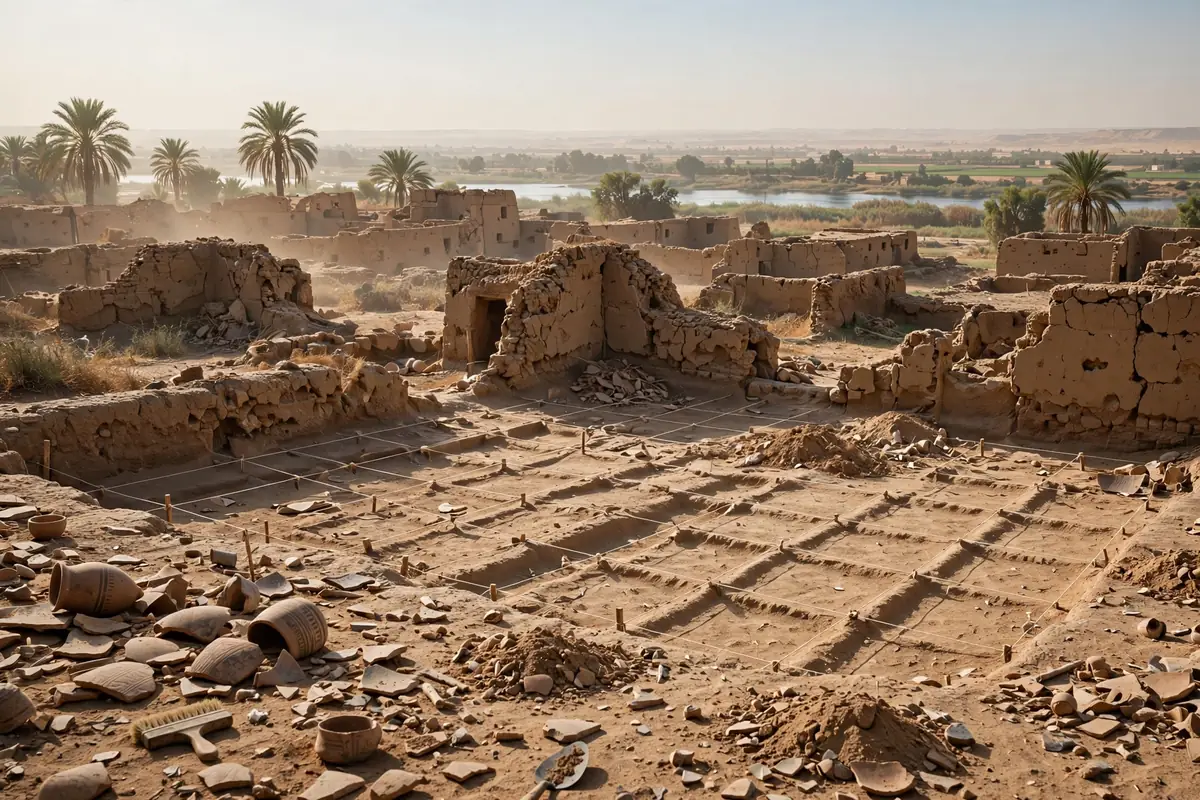
A fortress on the western frontier
In Egypt's Beheira province, in the western Nile Delta, archaeologists are excavating a place where the New Kingdom's military machine met ordinary life. The site is Tell al-Abqain — known also as Al-Abqaa' — where a roughly 3,000-year-old fortress was first unearthed in 2024. Built near Egypt's western border to defend against attacks from neighbouring armies, the fortress anchored a frontier that faced the Libyan tribes of the desert.
The latest season's finds, announced by Egypt's Ministry of Tourism and Antiquities, go far beyond walls and weapons. Excavations have revealed mudbrick houses, wells, grain silos, roads and pottery ovens used to prepare food — the infrastructure of a thriving community that lived, worked, worshipped and buried its honoured animals behind the defences. Minister of Tourism and Antiquities Sherif Fathy said the discoveries give a broader picture of the fortress, reaching beyond its military role to show how its inhabitants lived, stored food and practised their religion.
The horse that was buried like a soldier
The most striking single find is the complete burial of a young male horse. Preliminary study suggests it was a medium-sized, agile breed — the kind of animal that would have served in military training or pulled a war chariot. The skeleton was found intact, laid out with evident care, and just metres away archaeologists recovered cylindrical pieces of alabaster and limestone believed to be decorative fittings from a chariot harness.
The position of the body and the presence of the harness point to a deliberate, possibly ceremonial interment — an act of honour. Horses were the high technology of Bronze Age warfare, the engines of the chariot arm, and a good warhorse represented an enormous investment of breeding, training and care. That one was buried with such attention inside a working fortress suggests an animal that mattered — though the excavators are careful to say the exact reasons remain unknown.
Horse burials are rare enough in Egypt to make each one count. In a civilisation that lavished its funerary energies on humans and, famously, on cats, a carefully interred warhorse opens a window onto the emotional and symbolic economy of a military community: the bonds between soldiers and the animals they depended on.
A town behind the walls
The fortress was far more than a garrison. The mission uncovered a large mudbrick residential complex organised around a main street about four metres wide, with a second street intersecting it and connecting to the fortress's southern limestone entrance — evidence of deliberate urban planning on the frontier. Inside the rooms stood grain silos, pottery ovens and large storage jars, some still containing carbonised wheat: the logistics of feeding a community far from Egypt's main population centres, made visible in burnt grain.
Water, the perennial desert constraint, was managed with equal care. Residential chambers were found beside three stone wells bearing the titles of Ramesses II, and earlier excavations had already revealed wells in the settlement's southeastern corner. The picture is of an organised, supplied, permanent community — soldiers and their families, bakers and weavers, all sustained by infrastructure built to imperial standard.
Kings' names in stone
The written finds anchor the site firmly in the New Kingdom, which lasted from 1570 to 1069 BCE, without the need for laboratory dating. One limestone stela fragment bears the birth name, throne name and Horus name of Ramesses II — Ramesses the Great, the 13th-century-BCE pharaoh whose reign defined the age. Another bears a hieratic text associated with his son and successor Merneptah, describing the king's strength in comparison with the god Seth and invoking Ptah, the creator god — the first such text found anywhere in the Beheira archaeological region.
A third stela depicts a bound prisoner, bent forward with hands restrained. His clothing identifies him as a Libyan of the Meshwesh tribes — the very people the western fortresses were built to hold back. It is a small, vivid piece of frontier propaganda in stone: the enemy, captured and subdued, within the walls raised against him.
Smaller inscriptions fill out the religious and political texture. Scarab seals carry the names of Ramesses II and Seti I alongside gods including Amun, Sekhmet, Ptah and Seth. Amulets — fish, lotus flowers, cobras, the nefer sign, baboons — speak of protection, fertility, renewal and strength: the private devotions of people living under military discipline.
The archaeology of everyday life
Much of modern archaeology is less about spectacular treasure than about reconstructing how people actually lived, and Tell al-Abqain is an exemplary case. The pottery vessels served for storage, cooking, food service, perfumes and oils; one flask was linked with pilgrimage to Abydos, the sacred city of Osiris. Loom weights testify to weaving, stone grinders to food preparation, balance weights to trade or administration. Personal ornaments and jewellery point to social life and self-display inside the fortress.
Together, these modest objects do something the great monuments cannot: they show a frontier community as a community. Behind the fortress's defences were people eating bread, weaving cloth, carrying amulets, tending horses and honouring their kings — and, at some point, stopping to bury a horse with a care that still reads, three thousand years later, as respect.
The excavation is continuing, and the mission says further study should clarify how Tell al-Abqain fitted into Egypt's wider network of New Kingdom frontier defences — a chain of fortresses that held the western Delta against the desert, and held a small world together within.
A link in a chain of fortresses
Tell al-Abqain did not stand alone. New Kingdom Egypt maintained a network of frontier fortresses guarding the western Delta against the desert tribes, and the mission's continuing work aims to clarify exactly how this fortress fitted into that wider defensive system. The Meshwesh prisoner carved on the stela is a reminder of what the chain was for: Libyan peoples pressed repeatedly against Egypt's western border during the New Kingdom, and holding the Delta meant holding Egypt's breadbasket.
What makes Abqain valuable to historians is precisely its ordinariness within that system. Royal inscriptions celebrate kings; fortresses like this one reveal the unglamorous machinery that made kingship possible — the grain stores, the wells, the ovens, the streets. The warhorse, buried with honours among the houses, suggests that the people who operated that machinery could recognise devotion when they saw it — even in an animal.
Sources