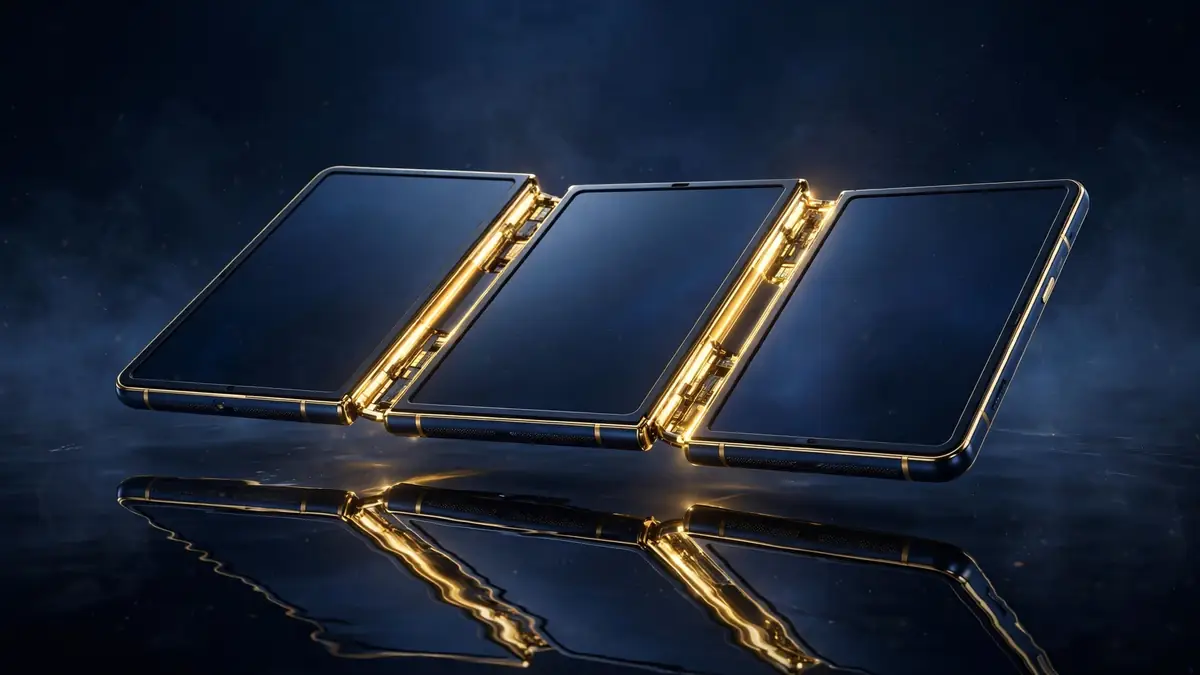
The foldable phone has spent the better part of a decade converging on one idea: a book that opens once. Huawei is now betting that the future folds twice. Its new Mate XT 2 Ultimate Design — a trifold smartphone that opens out twice into a tablet-sized screen — is, according to the company, both the slimmest and the largest foldable smartphone in the industry, and it is the first device to run HarmonyOS 7. Released in early September 2026 and still generating headlines at the end of the month, it is the most ambitious foldable design attempted by any major manufacturer.
A phone that becomes a tablet — properly
Most foldables ask you to accept a compromise: a phone that opens into a small tablet, or a phone that unfolds into something a little larger than a phone. The Mate XT 2 rejects the compromise. Its wing-like form folds twice, collapsing into a conventional smartphone slab and opening into a genuinely tablet-sized display. Once open, the handset is just 3.5mm thick — thinner than many single-screen flagship phones.
The engineering behind that is, in Huawei's own telling, unprecedented. The glass screen has to be tough enough for daily use while surviving thousands of folds, and the hinge mechanism — which must coordinate two separate folds — is the first of its kind. Huawei says the new design also brings improved water resistance over the original Mate XT, addressing one of the persistent weaknesses of complex folding mechanisms, along with a privacy screen feature that prevents nearby people from viewing the display.
That privacy screen is a telling addition. A tablet-sized display is a billboard for shoulder-surfers; Huawei clearly understands that the trifold's biggest practical risk is also its biggest selling point.
The chip inside: a bet on new physics
Inside the Mate XT 2 sits Huawei's Kirin 9050 Pro — and this is where the story gets genuinely interesting. Huawei says the chip features its "LogicFolding" Tau design, a semiconductor architecture from the company's HiSilicon team that is presented as a response to one of the industry's most fundamental problems: geometric scaling.
Moore's law — the historical observation that the number of transistors on a microchip doubles approximately every two years — is believed to be reaching its physical limit. Making chips smaller is becoming more difficult and more costly, and for Huawei, facing external restrictions on access to advanced chipmaking technology, the pressure to find a way around the problem arrived earlier than for anyone else. The "Tau Scaling Law" principle, unveiled in May 2026, is Huawei's attempt to keep performance climbing through architectural design rather than ever-shrinking transistors.
Huawei says the new chip design delivers greater computing power while using less electricity — the critical combination for a device whose triple-sized display will be hungry for both. The Mate XT 2 marks the LogicFolding Tau chip's official entry into mass commercialization, making this launch as much a semiconductor story as a form-factor one.
HarmonyOS 7 and the software question
The Mate XT 2 is the first smartphone to run HarmonyOS 7, Huawei's own operating system. The software challenge for a trifold is real: an interface must work across three display states — folded, partially open, fully open — and apps must transition gracefully between them. Huawei has had years to refine foldable software on its earlier devices, and the trifold form factor is where that investment either pays off or becomes embarrassingly visible.
For buyers in Western markets, the familiar caveat applies: Huawei's devices operate outside the Google ecosystem, which remains a dealbreaker for many users in the US, UK and Australia. But the Mate XT 2 is arguably the first Huawei device in years that makes you wish that were not the case — the hardware is that distinctive.
The price of ambition
Revolutionary engineering does not come cheap. The Mate XT 2 is priced from 19,999 yuan (about $2,980), with the top-end version costing 24,999 yuan (about $3,725). Sales began on September 12, and the device has reportedly been proving popular with consumers — a reminder that there is a real market for devices that refuse to look like everything else.
Huawei Executive Director Richard Yu was unusually candid about the economics at the launch press conference:
"Pricing right now is a real challenge, because memory costs have risen sharply. We adopted a lot of new technology, and the cost pressure has been enormous," Huawei Executive Director Richard Yu told the launch press conference, as reported by Reuters.
Memory prices are the hidden tax on every 2026 flagship, and the trifold — with its huge display, complex hinge and new silicon — pays that tax several times over.
Xiaomi's answer: the 18 Fold
Huawei did not have the foldable spotlight to itself. At a separate event on the same day, Xiaomi unveiled its most premium phone to date, the Xiaomi 18 Fold. Xiaomi's approach is different: what it calls a "medium-fold solution" that stays passport-sized when closed while supporting three apps side by side when opened.
Xiaomi CEO Lei Jun directly compared his device with Apple's products, noting that at 219 grams and 5.02mm thick when unfolded, the 18 Fold is lighter than Apple's iPhone Pro Max. It runs Xiaomi's in-house XRing O3 AI processor, which Lei claimed outperforms Apple's A19 Pro in responsiveness, and uses DRAM chips from Chinese memory maker CXMT.
Lei Jun was equally frank about costs:
"Nowadays, memory is very, very expensive. We don't say it is cheap, but it is value for money," Xiaomi CEO Lei Jun said at the launch, as reported by Reuters.
Priced from 10,999 yuan (about $1,540) to 14,999 yuan (about $2,100), the Xiaomi 18 Fold undercuts Huawei's trifold substantially — the classic Xiaomi play of premium ambition at a friendlier price.
The bigger picture: foldables grow up
Step back and the pattern is clear. Apple's own September event introduced the iPhone Duo — Apple's first foldable phone — alongside the iPhone 18 Pro line, the Apple Watch Series 12 and AirPods 5. With Apple finally in the foldable game, every other manufacturer's foldable strategy has to answer the same question: why should anyone buy ours?
Huawei's answer is maximalist: the most radical form factor, the most distinctive silicon, the most engineered hinge. Xiaomi's is pragmatic: lighter than a slab phone, priced to sell. Both strategies acknowledge the same reality — foldables have moved past the "does it survive a year" phase and into genuine design competition.
For Western buyers, the immediate question is availability. Neither the Mate XT 2 nor the Xiaomi 18 Fold has been confirmed for the US, UK or Australian markets, and Huawei's ecosystem constraints limit its appeal outside China regardless. But the technologies on display — the two-fold hinge, the LogicFolding chip architecture, the privacy display — will shape the foldables that do arrive in London, New York and Sydney over the next eighteen months. The trifold may never reach your pocket, but its ideas will.
Sources