Training the people who will rebuild Sudan's memory
In September 2026, UNESCO brought together 72 participants from 15 cultural heritage institutions for a training programme on rapid damage and risk assessment in Sudan. The training, implemented in collaboration with Sudan's Ministry of Culture, Information, Antiquities and Tourism and the Sudanese National Commission for Education, Science and Culture, was led by Maïssa Acheuk-Youcef from UNESCO's Emergency Operations and Programmes Unit, who introduced participants to international methodologies and practical tools for documenting harm to cultural sites.
The programme marks one of the most concrete international efforts yet to protect Sudan's cultural heritage amid the country's devastating conflict. It follows a grim logic that heritage professionals know well: in wars, the destruction of museums, archives, libraries and historic sites is rarely the headline, but it is often one of the longest-lasting wounds. Buildings can be rebuilt in years; a burned archive, a looted museum, a shelled historic quarter takes its memory with it.
"Protecting cultural heritage is not only about safeguarding sites," said Junaid Sorosh-Wali, Head of Office and UNESCO Representative to Sudan. "It is also about preserving the history, identity and collective memory of communities, and ensuring that culture can contribute to Sudan's recovery, resilience and social cohesion."
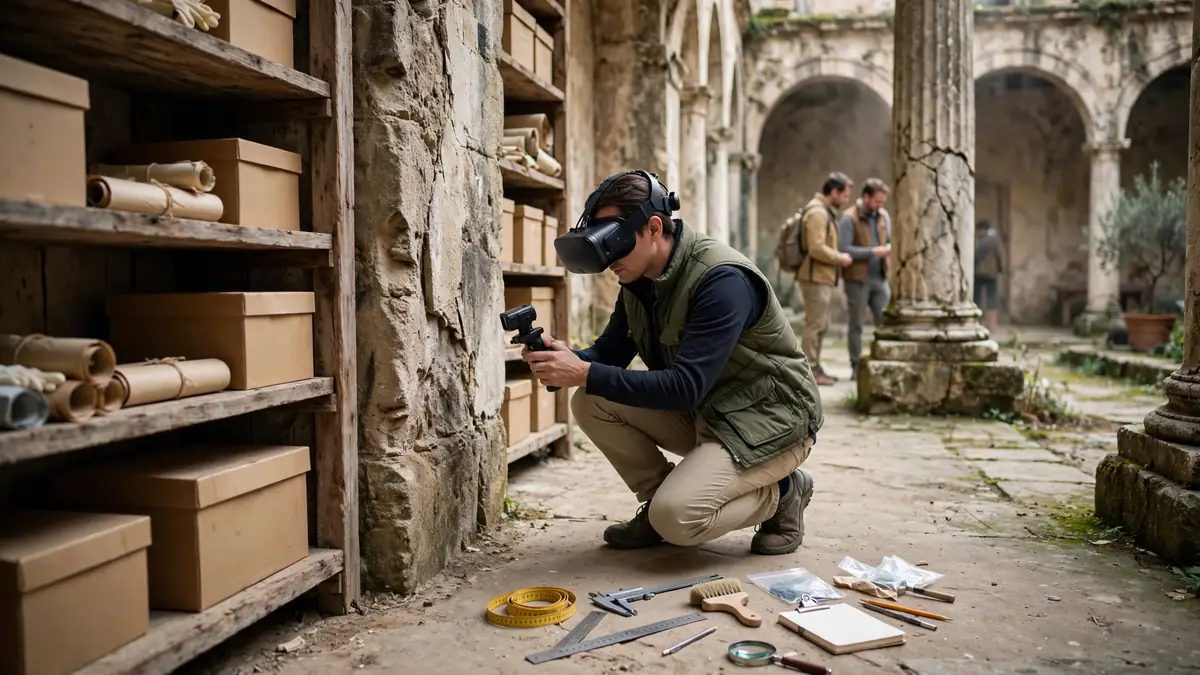
During the workshop, UNESCO launched its Virtual Reality Damage Assessment Tool for the first time, with participants testing the new tool using 3-D headsets. The idea is as practical as it is striking: heritage professionals can be trained to recognise, categorise and document structural damage in immersive simulations before they ever set foot in a dangerous or unstable building. In a country where access to damaged sites can be limited by security conditions, the ability to rehearse assessments virtually is not a gimmick — it is a necessity.
The training also used Beirut's experience following the 2020 port explosion as a case study. Participants heard how the city estimated the costs of recovery interventions for its damaged heritage — the Ottoman-era houses, the museums, the historic neighbourhoods of Gemmayzeh and Mar Mikhael — and explored how such an exercise might be applied to Sudan in the mid- to long-term. The parallel is instructive: Beirut's heritage community learned, under terrible pressure, how to turn damage into data — systematic, costed, prioritised data that could be presented to donors, insurers and governments. Sudan's professionals are now learning the same discipline before the recovery even begins.
From classroom to the field: 12 sites assessed
The training was followed by real-world application. Rapid damage and risk assessments were carried out at 12 cultural heritage sites affected by the conflict, with 15 Sudanese heritage professionals taking part in the on-site work. The locations included the Complex of the Republican Palace, the Natural History Museum, the National Museum of Ethnography, the National Archives of Sudan and the National Library of Sudan — as well as churches, a mosque and other cultural properties.
That list deserves a pause. The National Archives and the National Library are not glamorous institutions; they do not feature in tourist brochures. But they are the repositories of a country's documentary memory — land records, newspapers, manuscripts, photographs, the paper trail of a nation's existence. The Natural History Museum and the Museum of Ethnography hold the material record of Sudan's environments and cultures. Churches and a mosque on the same assessment list testify to a heritage that spans faiths and communities. UNESCO said the professionals learned to document damage systematically, identify risks and prioritise immediate emergency measures, using the UNESCO-ICCROM international methodology.
The assessments are intended to provide evidence about the condition of affected properties, the risks they face and their most urgent needs. That information, in turn, can help national authorities determine immediate protection measures and plan longer-term recovery interventions. It is unglamorous, methodical work — measuring cracks, photographing collapsed roofs, ranking urgencies — and it is exactly the kind of work on which every future restoration will depend.
Why heritage recovery is recovery, full stop
There is a persistent misconception that cultural heritage protection is a luxury concern — something to be addressed after the fighting stops, after the economy recovers, after the humanitarian crisis eases. The heritage field has spent decades arguing the opposite, and Sudan is now a test case. When communities return to damaged neighbourhoods, the state of their mosques, churches, museums and libraries sends a signal about whether normal life is possible again. Heritage sites are also, very practically, economic infrastructure: they anchor tourism, employ craftspeople and conservators, and give cities a reason to be visited rather than merely passed through.
Sorosh-Wali's framing — history, identity, collective memory, social cohesion — is the standard UNESCO doctrine, but it lands differently when the training involves 72 real people from 15 real institutions learning to use VR headsets to document the ruins of their own country's memory institutions. These are not international experts parachuting in; they are Sudanese professionals being equipped with international tools. That distinction matters. Recovery led by national specialists, using methods they have been trained in and tested themselves, is recovery that can outlast any single programme.
The long road from assessment to restoration
It would be dishonest to suggest that a training programme, however well designed, resolves anything. The assessments document damage; they do not repair it. The VR tool trains assessors; it does not stop shells. The Beirut case study offers a methodology; it cannot conjure the funding, the political stability or the years of painstaking conservation work that Sudan's heritage will require. What the programme does offer is the precondition for all of that: evidence, method and a cadre of trained people.
There is also a quieter achievement worth noting. In the international heritage world, Sudan's crisis has often been overshadowed — by the scale of the humanitarian emergency, by other conflicts, by the sheer difficulty of operating in the country. A programme that puts 72 Sudanese heritage professionals in a room with 3-D headsets and international assessment standards is a statement that the country's cultural memory is worth systematic, serious, well-funded attention — not as an afterthought to reconstruction, but as part of it.
The damage assessments from those 12 sites will now feed into planning for emergency measures and longer-term recovery. Somewhere in Khartoum, a conservator trained this month will walk into a damaged archive with a methodology, a headset-tested eye and a standardised form. It is a small, procedural kind of hope. But in heritage work, hope has always been procedural: measured, documented, prioritised — and, eventually, rebuilt.
Sources