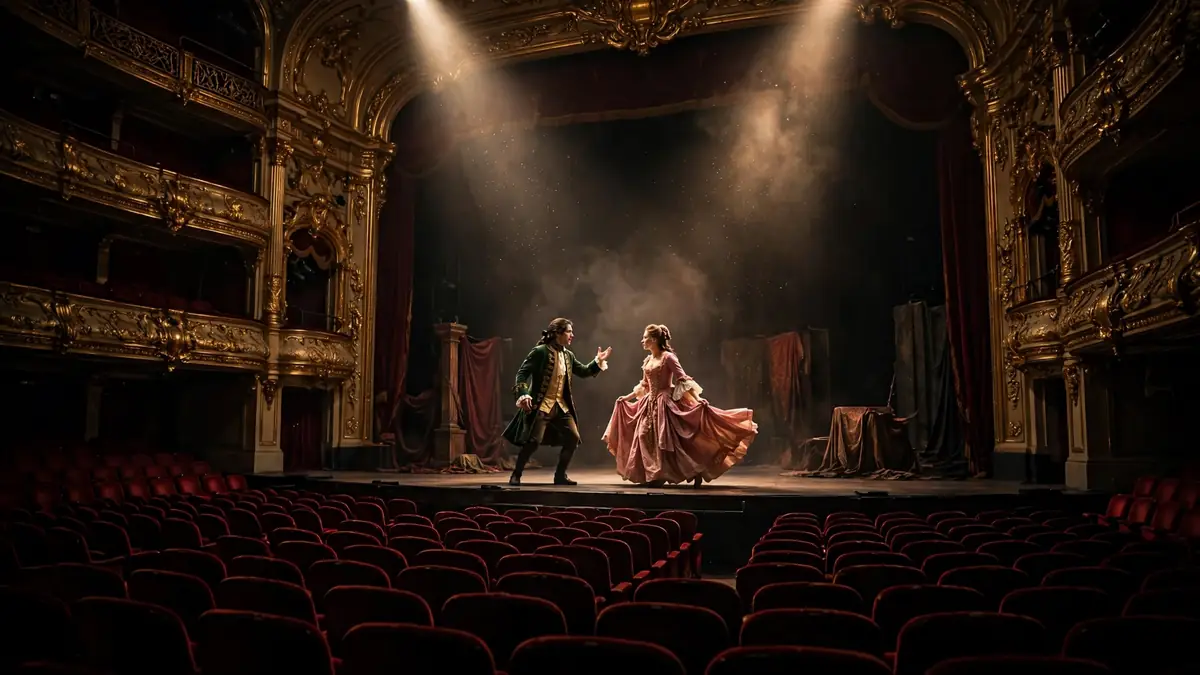
A week when the stage belongs to women
This week, theatres across three continents are making the same quiet argument: that the stories a society tells on stage reveal what it is willing to confront off it. In Cairo, the fourth edition of the Isis International Women's Theatre Festival runs from 25 September to 2 October 2026. In Dublin, the Dublin Theatre Festival — the oldest specialised theatre festival in Europe, inaugurated in 1957 — is under way, running until 11 October. And in Paris, the autumn theatre season has opened with a slate of productions in which women's lives, histories and artistry take centre stage. Taken together, it amounts to one of the most significant weeks for theatre on the 2026 cultural calendar.
The Cairo festival, named after the late Egyptian actress Sanaa Gamil, brings together Egyptian, Arab and international theatrical productions alongside workshops and intellectual sessions. Its programme includes productions presented through the Nihad Selaiha Incubator, as well as sessions addressing women in theatre and professional opportunities within the theatrical field. Festival artistic director Abir Ali has confirmed that the research papers presented during the festival's intellectual programme will be made available through the festival's official website — a move intended to extend the ideas beyond the run of the event itself, allowing researchers and theatre enthusiasts to engage with the studies and discussions long after the final curtain.
Theatre as research: Nigerian feminist theatre in Cairo
One of the festival's intellectual sessions illustrates what makes Isis distinctive: it treats theatre not only as performance but as a subject of serious scholarship. A research paper presented by Dr. Mohamed Amin Abdel Samad examined Nigerian feminist theatre, focusing on the relationship between women's writing and feminist theory, with particular attention to the work of Tess Onwueme, the acclaimed Nigerian playwright. The discussion raised questions about how women write about their own experiences and how theatrical texts can offer female characters perspectives that differ from conventional representations.
The choice of subject is telling. Nigerian theatre represents one part of a diverse African theatrical landscape, where artistic experiences are shaped by different cultural, historical and social contexts. Studying feminist theatre in Nigeria provides an opportunity to explore questions of identity, representation, language, power and the right to speak about women's experiences. That a Cairo festival is hosting scholarship on Nigerian women's theatre — and publishing it online for anyone to read — is a small but real act of intellectual solidarity across the continent, treating African theatre as a connected field of inquiry rather than a set of isolated national traditions.
As the festival's organisers put it, this approach makes theatre a tool for interaction and participation rather than simply a final artistic product. The audience is not only watching; it is being invited into the research, the argument and the unfinished work of representation.
Dublin: the grand old festival of European theatre
Running concurrently, from 24 September to 11 October, the Dublin Theatre Festival continues a tradition that stretches back to 1957 — making it the oldest specialised theatre festival in Europe. Few festivals can claim that kind of continuity, and fewer still have maintained their relevance across seven decades of theatrical change. Dublin in late September has long been a pilgrimage point for theatre professionals and audiences, a place where international productions meet Irish writing and where the programming tends to reflect the preoccupations of the moment.
The festival's endurance is itself a cultural statement. Theatre festivals are fragile things: they depend on public funding, on audiences willing to take risks on unfamiliar work, and on a civic belief that live performance matters enough to organise a city around. That Dublin has sustained its festival since the late 1950s — through economic crises, through the pandemic years that devastated live performance, through the relentless competition of the screen — is evidence of a cultural infrastructure that many cities would envy.
Paris: women painters, women playwrights, women's history
In Paris, the autumn season has opened with a striking concentration of work centred on women's lives. At the Théâtre Montparnasse, Catherine Hiegel — one of France's most decorated stage actresses — stars as the painter Suzanne Valadon in Suzanne, which opened on 25 September. The play explores Valadon's stormy relationship with her son Maurice Utrillo, and through it the larger story of a woman who began as a model for Renoir and Toulouse-Lautrec and became a significant painter in her own right, navigating the male-dominated art world of Montmartre.
At the Comédie des 3 Bornes, Joyeux Bordel (Joyful Mayhem) traces the story of women from 1789 to the present day through two actresses, weaving together historical narration and intimate personal journeys. The production, which opened on 19 September, uses the French Revolution — the moment when modern ideas of citizenship were born, and when women were so conspicuously excluded from them — as its starting point for a sweeping theatrical history.
Meanwhile, Caroline Vigneaux stars in Divorce à la Française at the Théâtre des Nouveautés (from 24 September), an adaptation of Éliette Abécassis's novel about a couple quarrelling over the custody of their children — domestic life as dramatic terrain. And the season's other major openings include Michel Hazanavicius's Ukraine Diaries, performed as a solo by Hugo Becker at Studio Marigny from 3 October, born from encounters in Ukraine; and the return of Alexis Michalik's Edmond — the Molière-sweeping hit about the creation of Cyrano de Bergerac — to the Théâtre du Palais-Royal on 2 October.
What this week tells us about theatre's direction
It would be too neat to claim that these festivals and seasons share a single programme. Cairo's Isis is explicitly a women's theatre festival with a scholarly arm; Dublin's is a general international festival with a 69-year history; Paris's autumn openings are the commercial and subsidised theatres doing what they do every year. But the convergence is real, and it reflects a broader shift that has been building for a decade: the centre of theatrical gravity is moving.
The old model — the male playwright, the male director, the canon of classics revived on rotation — has not disappeared, but it no longer goes unquestioned. Festivals like Isis insist that women's theatre is not a niche but a field, with its own research, its own incubators, its own transnational conversations. Productions like Suzanne and Joyeux Bordel insist that women's histories are not footnotes to the main narrative but the main narrative itself. And the decision to publish the Cairo festival's research papers online insists that the thinking around theatre should be as accessible as the theatre itself.
There is also a practical lesson in this week's calendar. Theatre is often described as a dying art, perpetually on the verge of being finished off by streaming, by short-form video, by the cost of living. Yet here is Cairo hosting its fourth international women's theatre festival, Dublin its sixty-ninth annual edition, and Paris opening a season packed with new productions. The art form's supposed fragility keeps failing to materialise — perhaps because, as the Isis festival understands, theatre was never only a product to be consumed. It is a tool for interaction and participation: a room full of people, thinking together, in real time. No screen has yet found a substitute for that.
Sources