Britain's most argued-about art prize heads north
On 26 September, one of the most famous — and most hotly debated — prizes in the visual arts opened its annual exhibition not in London, but in Middlesbrough. The Turner Prize 2026 exhibition, on view at the Middlesbrough Institute of Modern Art (MIMA) until 29 March 2027, presents the work of the four shortlisted artists: Simeon Barclay, Kira Freije, Marguerite Humeau and Tanoa Sasraku. The winner will be announced on 10 December 2026, receiving £25,000, with £10,000 going to each of the other shortlisted artists.
Established in 1984, the Turner Prize is awarded each year to a British artist for an outstanding exhibition or other presentation of their work. Its stated aim is to promote public debate around new developments in contemporary British art — and on that front, it has rarely failed. Few prizes generate so much newspaper ink, so many furious letters, and so many earnest defenders. The move to Middlesbrough continues a tradition of staging the exhibition outside London, putting contemporary art in front of audiences far from the capital's gallery districts.
MIMA, which is part of Teesside University, sits in the heart of a post-industrial town in northeast England — a region whose story of industrial rise, decline and attempted reinvention is woven directly into this year's show. According to Tate Britain director Alex Farquharson, the exhibition represents "a fascinating cross-section of the visual arts in Britain today." The shortlisted artists, he notes, engage with topical concerns including "ecological thought, human precarity, the geopolitics of oil, and the lived experience of deindustrialisation in the North of England."
Tanoa Sasraku: crude oil as a museum object
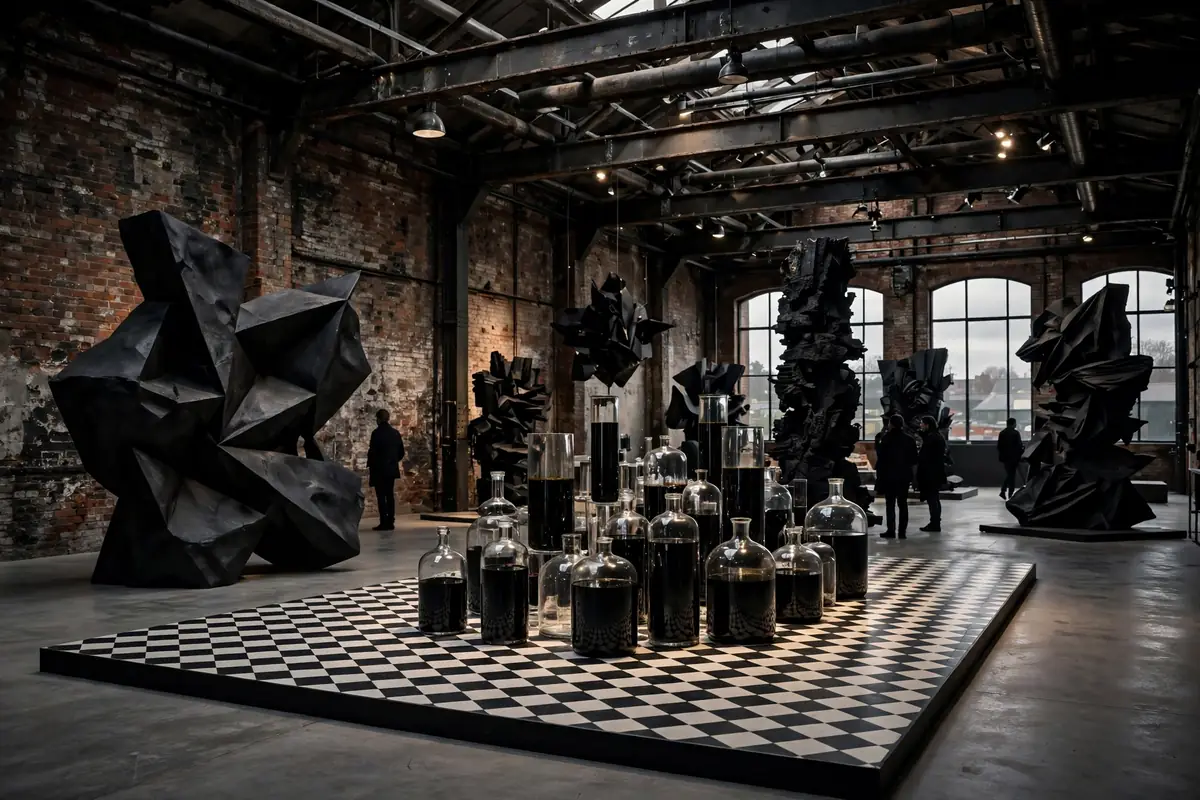
Plymouth-born Tanoa Sasraku's display, entitled Morale Patch, takes on the instruments and organisations that facilitate extractivism — the removal of natural resources for export and profit. The setting is deliberately oppressive: visitors enter a space compounded by a strong-smelling rubber floor, where paperweights containing actual crude oil stand on a chequered central display representing water and desert, in a work titled Watchlist (2025).
The conceit is striking. Crude oil, usually hidden inside pipelines and tankers, is presented here like a paperweight on a desk — domesticated, contained, almost ordinary. The effect is to make the viewer feel the strangeness of treating extracted petroleum as a decorative object, and by extension to ask who benefits from the global machinery of extraction. It is ecological art that does not lecture so much as stage an encounter: you smell the rubber, you see the black liquid suspended in glass, and the abstraction of "the oil industry" becomes something you can stand next to.
Marguerite Humeau: sculpture from living materials
Marguerite Humeau, who is originally from France but lives in London, creates provocative sculptural compositions from an extraordinary palette of natural sources: beeswax, 150-year-old walnut, 4,500-year-old yeast, and a culture drawn from termite mushrooms. Her display, Torches, treats sculpture as something that can be grown, cultured and aged rather than simply carved or cast.
Humeau's work belongs to a growing tendency in contemporary art to treat materials as collaborators rather than raw matter — the yeast is alive, the beeswax carries the history of a hive, the ancient wood has outlived everyone who will ever see it displayed. In an exhibition that Farquharson frames around ecological thought, her contribution asks some of the most unsettling questions: what does it mean to make art from living things, and what obligations does that create?
Simeon Barclay: the M62 as cultural memory
Simeon Barclay creates environments where objects, architecture, sounds, video and images collide to create a deeply personal and often humorous portrait of British culture. He is nominated for his performance The Ruin, commissioned by the Roberts Institute of Art and previously presented at the Institute of Contemporary Arts in London, the Hepworth Wakefield in West Yorkshire, and New Art Exchange in Nottingham.
For his presentation at MIMA, Barclay has translated the energy of the live performance into a spatial intervention, resonating with his own voice. The work invites the audience on a journey back in time to when the M62 motorway was being carved through the Pennines — one of the most significant infrastructural projects of postwar Britain. The motorway, that most mundane of national symbols, becomes a lens for examining how Britain rebuilt and reimagined itself in the decades after the war — and what was buried, displaced or paved over in the process.
There is something quietly radical about treating a motorway as a subject for art in the North of England, in a gallery a short drive from the Pennines themselves. The M62 is infrastructure that Northerners know in their bones; to see it reframed as cultural history is the kind of gesture that makes the Turner's regional stagings feel like more than a touring obligation.
Kira Freije and the shape of the shortlist
The fourth shortlisted artist, Kira Freije, rounds out a shortlist that critics have already described as unusually coherent. Taken together, the four artists trace a map of contemporary British preoccupations: the afterlife of industry, the politics of the natural world, the global flows of energy and capital, and the question of who gets to tell the story of a place.
That coherence is worth noting because the Turner Prize is often accused — usually by the same newspapers that cover it most eagerly — of incoherence or provocation for its own sake. This year's selection reads instead as a considered survey: each artist nominated for a specific solo exhibition or presentation from the past year, each bringing a distinct material language, and each, in different ways, asking what Britain is made of and what it is becoming.
Why Middlesbrough matters
The presentation of Turner Prize 2026 at MIMA has been supported by Middlesbrough Council, the Tees Valley Combined Authority, the Henry Moore Foundation and others — a coalition that speaks to how seriously the region takes this moment. For Teesside, a place whose identity has been shaped by steel, chemicals and shipbuilding, hosting the country's premier contemporary art prize is both a cultural vote of confidence and a challenge: the art on show is, in part, about deindustrialisation, and it is being shown in a town that lived it.
There is a long-running debate about whether major cultural prizes should travel beyond the capital, or whether doing so is a kind of well-meaning tokenism. The evidence of past regional Turners suggests the former: exhibitions staged in cities like Hull, Coventry and now Middlesbrough have drawn strong local audiences and reframed the prize's relationship with the public. When the art itself is about the North of England — as Barclay's M62 journey so directly is — the setting stops being a backdrop and becomes part of the meaning.
The exhibition runs until late March 2027, giving visitors from across the UK — and well beyond — months to make the trip. The winner, announced on 10 December, will take home £25,000 and a permanent place in the prize's argumentative history. But the exhibition itself is the real event: four artists, four visions of Britain, in a gallery at the heart of a town that has earned the right to host them. Whatever the judges decide in December, the conversation — which is, after all, the prize's stated purpose — has already begun.
Sources