A blockbuster opening, years in the making
When the British Museum's new exhibition dedicated to Korea opened its doors this week, it arrived on a wave of goodwill that few museum shows can claim. For months, the country has dominated global pop culture: Korean music, Korean food, Korean beauty and Korean drama have moved from niche enthusiasms to mainstream fixtures in London, New York, Sydney and Singapore. The Netflix animated hit KPop Demon Hunters, released last summer, became one of the most talked-about films on the planet and sent a fresh generation of fans hunting for the folk paintings and palace screens that inspired its fictional idol group. The British Museum's answer to all of this attention is a calm, confident assertion that Korea's creative story did not begin with streaming platforms — it began more than two thousand years ago.
The exhibition, simply titled "Korea," spans from the early Iron Age to the present day, bringing together works dating back to around 400 BC alongside pieces by contemporary Korean artists. It is the kind of long-view storytelling that museums do best when they are at their bravest: rather than trying to compete with pop culture, it places pop culture in its proper context, as the latest chapter in a very long book.
"Most people, especially young people in the UK... know about Korea through its popular culture," curator Sang-ah Kim told Reuters as the exhibition opened. "They may not know Korea has a long history, over 2,000 years of creativity, resilience and technical skill." That sentence, modest on its face, is really the exhibition's thesis. The show asks visitors to consider that the visual fluency and technical ambition they admire in contemporary Korean culture — the meticulous stagecraft, the graphic precision, the design discipline — have deep historical roots.
The Lee Kun-hee collection: from private vault to public gallery
A significant part of the exhibition draws on the collection of former Samsung chairman Lee Kun-hee, who died in 2020, and his family. For decades, Lee assembled one of the most historically significant collections of Korean art in the world, largely out of public view. In April 2021, his family donated more than 23,000 artworks from his lifelong personal collection to institutions including the National Museum of Korea and the National Museum of Modern and Contemporary Art, in one of the largest art donations ever made.
Since then, a touring selection from that collection — shown under the banner Korean Treasures: Collected, Cherished, Shared — has travelled to the Smithsonian's National Museum of Asian Art in Washington and the Art Institute of Chicago, before reaching London for a run from September 2026 through January 2027. The collection spans roughly 1,500 years of Korean history, from Goryeo dynasty celadon to Joseon-era treasures and paintings by the famed modern artist Kim Whan-ki. Experts estimated its appraised value at between 2 trillion and 3 trillion won at the time of donation, with the market value potentially far higher.
The late chairman once said that even if collecting and preserving cultural heritage requires tremendous cost and time, it is a duty to safeguard the future of culture. The British Museum exhibition puts that philosophy on public display: works that were once seen by almost no one are now being studied by schoolchildren, scholars and curious visitors who wandered in after seeing a cartoon.
What visitors will actually see
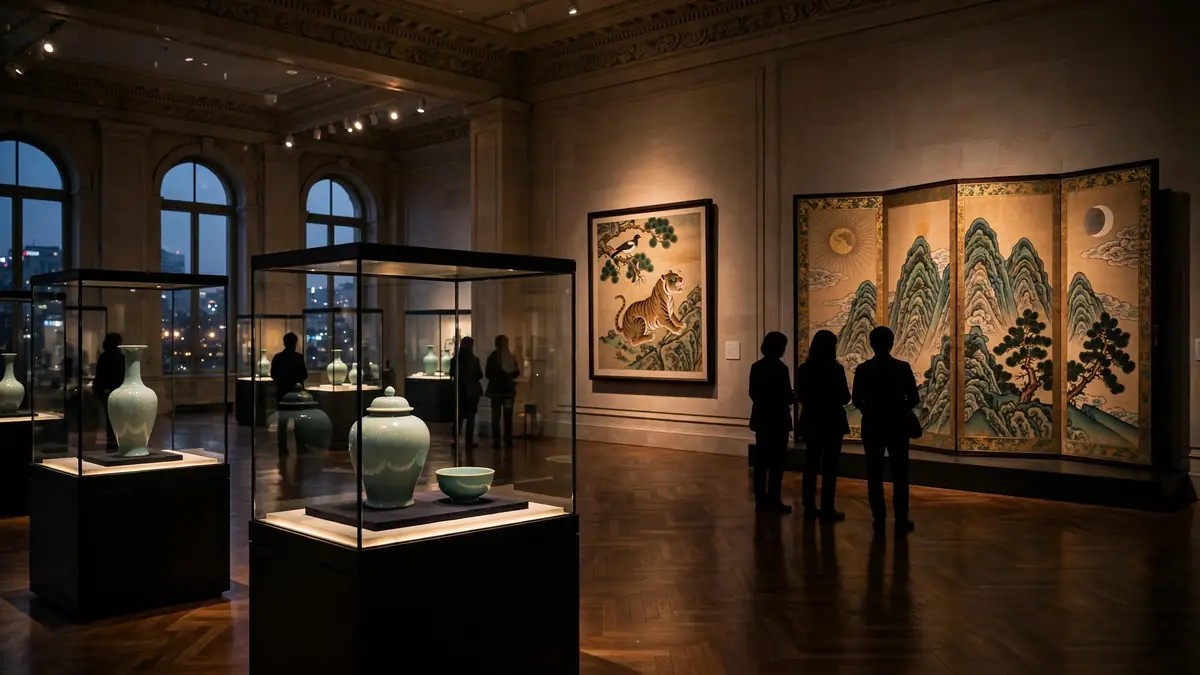
The exhibition's range is deliberately vertiginous. At one end: statuettes of bodhisattvas and a collection of sutras dating from the centuries following the introduction of Buddhism to Korea, when the peninsula's artists and monks were absorbing, translating and transforming the visual language of the Buddhist world. At the other: celebrated Goryeo celadon ceramics, whose pale green glaze remains one of the great technical achievements of world ceramics, and works by living Korean artists wrestling with identity, migration and memory.
Among the contemporary highlights is a piece from Yeesookyung's "Translated Vase" series — a sculpture assembled from shards discarded by potters, celebrating the beauty of imperfection. The work does something clever: it takes the very idea of the broken vessel, which in many traditions would be swept away, and turns it into an argument for a different aesthetic, one in which repair and fragmentation are visible and honoured. It is a fitting centrepiece for an exhibition about cultural resilience.
Also on display are pieces by Suh Do Ho, including his thread drawing "Self-Portrait," which reflects on ideas of home, migration and belonging — themes that will resonate with anyone who has moved between countries, or watched family members do so. And there are works by Lee Jung-seop, an artist separated from his family during the Korean War who etched images into the foil lining of cigarette packets when he could not afford paint or canvas. His presence in the exhibition is a reminder that the "2,000 years of creativity" the curator invokes was not always, or even mostly, a story of comfort and patronage. Some of Korea's most affecting art was made from scarcity.
The Demon Hunters connection
Some exhibits, the museum expects, will feel familiar to visitors whose introduction to Korea came through its contemporary cultural exports. "People, especially young audiences...may get a lovely surprise when they see the 'Tiger and Magpie' or 'Sun, Moon and Five Peaks' if they watched 'KPop Demon Hunters'," Kim told Reuters.
The Netflix animated film, which became a genuine cultural phenomenon, draws on traditional Korean imagery throughout: tiger and magpie paintings inspired the film's characters Derpy the Tiger and Sussie the Magpie, while the fictional group HUNTR/X performs in front of a digital interpretation of a "Sun, Moon and Five Peaks" folding screen artwork — the iconic Joseon-dynasty screen that once stood behind the king's throne. For viewers who fell in love with the film's visuals, the British Museum now offers the real thing: the paintings, the screens, the craft traditions that the animators sampled.
This is the shrewdest move the exhibition makes. It neither condescends to pop-culture fans nor treats the film as a gimmick. Instead it suggests that curiosity is a doorway: come for the demon-hunting idol group, stay for two millennia of celadon, Buddhist sculpture and thread drawings. In an age when museums compete for attention with every screen in a visitor's pocket, that kind of bridge-building is not just good marketing — it is good pedagogy.
Why this exhibition matters now
The timing is worth noting. Korea's cultural exports have never been more visible in the West, and the appetite to understand them has never been greater. Google's Year in Search data for 2025 made KPop Demon Hunters the most-searched movie of the year, and interest in Korean travel, products and language learning all surged in its wake. The British Museum is meeting that curiosity with substance rather than merchandise.
There is also a quieter significance. Exhibitions of this scale — drawing on a collection valued in the trillions of won, spanning 2,000 years, placing Buddhist sutras next to contemporary thread drawings — require a level of international cultural cooperation that is never guaranteed and should never be taken for granted. That they happened at all is a small piece of good news about how countries can still talk to each other through art.
For visitors from the exhibition's core audiences — and for the young British audiences the curator specifically hopes to reach — the show offers something increasingly rare: a long, unhurried encounter with a culture that rewards sustained attention. Two thousand years of creativity, resilience and technical skill, arranged across a few galleries, waiting for anyone willing to walk through. Pop culture may have brought them to the door. The museum is betting that history will keep them inside.
Sources