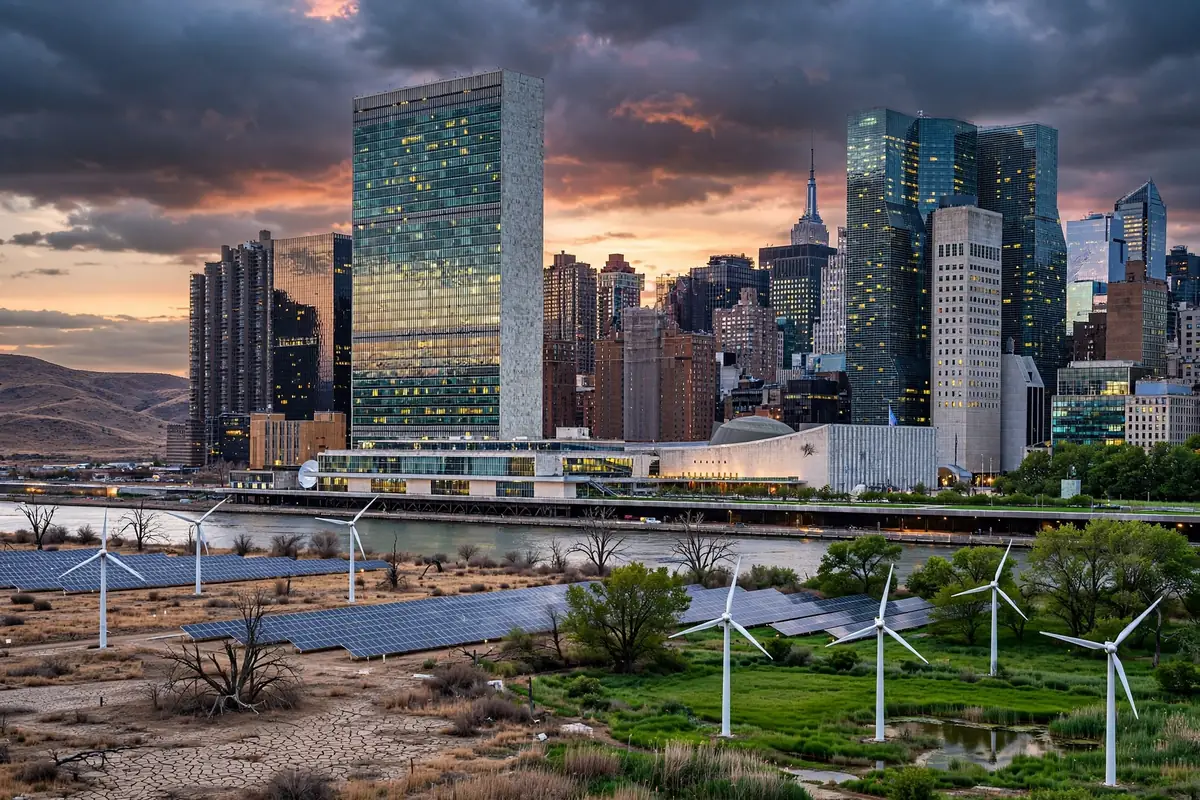
A final summit for a defining issue
On September 23, the United Nations held its 2026 Climate Summit as part of the High-Level Week of the 81st session of the General Assembly in New York. The meeting brought together world leaders, climate scientists, major energy producers and consumers, civil society groups and development experts to confront what organizers described as a dangerous new phase of the climate crisis.
For Secretary-General António Guterres, it was a valedictory moment. His term ends on December 31, and climate change has been the defining cause of his decade in office. In his opening remarks, he framed the stakes in the starkest terms: 'The world is crying out for climate justice — in mitigation, in adaptation, in finance. We must answer that call with action, and we don't have a moment to lose.'
His frustration with the pace of change was unmistakable. 'But emissions are still rising when they must plummet, and fossil fuel expansion continues, defying science, economics, and common sense,' he said. 'We have seen our fossil fuel dependence wreak havoc, driving up costs, draining budgets, squeezing households, and leaving countries at the mercy of conflicts and decisions far beyond their borders.'
The G20 must lead — with deadlines
The centerpiece of Guterres's message was a direct challenge to the world's largest economies. The G20 countries are responsible for around 80 per cent of global emissions, he noted, and they must lead the transition by setting clear timelines for moving away from fossil fuels.
The call marks a shift in tone from the diplomatic language of earlier summits. Rather than inviting voluntary pledges, the Secretary-General demanded specifics: dates, plans, and accountability. The summit's framing document argued that only binding national timelines can close the gap between the promises governments have made and the emissions cuts the science requires.
He also turned his fire on the industry at the center of the crisis. Fossil fuel companies are 'banking windfall profits — while everyday people foot the bill,' he said. A day earlier, he had accused five major Western oil companies of earning nearly half a trillion dollars in profits since Russia's invasion of Ukraine — a figure he contrasted with the $34 billion mobilized to help developing countries adapt to a warming world. He accused the industry of treating the atmosphere as an 'open sewer.'
1.5°C: the overshoot is 'virtually inevitable'
The summit's backdrop was a grim scientific consensus. New findings presented to delegates project that it is virtually inevitable that global temperatures will temporarily exceed 1.5°C above pre-industrial levels within the next ten years — the limit set under the 2015 Paris Agreement as the threshold for avoiding the worst climate damages.
The UN chief said the challenge now is to make that overshoot as small and as short as possible. An overshoot presents widespread, multifaceted risks — from extreme weather patterns to escalating public health emergencies. Intensifying heatwaves, droughts, wildfires, storms and floods continue to cause millions of deaths annually, drive mass displacement and destroy critical infrastructure, particularly in low-lying coastal regions.
Coastal communities face an especially stark arithmetic. The UN has warned that 770 million people live in coastal areas affected by sea-level rise, and that just a half-metre rise by the end of the century could force up to 300 million people from their homes. Countries that contribute least to climate change were described by summit speakers as those facing the greatest threat.
Money: $1.3 trillion a year by 2035
Finance dominated much of the behind-the-scenes discussion. Guterres reiterated the target that climate finance should reach $1.3 trillion a year by 2035, with at least $300 billion mobilized annually for developing countries. The figure reflects a hard-learned lesson of the past decade: emissions pledges without money behind them do not survive contact with fiscal reality.
The debate over who pays — and in what form — spilled into the open during the General Assembly week. Nepal's prime minister used his address to demand grant-based support rather than loans for recovery from the glacier flood that killed at least 1,450 people in his country, arguing that vulnerable nations should not be forced into debt to rebuild from climate disasters. Turkey's president, Tayyip Erdoğan, told the summit it was unrealistic to expect all countries to advance at the same pace while inequalities in access to financing and technology persist.
'Every proposal in which we don't make our climate targets meet societal and economic realities is bound for failure,' Erdoğan said, adding that steps to strengthen countries' prosperity must be shaped by their own conditions, resources and development priorities.
What the summit actually produced
Beyond the speeches, the summit announced a set of new initiatives aimed at the machinery of the energy transition: cooperation on power grids, on critical minerals for clean technology, and a renewed push on early warning systems so that vulnerable communities can prepare for extreme weather.
The timing matters because the next milestone is close. The COP31 climate talks open in Antalya, Turkey, on November 9 — just six weeks after the New York summit. Turkey's COP31 president, Environment Minister Murat Kurum, used the UN platform to lay out an action agenda aimed at turning existing commitments into projects and measurable results, with targets including raising electricity's share of energy consumption to 35 per cent by 2035 and cutting projected increases in municipal waste by half.
COP31 will run under an unusual arrangement: Turkey holds the presidency, while Australia leads the formal negotiations, with a pre-COP meeting in Fiji next month and a leaders' meeting in Tuvalu giving Pacific island nations a voice. Kurum also proposed a Green Industrialisation Facilitation Mechanism to connect the project needs of least-developed countries with technology and financing, plus initiatives covering green freight corridors, industrial decarbonisation, artificial intelligence and clean technologies, energy-efficient buildings, oceans, food security and climate-resilient health systems.
What it means for the rest of us
For readers in the US, UK, Canada, Australia, New Zealand and the EU, the summit's outcomes land in two places: energy bills and climate risk. The push for faster grid buildout and critical-mineral supply chains is, at its core, an attempt to make clean electricity cheaper and more reliable than fossil fuels — the economic argument Guterres leaned on when he said fossil fuel dependence 'drives up costs, drains budgets and squeezes households.'
The overshoot warning has a more personal edge. A world that temporarily exceeds 1.5°C is a world of more intense heatwaves in European cities, more destructive wildfire seasons in California and Australia, stronger storms in the Atlantic, and rising insurance costs in every coastal postcode. The summit's message was that these are no longer distant projections but the operating conditions of the next decade.
Whether the New York summit will be remembered as a turning point or another round of well-meaning rhetoric depends on what happens in Antalya in November — and, more importantly, in national capitals afterward. Guterres's final climate summit ended with an appeal not for hope but for timetables. 'We don't have a moment to lose,' he said. The test of that claim will be measured in years, degrees, and dollars.
Sources