The disaster
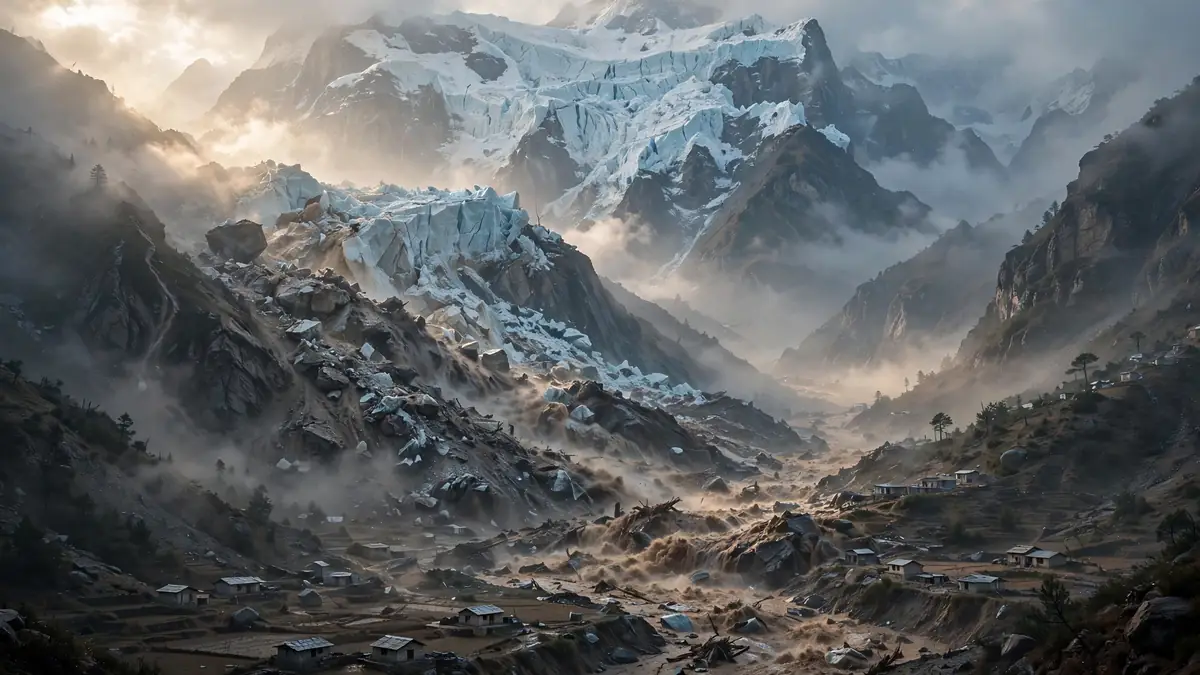
In late August, a glacier collapsed near the border between Nepal and China's Tibet Autonomous Region, triggering landslides and a flash flood that tore through the valleys downstream. Relief agencies describe the trigger as a glacier-related ice-rock avalanche on August 26 that unleashed a wall of water, debris and boulders on mountain communities in the districts of Rasuwa, Nuwakot, Gorkha and Dhading.
The scale of the destruction is still coming into focus more than a month later. According to a situation update from World Vision International Nepal, published September 23, at least 1,415 people lost their lives and 5,786 remain missing or unaccounted for. Around 20,000 households were affected, with 84,000 people — including 22,000 children — now in need of humanitarian assistance.
Homes, markets, roads, bridges, schools and other critical infrastructure were damaged or destroyed, cutting off access to essential services and livelihoods across the affected valleys. Around 20,000 households require food assistance, while 65,000 people need emergency water, sanitation and hygiene support. Some 22,000 children urgently need safe drinking water, sanitation and hygiene services. Families also need safe shelter, livelihood support and psychosocial care as they begin the long journey toward recovery.
'Grants, not loans'
On September 24, Nepal's Prime Minister Balendra Shah carried that devastation onto the world's biggest diplomatic stage. Addressing the 81st United Nations General Assembly in New York, he called for grant-based international support to help the Himalayan nation recover from the flood that killed at least 1,450 people.
Shah told the Assembly that Nepal's recovery and reconstruction needs were estimated at about 10 per cent of gross domestic product — a staggering burden for one of the world's poorest countries. And he argued that vulnerable countries should not be forced to take on additional debt to rebuild from catastrophic climate events.
'When a climate-driven disaster destroys infrastructure of a poor country, the answer cannot simply be another mega loan or a patchwork of small grants,' Shah said. 'We need adequate grant-based support from the world.'
The distinction matters. Loans — even concessional ones — add to the debt load of countries already struggling with repayments, and the poorest nations routinely spend more servicing debt than they receive in climate finance. Grants, by contrast, do not have to be repaid. For Nepal, where the flood swept away roads, bridges, schools, homes and livelihoods, interrupting years of development progress, the difference between a grant and a loan could shape the country's trajectory for a generation.
The missing
Weeks after the flood, search and recovery operations were still under way, with more than 6,000 people remaining missing in the area, according to Reuters. Shah told the General Assembly that many of them may never be found — a grim acknowledgment that entire settlements were buried under debris or swept into rivers swollen beyond recognition.
The humanitarian response has been mobilizing since the first days. World Vision International Nepal, working with local partners KIRDARC Nepal and Good Neighbors Nepal, reported that as of September 23 its response had reached 8,684 people, including 3,521 children and 258 people with disabilities. The operation has delivered emergency food packages to 3,750 people, hygiene kits to 2,325 people including 930 children, shelter kits to 455 people, bedding sets to 860 people, and dignity kits to 559 women and girls. Two child-friendly spaces are supporting 116 children, alongside water purification supplies and tanks to improve access to safe drinking water.
Earlier in the week of the UN address, the World Bank made available up to $170 million in emergency financing to help Nepal respond to the disaster and begin recovery efforts — a significant sum, though a fraction of the estimated reconstruction need.
A Himalayan early-warning system
Shah's address went beyond a plea for money. He urged closer cooperation between Nepal, India and China on climate resilience, calling for an urgent Himalayan mechanism to share satellite data, monitor glacial lakes, strengthen early-warning systems and coordinate disaster responses across borders.
The proposal reflects the geography of the threat. Glaciers, glacial lakes and steep valleys do not respect national boundaries — the flood that devastated Nepal began near the Tibet border, and the rivers it swelled flow onward into India. Scientists have long warned that thousands of glacial lakes across the Himalayas are growing as glaciers retreat, and that many are held back only by unstable walls of rock and ice debris that can fail catastrophically, as happened in August.
An early-warning network spanning the three countries — combining satellite monitoring of unstable lakes, ground sensors, and cross-border alert protocols — could give downstream communities the hours of notice that mean the difference between evacuation and catastrophe. It is the kind of practical, regional cooperation that climate adaptation demands and that geopolitics often complicates.
Why this matters beyond Nepal
The Nepal disaster is a case study in the central injustice of the climate crisis: the countries least responsible for warming suffer its worst consequences, and then are asked to borrow money to recover. The Himalayas, sometimes called the Third Pole, hold the largest reserves of ice outside the polar regions and feed rivers on which nearly two billion people depend. As that ice destabilizes, the risk of exactly this kind of catastrophe is growing across the entire mountain arc, from Pakistan to Bhutan.
For the international audience — in Washington, London, Brussels, Canberra and beyond — the story is also a preview of the debates heading into the COP31 climate talks in Antalya in November. Loss and damage finance, the principle that wealthy polluting nations should help pay for climate disasters in vulnerable countries, was one of the hardest-fought issues of recent climate negotiations. Nepal's prime minister has now put a human face on it: 1,450 dead, 6,000 missing, and a bill equal to a tenth of his country's economy.
The question he posed to the General Assembly was simple and uncomfortable. When the next glacier collapses — and scientists say there will be a next one — will the world offer the affected country a lifeline, or another loan?
Sources