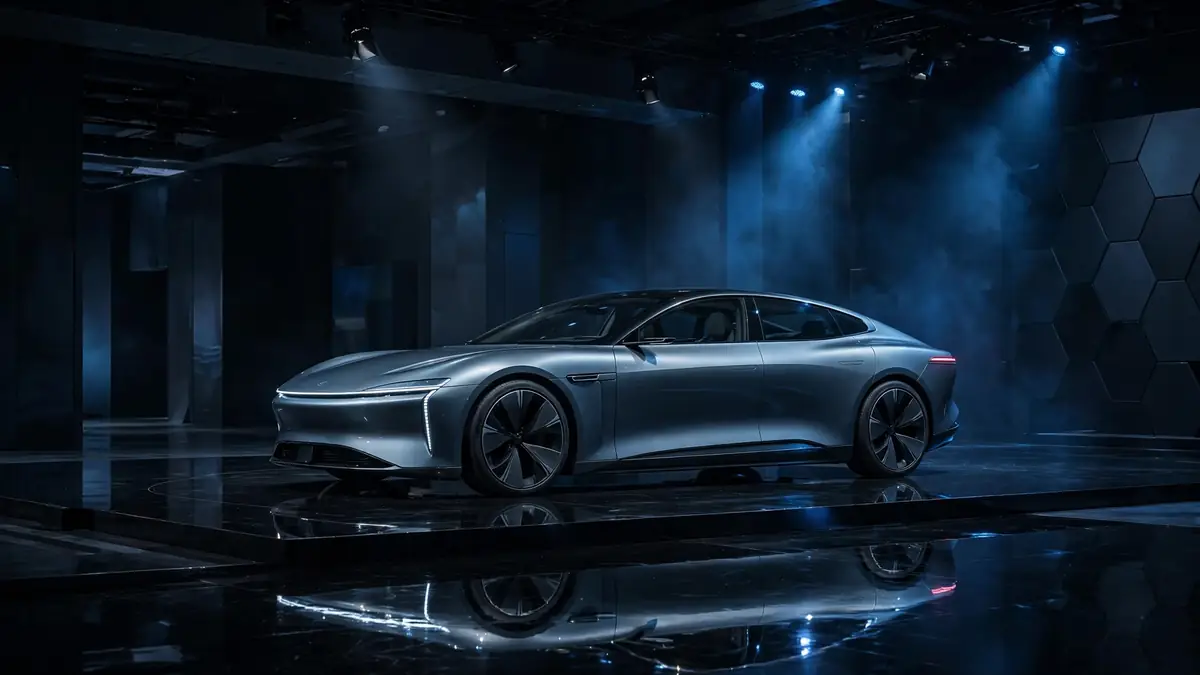
Volkswagen has launched presales of the ID. UNYX 09, the second model jointly developed with Chinese electric-vehicle maker Xpeng, expanding its electric offensive in a market where the German giant is fighting for its future. The new electric fastback sedan went on presale in China on Thursday, September 24, 2026, with prices starting from 199,900 yuan (about $29,785).
The launch comes as Volkswagen confronts a deepening crisis in what was long its largest market. Deliveries to China fell 26 percent to 971,000 units in the first half of 2026 — the company's lowest level in 16 years — and the carmaker said in July that it was unable to escape the significant decline. This week, Volkswagen's China chief said the current contraction in the Chinese market was equivalent in impact to the COVID-19 pandemic.
The ID. UNYX 09 is the latest offering in Volkswagen's in China, for China campaign, which aims to accelerate vehicle development and compete more effectively with domestic carmakers such as BYD and Geely. The partnership with Xpeng has become central to that China revamp strategy, following the launch of the first jointly developed model, the ID. UNYX 08 SUV, earlier this year.
Built in two years
The headline achievement is speed. Volkswagen says the ID. UNYX 09 was brought to production in just 24 months — roughly 30 percent faster than its traditional development cycles — on a new China-based architecture. For a company whose engineering timelines have long been measured in four- to five-year cycles, the two-year turnaround is a genuine break with tradition and a direct answer to the pace of Chinese rivals.
The mid- to large-size EV coupe pairs batteries from CATL, the world's largest battery maker, with Xpeng's VLA intelligent driving assistance system. It will be built at Volkswagen's Hefei plant, west of Shanghai, which also produces the ID. UNYX 08. The new sedan officially goes on sale at the end of October.
The specifications tell a story about where Volkswagen believes the Chinese market is heading: advanced driver-assistance technology, sourced from a local partner, paired with cost-competitive batteries from a local supplier, built in a local plant, and priced from under 200,000 yuan. Every link in that chain reflects the in China, for China logic.
Why the Xpeng partnership matters
Volkswagen's alliance with Xpeng, announced in 2023, was one of the most striking admissions in modern automotive history: a legacy giant that had dominated China for decades conceding that it needed a local startup's help to survive electrification. The ID. UNYX 08 SUV was the first fruit of that collaboration; the 09 fastback is the proof that the pipeline is now flowing.
The partnership works because each side fills the other's gap. Xpeng brings software-defined vehicle architecture, intelligent driving systems and development speed. Volkswagen brings manufacturing scale, brand equity, a vast dealer network and deep pockets. In a market where homegrown brands have steadily eroded the market share the German giant once held, that combination is Volkswagen's best available answer.
Volkswagen plans to launch more than 20 battery-electric and plug-in hybrid models in China this year — an extraordinary cadence that underlines how seriously Wolfsburg takes the threat. The question is whether volume of launches can translate into volume of sales against BYD, Geely and a new generation of Chinese brands that have redefined what Chinese buyers expect from a car.
Reading the 199,900 yuan price
The starting price of 199,900 yuan positions the ID. UNYX 09 squarely in the heart of China's most competitive segment: the mid-size electric sedan, where domestic brands have been waging a relentless price war. At roughly $29,785, it undercuts many Western-branded rivals while offering Xpeng's driver-assistance technology — a combination designed to make the car competitive on both price and features.
But pricing is only part of the battle. Chinese buyers increasingly choose cars for their software experience, intelligent driving capabilities and digital ecosystems — areas where domestic brands set the standard. By embedding Xpeng's VLA system, Volkswagen is effectively outsourcing the part of the car that matters most to Chinese buyers to a company that understands them natively.
It is also a signal to the rest of the industry. Joint ventures in China were once about manufacturing access; now they are about software access. Volkswagen's willingness to let a partner's technology define the driving experience shows how far the balance of power has shifted — from the foreign partner's engineering to the local partner's code.
What success looks like — and what is at stake
For Volkswagen, the ID. UNYX 09 is more than a product launch; it is a test of a strategy. The company's China business model — premium German engineering, long development cycles, global platforms — has been comprehensively outflanked by faster, cheaper, smarter domestic rivals. The Xpeng partnership represents a bet that Volkswagen can adopt Chinese speed without losing German credibility.
The stakes extend beyond China. Lessons from the in China, for China program — compressed development timelines, local software partnerships, aggressive cost engineering — are already influencing how Volkswagen approaches electrification elsewhere. If the 24-month development cycle works in the world's most competitive EV market, it will not stay confined to China for long.
There are reasons for caution. One fastback sedan, however well-executed, cannot by itself reverse a 26 percent sales decline or close the gap with BYD. The ID. UNYX 08's performance earlier this year will be the leading indicator: if the first Xpeng joint model is gaining traction, the 09 has a foundation to build on. If not, the partnership's promise remains unproven.
What is clear is that Volkswagen has stopped pretending it can win China the old way. The ID. UNYX 09 — conceived, engineered and priced for China, developed at Chinese speed, carrying Chinese software — is the most complete expression yet of a company reinventing itself to survive its most important market. Whether buyers believe the reinvention will be decided in showrooms over the coming months, starting with the official on-sale date at the end of October.
Sources