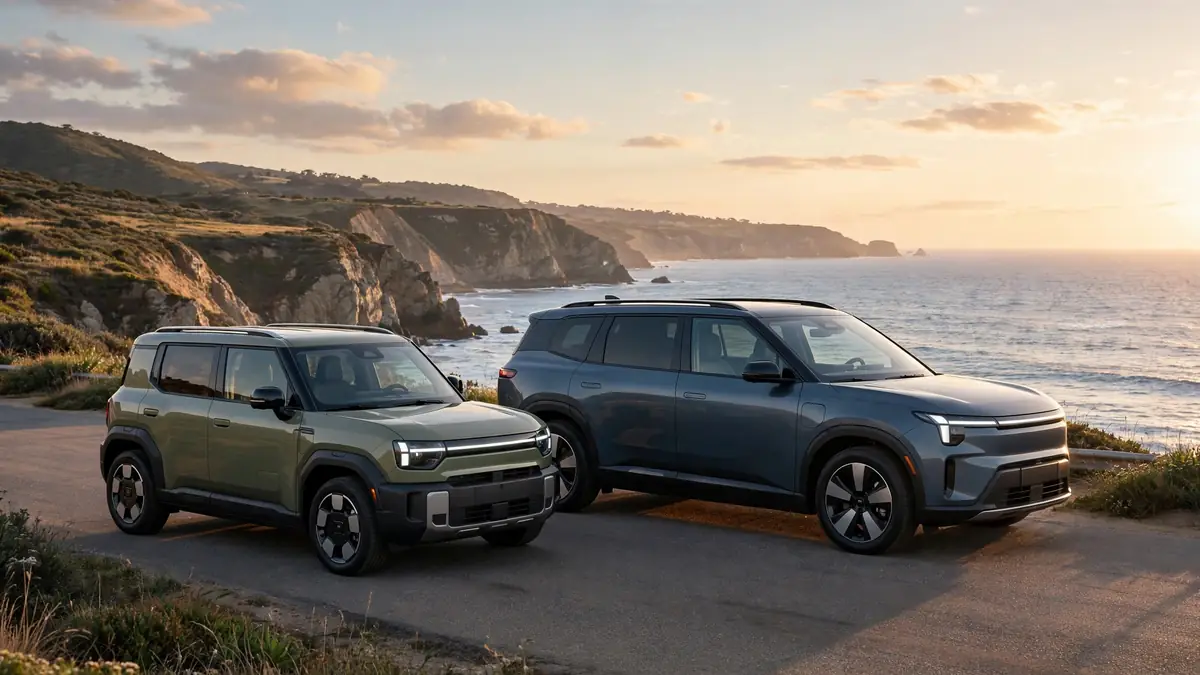
Hyundai is preparing to plug two of the most conspicuous gaps in its electric lineup with a pair of new IONIQ-badged SUVs, according to reports published this week. The Korean automaker plans to introduce a compact B-segment crossover expected to wear the IONIQ 4 badge and a larger, family-oriented model anticipated to take the IONIQ 7 name — one slotting below the IONIQ 5, the other between the IONIQ 5 and the flagship IONIQ 9.
The news, first detailed by Auto Express and picked up by Electrek on September 29, 2026, comes as Hyundai pushes to cover the full spectrum of electric SUV demand over the next 12 to 18 months. The IONIQ 7 is slightly bigger than the IONIQ 5 and aimed squarely at families, offering more interior space. The IONIQ 4, by contrast, is a B-segment SUV that will sit between the recently launched IONIQ 3 and the IONIQ 5.
Hyundai has yet to confirm full specifics, but Chris McKinnon, Hyundai Europe's vice president of product, told Auto Express to watch this space for more information on the upcoming B-segment SUV. When asked whether the new small SUV would be similar to sister brand Kia's successful EV3, McKinnon declined to be drawn: I really can't answer that question, to be honest,
he said — while adding that the segment was an important one for the Hyundai brand.
The IONIQ 4: Hyundai's answer to the small-SUV boom
The smaller of the two newcomers is arguably the more strategically important. The B-segment — compact crossovers — is one of the fiercest battlegrounds in the European EV market, and it is territory Hyundai currently concedes to rivals including its own sister brand Kia, whose EV3 has been winning the race to electrify the segment.
Like the EV3, the Hyundai IONIQ 4 is expected to feature a boxier, more traditional SUV-like design than the IONIQ 3 and IONIQ 5 — a lifestyle-oriented look prioritising comfort, practicality and interior versatility over sporting pretensions. Inside, the electric SUV is expected to carry Hyundai's new interior design language as seen in the IONIQ 3, along with the next-generation Pleos Connect infotainment system.
Powertrain hardware is likely to be shared with the IONIQ 3, which would mean 42 kWh and 61 kWh battery options. The smaller pack provides up to 214 miles (344 km) of WLTP range in the IONIQ 3, while the larger pack stretches to 308 miles (497 km) — figures that would make the IONIQ 4 competitive in a segment where 200-plus miles of real-world range is the price of entry. A single front-mounted motor is expected at launch, with a dual-motor version — and potentially even a high-performance IONIQ 4 N — possible further down the line.
Pricing is expected to start at around £25,000 (about $33,000), slightly above the IONIQ 3. While the Kona Electric is still currently available in the UK, it is expected to be discontinued and replaced by the new IONIQ 4 — a passing of the torch from Hyundai's first-generation EV thinking to its dedicated-electric-platform era.
The IONIQ 7: room for the family
At the other end of the new arrivals, the IONIQ 7 will sit between the IONIQ 5 and the three-row IONIQ 9, closer to the 5 in both price and size. The model is expected to take a boxier shape to deliver a more versatile interior, targeting families who need more space than the IONIQ 5 offers without stepping up to the flagship 9.
Given its size and positioning, the IONIQ 7 is expected to use an 800-volt electrical architecture — the fast-charging technology that has become a Hyundai-Kia hallmark and a genuine differentiator against rivals still on 400-volt systems. Single- and dual-motor layouts are anticipated, though specifics on battery sizes and range projections remain unconfirmed; to stay competitive, it will likely need to offer well over 300 miles of range in its longest-legged form.
Like the IONIQ 4, the IONIQ 7 will showcase the next evolution of Hyundai's design language and digital interfaces, including the Pleos infotainment system. The pair are expected to arrive over the next 12 to 18 months, with the compact model tipped for production possibly in 2027.
Why the gaps matter
Hyundai's IONIQ lineup has grown impressively — from the retro-futuristic IONIQ 5 through the sleek IONIQ 6 sedan, the compact IONIQ 3 and the three-row IONIQ 9 — but the spaces between the models have been glaring. The jump from the IONIQ 3 to the IONIQ 5 leaves the entire B-segment crossover market unaddressed, and the gap between the 5 and the 9 leaves family buyers with an awkward choice between too small and too big.
Those gaps are not abstract. Kia's EV3 has demonstrated exactly how much demand exists for a well-executed compact electric SUV, and Hyundai has watched its sister brand convert that demand into sales-chart success. The IONIQ 4 is, in effect, Hyundai's admission that it cannot leave that segment to Kia alone.
The IONIQ 7 addresses a different pressure: the family SUV is the volume heartland of the European market, and electrifying it convincingly — with proper space, proper range and proper charging speed — is one of the industry's defining challenges. An 800-volt, family-sized Hyundai priced just above the IONIQ 5 would land in one of the most contested spaces in the business.
What to watch next
Several questions remain open. Hyundai has not confirmed the IONIQ 4 name — though it is the industry's strong expectation — nor has it committed to firm launch dates, pricing or full specifications for either model. McKinnon's careful non-answers suggest the details are close but not yet ready for daylight.
The competitive context is also shifting. The affordable-EV segment is about to get more crowded, with new entries from European, Chinese and Korean brands all converging on the £25,000 mark. The IONIQ 4 will need more than a badge to stand out — it will need the range, charging speed and interior quality that made the IONIQ 5 a benchmark.
For buyers, the message is patience with purpose: if you have been waiting for a smaller Hyundai electric SUV, or a family-sized one that is not quite a flagship, the next 12 to 18 months should deliver both. And if the IONIQ 4 can channel even a fraction of what made the EV3 a hit — boxy charm, honest practicality, keen pricing — Hyundai's lineup will finally look complete.
Sources