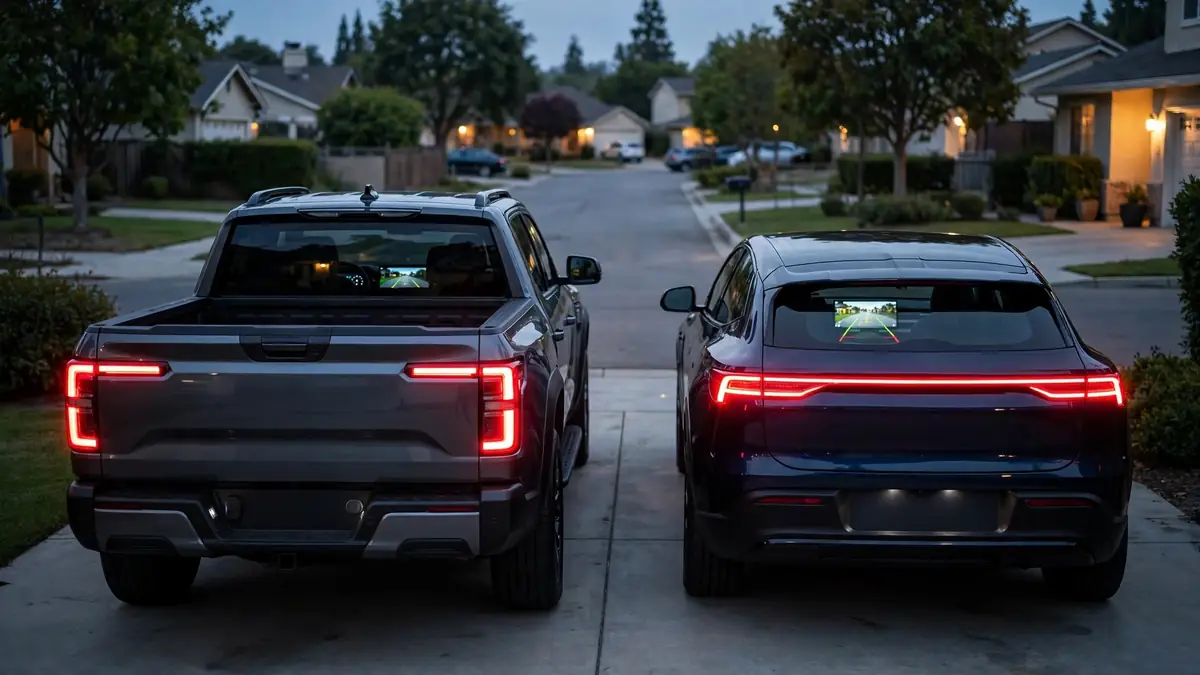
Rivian Automotive is recalling about 100,700 vehicles because a software prompt can briefly block the rearview camera image while the vehicle is in reverse, the company said on Wednesday, September 23, 2026. The recall covers most of the vehicles the electric-vehicle maker has ever produced — and it marks the first recall to reach the company's new R2 SUV, which only began deliveries in June.
According to the recall notice, the rearview camera image may be obstructed by a notification when the vehicle is in reverse, reducing the driver's rear visibility and increasing the risk of a crash. Rivian is not aware of any customer reports, crashes or injuries connected to the problem — but the glitch means the vehicles may not comply with FMVSS 111, the federal rear-visibility standard that treats the backup camera image as mandatory safety equipment.
The flaw is remarkably narrow. In rare cases where a driver has switched off stability control, a prompt urging them to turn it back on can overlay and cover the camera view while reversing, Rivian told Reuters. The image returns as soon as the vehicle starts moving — which is precisely why the company describes the issue as brief, but regulators treat any failure of the rearview image as a noncompliance matter regardless of duration.
Which vehicles are affected
The US filing covers three model lines:
- 2022–2027 Rivian R1S SUVs — 62,259 vehicles
- 2022–2026 Rivian R1T pickups — 34,088 vehicles
- 2027 Rivian R2 SUVs — 2,481 vehicles
The recall number is FSAM-1866. The model-year breakdown, reported by InsideEVs, shows the scale of the action: it spans essentially the company's entire production history, from the earliest R1T pickups through the first few thousand R2s. For a young automaker, that breadth is less a sign of systemic trouble than a reflection of how small its fleet still is — every vehicle Rivian has ever built shares substantially the same software stack, so a single bug touches almost everything.
The R2's inclusion is the detail worth watching. The more affordable SUV began customer deliveries in June and represents Rivian's bid to move from a niche premium brand to a volume player. A recall touching the R2 within its first months on sale is awkward timing, but the over-the-air nature of the fix limits the practical damage.
What drivers should do
The fix is simple: install the latest over-the-air software update. According to Rivian's recall notice, more than 95 percent of affected vehicles have already downloaded the remedy, making this less a warning than a receipt — most owners are protected before the paperwork reaches them.
Drivers who have not yet updated can check their VIN on Rivian's recall page. Formal owner notification letters are scheduled to go out on November 9, which means many drivers will receive a letter for a problem their vehicle no longer has. The recall remedies are provided at no charge, as with all safety recalls.
How would a driver recognise the issue? The safety report notes that a reverse image that fails to appear would be noticeable to the driver when it does not appear as expected. Selecting the camera page on the center display, or simply starting the vehicle moving so speed becomes non-zero, causes the reverse image to reappear.
Why backup cameras are treated as sacred
To understand why a fleeting software overlay triggers a six-figure recall, it helps to remember the stakes behind the backup camera mandate. The National Highway Traffic Safety Administration required rearview cameras in most new vehicles built from May 2018 after years in which backover crashes were killing nearly 210 people a year, CNN has reported. The camera image is not a convenience feature in the eyes of regulators; it is safety equipment, held to the same seriousness as a brake light or an airbag.
That is why the framing here is noncompliance rather than defect-caused harm. Reuters described the case as a noncompliance matter — the trigger is a missed federal standard, not a reported crash. Rivian found and reported the issue itself, which is how the modern recall system is supposed to work: the company identifies a deviation from the standard and corrects it across the fleet, increasingly via software.
The bigger picture for software-defined cars
There is a broader lesson in the Rivian recall, and it cuts in two directions. On one hand, the episode shows how fragile the boundary between convenience software and safety-critical systems has become. A user-interface prompt — a piece of code whose entire job is to nudge the driver about a setting — was able to obscure a federally mandated safety display. As vehicles become more software-defined, the attack surface for this kind of interaction grows with every new feature.
On the other hand, the remedy shows the system's strengths. An over-the-air update reached more than 95 percent of the fleet before the recall was even announced — a speed of remediation that was unimaginable in the era of dealer-visit recalls. The same connectivity that creates the vulnerability also delivers the fix.
For Rivian, the financial impact should be modest. Software recalls carry a fraction of the cost of hardware campaigns, and the company's proactive posture — reporting the issue before any injuries were recorded — is exactly what regulators want to see. It is also worth noting how recalls like this one are reshaping the relationship between automakers and safety regulators. A decade ago, a recall meant mailed letters, dealership appointments and a paper trail measured in weeks. Today, the great majority of affected Rivian owners were protected by a software update downloaded in the background before the recall was even public. The formal notices and VIN lookups remain, but the actual safety work increasingly happens silently, over the air, at internet speed. The real test is reputational: whether buyers of the new R2 read this as evidence of a responsive company or of software that ships before it is ready. With the R2 meant to carry Rivian into the mainstream, every early headline about the new model lands heavier than the last.
Sources