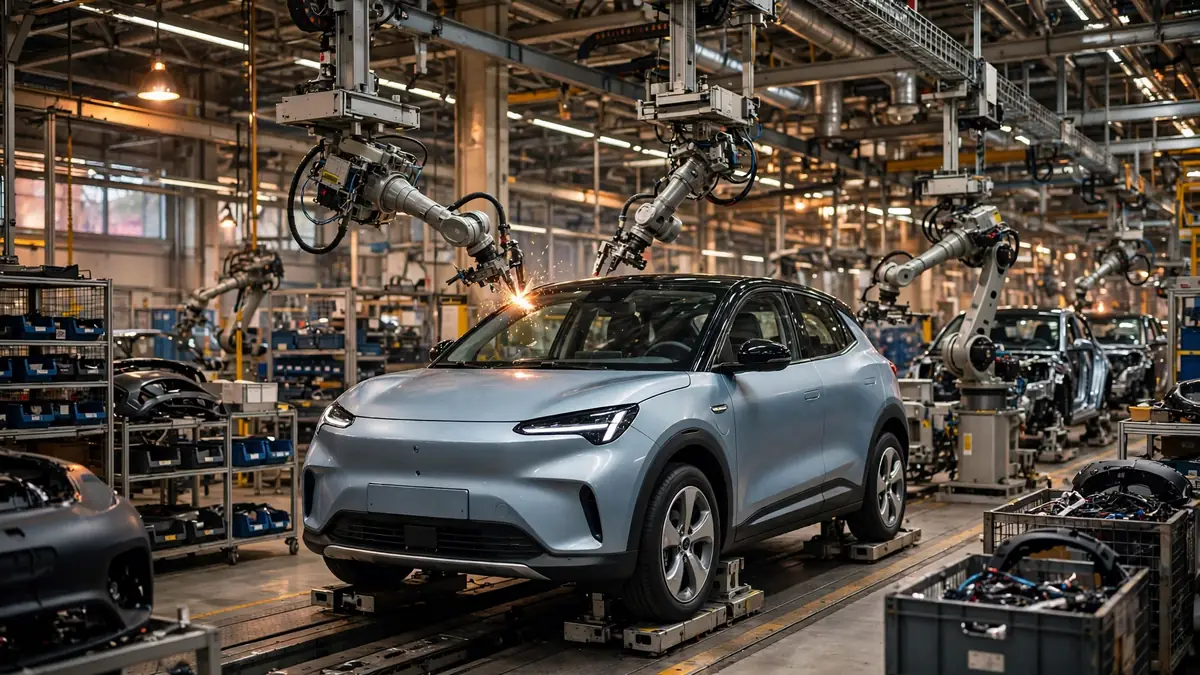
General Motors is building roughly 75 percent fewer Chevrolet Bolt electric vehicles than it had originally planned, a sharp retrenchment that lays bare how dramatically the removal of federal support has reshaped the American EV market. The Kansas City-area plant where the Bolt is assembled is now on pace to produce about 35,000 of the small electric SUVs in total before production ends in the first quarter of 2027, according to the union leader who represents the factory's workers.
The disclosure, made by Dontay Wilson, president of United Auto Workers Local 31, to Reuters on Monday, September 29, 2026, marks one of the clearest acknowledgements yet that the post-subsidy American EV market is far smaller than Detroit's largest automaker had banked on. The Fairfax Assembly Plant in Kansas City, Kansas, had originally been on track to produce around 150,000 Bolts by the time the line stops early next year, Wilson said.
It is worth stressing what the numbers represent. The union's estimate is based on the daily volume of vehicles moving through the plant — not a production figure provided by GM itself. In a statement, the Detroit automaker declined to comment on Bolt production volumes. We continuously evaluate market dynamics and customer demand to make decisions regarding our operations,
GM spokesman Kevin Kelly said in an emailed statement. The company has consistently described the revived Bolt as a limited-run model, and has not said when it will be discontinued.
An affordable EV launched into a very different market
The current-generation Bolt went on sale early this year with a starting price of $27,600, and GM presented it as an affordable option in a market crowded with expensive electric models. An earlier version of the Bolt sold from 2016 to 2023 and built a loyal following among buyers who wanted a reasonably priced, no-frills EV.
This time, the value proposition has collided with a transformed policy landscape. Following the removal of the $7,500 federal tax credit for EV buyers in September 2025 — part of a series of moves by the Trump administration and Republican lawmakers to withdraw federal subsidies for battery-powered cars — electric-vehicle sales in the United States fell sharply. Through August 2026, GM had sold just 4,224 new Bolts, a figure that made the limited-run framing look increasingly like an understatement.
The Bolt is hardly an outlier. Since the second quarter of 2025, GM has recorded $10.9 billion in EV-related charges, joining a long list of automakers walking back ambitious electric investments. The company still builds about a dozen electric models, but it has retooled several plants to produce petrol-engine vehicles instead — a reversal that would have been unthinkable during the industry's peak EV-expansion years.
What happens to the Kansas plant
The Fairfax Assembly Plant's future is already being redrawn around a different powertrain. Once Bolt production ends, the factory will begin building the petrol-powered Chevrolet Equinox, which GM moved from Mexico. In 2028, the plant is scheduled to add production of the Buick Envision SUV, currently built in China.
The sequence is telling. A factory that was supposed to anchor GM's affordable-EV future is being repurposed, within the span of a single model cycle, around the internal-combustion crossovers American buyers are actually purchasing. The shift also illustrates the tariff and trade calculations now woven into production planning: moving Equinox output from Mexico and Envision output from China into Kansas reflects an industry reorganising supply chains around a more protectionist US trade posture.
Reading the 35,000 number honestly
It would be easy to treat the revised figure as simply bad news for electrification. The reality is more nuanced. GM never positioned the new Bolt as a mass-market cornerstone in the way it once talked about its Ultium-based lineup; from the start, executives framed it as a limited run aimed at budget-conscious buyers and fleet customers. The question is whether 35,000 units represents a deliberate niche play or a reluctant retreat from a 150,000-unit ambition that collapsed when the tax credit disappeared.
Wilson's account suggests the latter. The plant's capacity and production cadence had been aligned for the higher volume before plans changed in the wake of the credit's removal. That sequence — capacity built for six figures, output collapsing to a fifth — points to a demand shock rather than a pre-planned boutique run.
For shoppers, the immediate picture is mixed. Fewer Bolts will be available, but the ones that reach dealers may be more negotiable, particularly as GM works through a model it has publicly described as finite. For the broader market, the episode is a case study in how quickly purchase incentives drive EV adoption: strip away $7,500 of support, and even a $27,600 price tag struggles to move metal.
The bigger signal for Detroit
The Bolt's shrinking run fits a wider pattern. Automakers across the industry have scaled back EV plans after the subsidy withdrawal, with several delaying or cancelling battery-plant projects and rebalancing lineups toward hybrids and petrol models. What makes the Bolt story notable is the speed of the reversal: a model launched this year, on a well-understood formula, being wound down to a fraction of its intended volume within months.
It also raises a longer-term question about affordability. The industry's EV strategy long rested on the assumption that scale would eventually bring costs down enough to compete without subsidies. The Bolt — GM's most direct attempt at a genuinely affordable electric car — has instead become evidence of how dependent that affordability remains on policy support. When that support vanishes, so does much of the market for sub-$30,000 EVs.
None of this means the EV transition is over; it means it is running on a different timetable than the one Detroit wrote a few years ago. GM continues to sell electric vehicles, and demand in some segments has proven more resilient. But the Fairfax Assembly Plant's quiet retooling — from affordable electric future to petrol crossover present — captures the industry's mood as 2026 draws to a close: less certainty, more hedging, and a frank admission that the customer, not the policy paper, sets the pace.
Sources