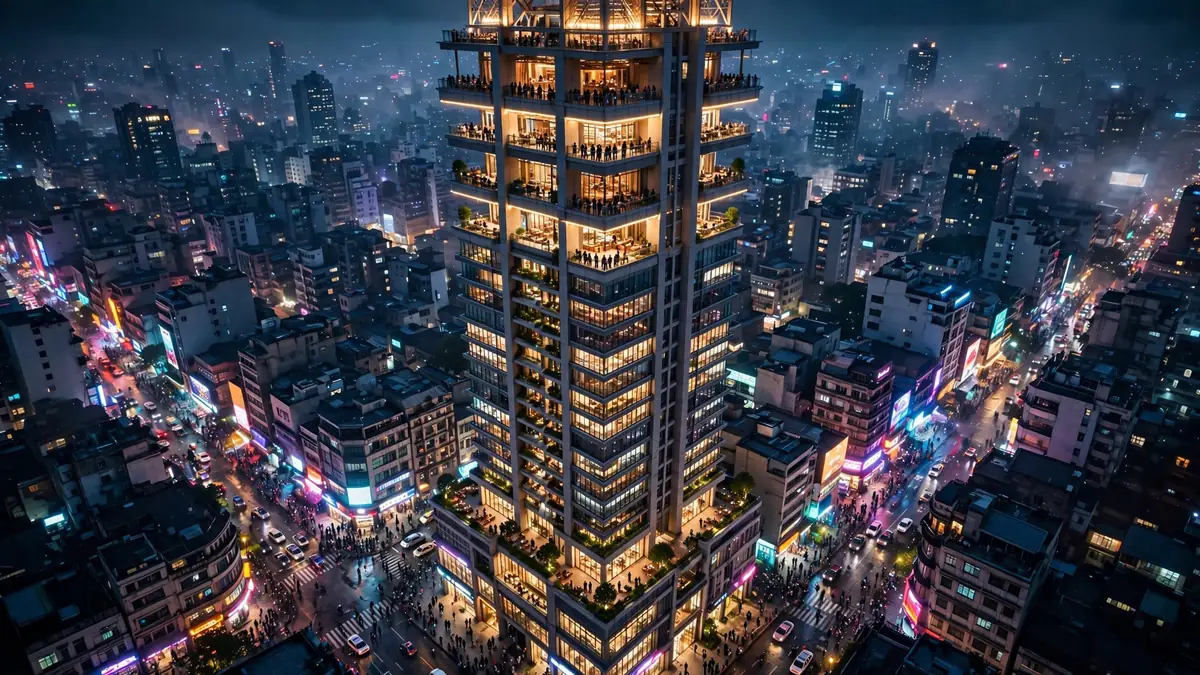
A $1.25 billion bet on the future of Times Square
One of the largest construction financings in New York City this year closed in September 2026, when Extell Development Co. secured a $1.25 billion construction loan for The Torch — a 60-storey mixed-use tower rising at 740 Eighth Avenue in the heart of Times Square. With 40 of its 60 floors already built, the financing clears the way to complete one of Manhattan's most ambitious and unconventional developments: a skyscraper that combines a near-1,800-room hotel, retail, three observation decks, and a 250-foot amusement ride.
The total project budget stands at $1.31 billion, making the loan package one of the most significant votes of confidence in New York's post-pandemic development market. The senior debt — $1.1 billion — was arranged by a bank group led by JPMorgan, with a further $150 million in mezzanine debt from US institutional investors. The transaction was guided by law firm Davis Polk & Wardwell, and its terms were disclosed through a filing on the Tel Aviv Stock Exchange, reflecting Extell's Israeli investor base.
The pricing tells its own story about the cost of building big in 2026. The senior loan was priced at SOFR plus 4.0 per cent, with the mezzanine tranche at 6.79 per cent — levels that underline how expensive development capital remains, even for a project this far along. That lenders were willing to commit at these terms, with the building already two-thirds complete, speaks to the perceived strength of the underlying asset.
What The Torch will be
The Torch is not a conventional Manhattan tower. Its programme reads like a vertical entertainment district: approximately 1,800 hotel rooms, extensive retail and food-and-beverage space, some 130,000 square feet of advertising and signage area, three separate observation decks, and a 250-foot amusement ride integrated into the structure. On room count alone, it will rank among the largest hotel projects in New York City.
The hotel component is backed by a 40-year franchise agreement with an international hotel chain and a $60 million capital commitment from the hotel partner — a long-dated endorsement that suggests the operator sees Times Square hospitality as a durable business. The developers are targeting annual net operating income of $250 to $270 million once the building is complete and stabilised, a figure that would place The Torch among the highest-earning single assets in the city's hospitality and entertainment landscape.
The observation decks and the amusement ride are the project's signature moves. New York's observation-deck market has become fiercely competitive in recent years, with several towers vying for the tourist dollar at the top of the skyline. Three decks in a single building — plus a thrill ride at 250 feet — is an attempt to differentiate in a crowded field by offering something closer to a theme park than a viewpoint.
The architecture of vertical entertainment
Designing a 60-storey building that is simultaneously a hotel, a retail complex, an advertising platform, and an amusement venue is an architectural problem with few precedents. The structural demands alone are formidable: a 250-foot ride imposes dynamic loads that a conventional tower never has to consider, while the 130,000 square feet of signage — Times Square's lifeblood — must be integrated into a facade that also serves hotel guests expecting quiet rooms and views.
The mixed-use stacking is the core of the design challenge. Hotels, observation decks, and entertainment venues have radically different circulation, servicing, and security requirements, and separating their flows within a single vertical structure requires careful planning. The three observation decks, in particular, must handle enormous visitor throughput without interfering with hotel operations — a problem of vertical logistics as much as of architecture.
There is also the question of what the building does to Times Square itself. The district has been reinventing itself for a century, and each generation's towers — from the early theatres to the glass office blocks to the current wave of supertalls — have rewritten its character. The Torch's bet is that the future of Times Square is experiential: that visitors want not just to look at the lights but to be lifted, spun, and entertained above them.
What the financing says about the market
The September 2026 closing is significant beyond a single project. Large-scale construction lending in New York has been cautious in recent years, with lenders scrutinising development risk more closely than they did in the cheap-money era. A $1.25 billion commitment to a mixed-use entertainment tower — a complex, operationally demanding asset class — suggests that capital is returning to ambitious Manhattan development, at least for projects with strong sponsorship and substantial completion already achieved.
The structure of the deal is instructive. With 40 of 60 floors complete, the remaining construction risk is largely about fit-out and systems rather than structure — the phase of a project where budgets are most likely to overrun but where the building's existence is no longer in doubt. The mezzanine tranche at 6.79 per cent and the senior pricing at SOFR plus 400 basis points reflect a market that prices development risk honestly but is still willing to fund it.
The 40-year hotel franchise agreement is perhaps the most telling detail. Hotel brands do not sign four-decade commitments lightly; the agreement implies a shared conviction that Times Square will remain one of the world's premier hospitality locations for a generation. It is a long bet on tourism, on New York, and on the idea that the experience economy has decades left to run.
The road to completion
With financing secured, the task now is execution: completing the remaining 20 floors, fitting out nearly 1,800 hotel rooms, installing the observation decks and the amusement ride, and bringing the building's complex operations online. The developers will need to market the hotel and entertainment components in a city where both face intense competition, and to coordinate an international franchise partnership across a 40-year horizon.
If The Torch hits its $250–270 million NOI target, it will stand as a vindication of the vertical-entertainment model — and a template for how dense cities can stack leisure, hospitality, and spectacle into a single structure. If it falls short, it will be studied just as closely, as a cautionary tale about the limits of building bigger in the world's most expensive construction market. Either way, Times Square's skyline is about to get a lot more interesting.
Sources