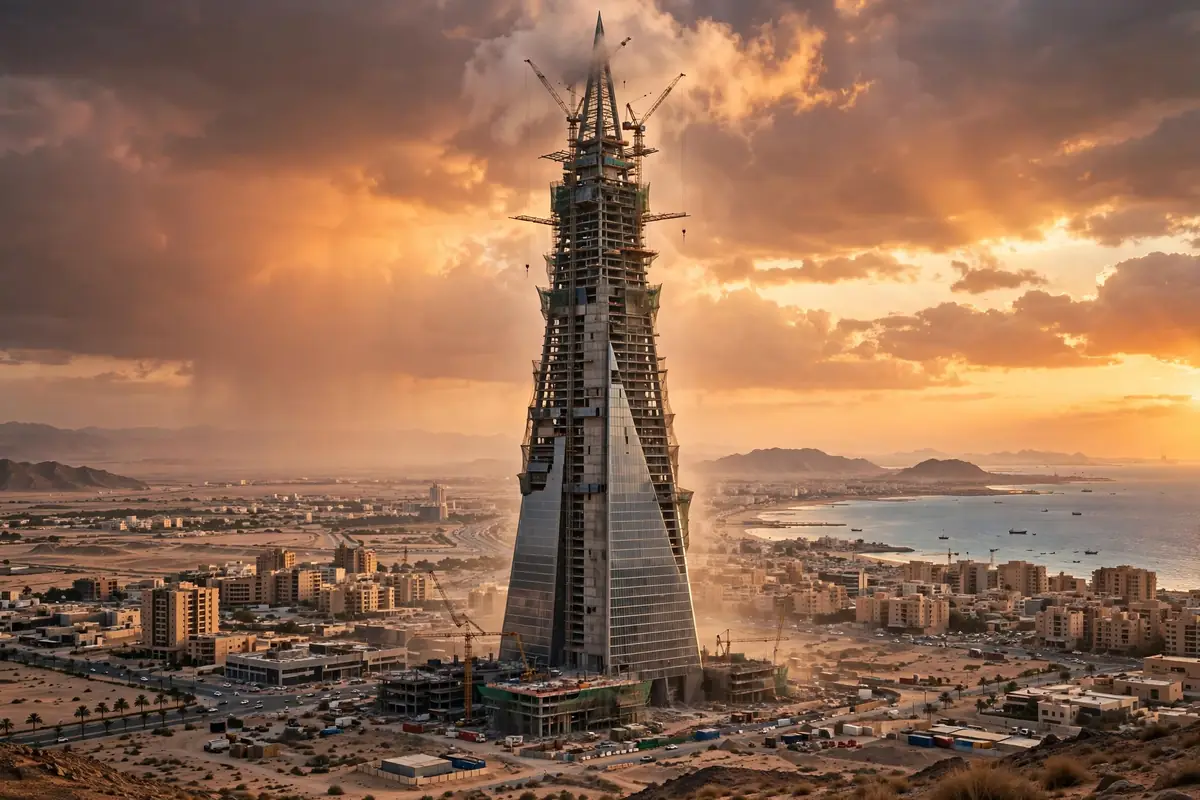
The kilometre-high dream climbs past 113 floors
The race to build the world's first kilometre-tall building took a significant step forward this month, with new specialist data confirming that Saudi Arabia's Jeddah Tower had reached 454 metres and its 113th floor as of August 31, 2026. The figure comes from the Council on Vertical Urbanism, the independent tall-building research body, and represents the most authoritative recent measurement of a project that has been under construction — with one long interruption — for over a decade.
Jeddah Tower is designed to rise above 1,000 metres, which would make it the first building in history to break the kilometre barrier and decisively surpass Dubai's 828-metre Burj Khalifa as the world's tallest building. Reports in Saudi media cite a planned total of around 167 floors and a targeted completion date of August 2028 — an ambitious timetable that would require the tower to add roughly 50 more floors and over 500 metres of height in less than two years.
The latest update follows the project's formal restart on January 20, 2025, when the Saudi Binladin Group took over the remaining works under a contract estimated by the construction intelligence service MEED at around SR8 billion (roughly US$2.1 billion). The project is being developed by the Jeddah Economic Company. After years of stasis, the tower is finally climbing again — and the world's tall-building watchers are paying close attention.
A building designed to be a statement
Jeddah Tower — long known during its planning as the Kingdom Tower — was conceived as the centrepiece of Jeddah Economic City, a vast new urban district on the Red Sea coast north of Jeddah. The tower's design is a sleek, faceted needle that tapers as it rises, a form driven as much by wind engineering as by aesthetics: at heights above 800 metres, managing wind loads and vortex shedding becomes the dominant structural problem, and the tower's stepped, triangular profile is shaped to confuse the wind.
The building was designed by Chicago-based architect Adrian Smith, the architect behind the Burj Khalifa, during his tenure at Skidmore, Owings & Merrill — a lineage that makes the project a kind of sequel to the world's current tallest building, by the same hand, aiming to break its own record. The mixed-use programme is expected to include a hotel, serviced apartments, offices, and residential units, crowned by what would be the world's highest observation deck.
The engineering challenges of a kilometre-tall building are genuinely unprecedented. Concrete must be pumped to heights no pump has reached before. Elevators must move people efficiently across a vertical distance equivalent to a small town's main street stood on end. The building's sway, its foundations in the Red Sea coastal geology, and the logistics of constructing at altitudes where weather changes by the hour all push beyond the current state of the art. Every floor added above 800 metres is, in a real sense, an experiment.
The long road to 454 metres
The tower's history is a case study in how megaprojects survive. Construction began in the early 2010s and proceeded steadily until the project stalled amid the regional upheavals of the late 2010s — a years-long pause during which the half-built core stood as one of the world's most expensive question marks. The January 2025 restart, backed by the Saudi Binladin Group's SR8 billion contract, was the moment the project went from suspended ambition back to active construction site.
Since the restart, progress has been rapid by supertall standards. Reaching the 113th floor and 454 metres by the end of August 2026 represents roughly 20 months of sustained climbing — a pace that reflects both the contractor's resources and the advantage of resuming a project whose foundations, core design, and supply chains were already established. The tower is now well past the height of most of the world's supertalls; only a handful of buildings on earth stand taller than Jeddah Tower does today, unfinished.
It is worth noting what the data does not confirm. A newer claim circulating in some reports — that the tower has already reached 116 floors and about 470 metres — could not be independently verified against authoritative tall-building sources. The latest confirmed measurement remains 113 floors and 454 metres as of August 31. In a project of this profile, where every metre is news, the distinction between confirmed and claimed matters.
What a kilometre means
If Jeddah Tower is completed as planned in 2028, it will reset the global height race in a way not seen since the Burj Khalifa opened in 2010. The psychological barrier of one kilometre — a full 172 metres above the Burj Khalifa — would stand as one of the great engineering achievements of the century, comparable in its way to the longest bridges or the deepest tunnels. It would also cement Saudi Arabia's position at the centre of the supertall conversation, alongside the UAE and, increasingly, Asia's rising skylines.
The project sits within the broader context of Saudi Arabia's construction boom under its Vision 2030 programme, which has channelled enormous investment into new cities, tourism destinations, and landmark architecture. Jeddah Economic City — the district the tower anchors — is envisioned as a new urban centre for the Red Sea coast, and the tower's completion is tied to the district's credibility as much as to any height record. A kilometre-tall tower with nothing around it is a monument; with a city around it, it is a downtown.
For the architecture and engineering professions, the tower is a live laboratory. The solutions developed for its structure, its vertical transportation, its facade maintenance, and its building systems will filter into the next generation of supertalls worldwide — including projects in the Gulf, South Asia, and East Asia that are already on the drawing board. Whether or not the August 2028 target holds, the knowledge being generated on that construction site is permanent.
The view from 454 metres
There is something fitting about the current moment: a tower designed to be the world's tallest, standing at 454 metres — taller than all but a few completed buildings on the planet — and still less than halfway to its own ambition. The remaining climb, from 454 metres to over 1,000, is where the truly unprecedented engineering begins.
The next two years will determine whether the kilometre tower joins the Burj Khalifa in the history books or remains the most spectacular almost in construction history. For now, the cranes are moving, the core is climbing, and the world's tallest building race — dormant for over a decade — is back on.
Sources