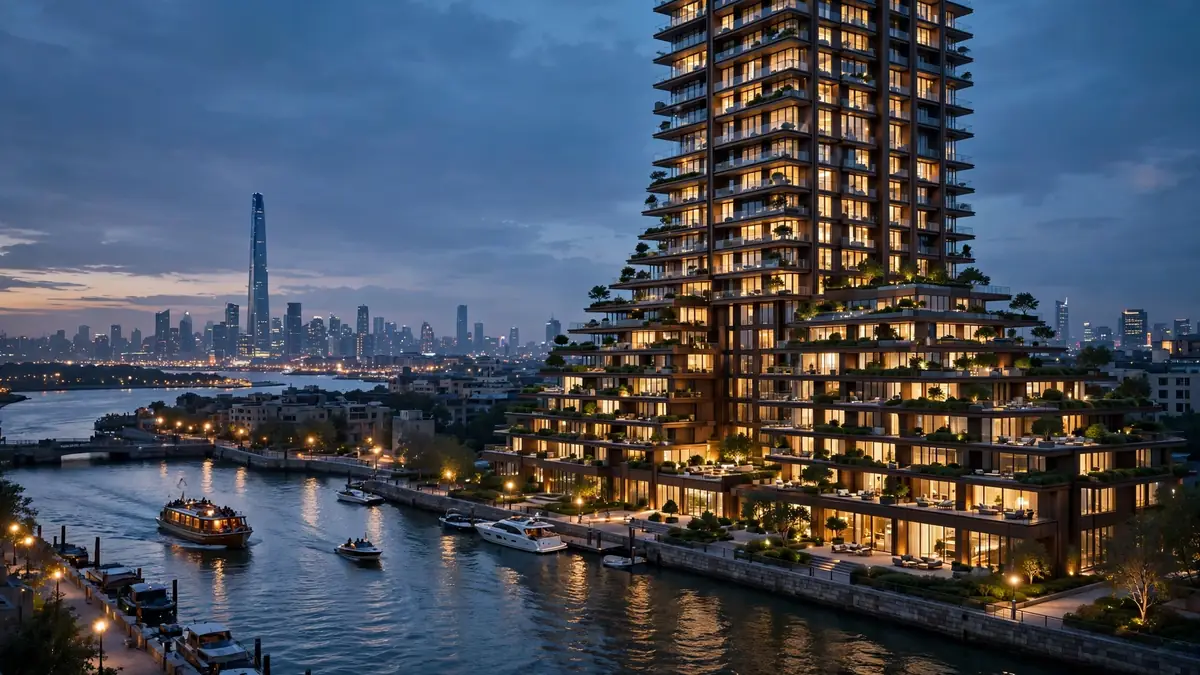
Dubai's residential skyline gains a 350-metre giant
Dubai inaugurated one of the world's tallest residential buildings in September 2026 with the opening of Al Habtoor Tower, a 350-metre skyscraper on the Dubai Water Canal in Al Habtoor City. Rising 1,155 feet above one of the emirate's most active waterfront districts, the 85-storey tower adds 1,740 luxury apartments to a city that continues to build upward at a pace few places on earth can match.
The tower's setting is central to its pitch. Positioned on the Dubai Water Canal — the artificial waterway that cuts through the heart of the city's commercial districts — the building claims panoramic views of the Burj Khalifa, Business Bay, the Arabian Gulf, and Sheikh Zayed Road. It is a location that places residents within minutes of the city's business core while giving the tower itself a waterside frontage, a combination Dubai's developers have learned to sell at a premium.
With a total built-up area of more than 25,000 square metres (over 274,000 square feet), the tower is organised around a simple vertical logic: three below-grade basement floors for parking and services, a ground floor for lobbies and retail, and 85 residential floors above. The scale is notable even by Dubai standards — the city already hosts several of the world's tallest residential towers, and Al Habtoor joins a race that has been running for two decades.
Inside the tower: 1,740 homes in the sky
The residential programme is aimed squarely at the luxury end of the market. The 1,740 apartments are offered as one-bedroom units ranging from 78 to 141 square metres, two-bedroom units from 118 to 192 square metres, and three-bedroom units from 162 to 229 square metres. The largest and most expensive homes — branded as the Ultra Residences and Sky Villas — occupy the top six floors, where the views are longest and the prices presumably highest.
Moving that many residents efficiently is an engineering challenge in itself. The tower is fitted with 24 high-speed elevators capable of travelling at 7 metres per second — among the fastest in the world — a specification that reflects how seriously supertall residential design now takes the question of vertical circulation. In towers of this height, elevator performance is not a luxury amenity but a basic determinant of whether daily life in the building actually works.
The amenity programme reads like a small resort: a wellness spa, a fitness gym, padel and tennis courts, multiple indoor and outdoor swimming pools, a children's playground, a library, event and networking rooms, a concierge desk, and on-site restaurants. According to Sam Annous, managing director of Penetron Saudi Arabia, the tower also features the world's highest terraced gardens and multiple pool decks — claims that, if borne out, would add another superlative to Dubai's long list.
The engineering beneath the glamour
For all the attention on height and luxury, the building's most demanding engineering problem was below ground. With three basement floors sitting close to the Dubai Water Canal — and in a region where groundwater and soil conditions punish concrete — the tower's foundations and below-grade structures required serious waterproofing.
The builders specified a crystalline waterproofing admixture known as Penetron Admix for the below-grade concrete, a treatment designed to make the concrete itself the waterproofing barrier rather than relying on applied membranes. Annous, whose company supplied the product, described the tower as "one of the world's tallest residential buildings" and positioned the waterproofing as essential to the durability of its subterranean structures. It is a reminder that supertall construction is as much about what you cannot see as what you can — the most expensive concrete in the building may be the concrete nobody ever looks at.
The engineering of residential supertalls has matured considerably since Dubai's first wave of tall towers in the 2000s. Wind engineering, concrete pumping to extreme heights, fire-safety systems for high-rise residential use, and the logistics of maintaining a facade hundreds of metres above the street are now established disciplines with their own specialists. Al Habtoor Tower is a product of that accumulated knowledge — and a test of it.
Dubai's residential tower race
The inauguration arrives at a moment when Dubai's property market remains one of the world's most closely watched. The emirate has spent two decades positioning itself as a global destination for luxury real estate, and branded, amenity-rich residential towers are the core product. Al Habtoor Tower enters a market segment — ultra-prime waterfront apartments — that has seen sustained demand from international buyers, including significant interest from the United Kingdom, Europe, and the wider Gulf region.
For the city's skyline, the tower reinforces a pattern: Dubai builds tall not just for offices and hotels but for homes. Residential supertalls were once considered a niche; in Dubai they are the mainstream. The design challenges are real — how to give 1,740 households genuine quality of life at altitude, how to keep service charges sustainable, how to make a 350-metre building feel like a neighbourhood rather than a stack of units — and every new tower is an experiment in answering them.
The terraced gardens are the most interesting architectural move in that experiment. If the claim of the world's highest terraced gardens holds, the tower will offer its residents something genuinely rare: substantial outdoor space hundreds of metres above the city, in a climate where outdoor living is a prized commodity for much of the year. High-altitude landscaping is technically demanding — wind, irrigation, and planting at height all require specialist solutions — but it is also what separates the current generation of residential towers from the sealed glass boxes of the last one.
What the tower signals
Al Habtoor Tower's September 2026 inauguration is more than a single building's debut. It is a data point in Dubai's ongoing bet that the appetite for vertical luxury living is structural rather than cyclical — that there will always be buyers for a home in the sky with a canal view, a spa downstairs, and the world's fastest elevators. Whether that bet holds through the next property cycle will determine how this tower is remembered: as a landmark of a confident era, or as a very tall reminder of one.
For architecture, the tower is worth watching for quieter reasons. Its below-grade engineering, its elevator strategy, and its high-altitude gardens are all problems the next generation of residential supertalls — in the Gulf, in Asia, and increasingly in Western cities — will have to solve. The glamour is in the skyline; the lessons are in the basement, the lift shaft, and the terrace.
Sources