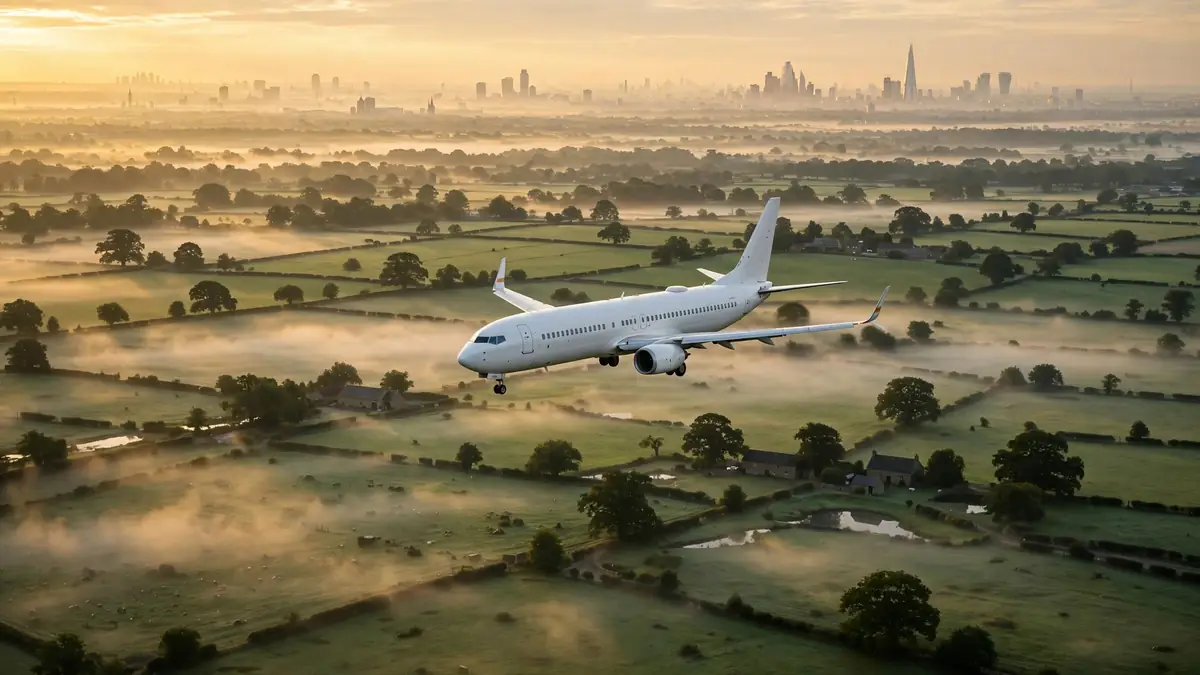
Ryanair has unveiled its biggest-ever UK winter schedule — 435 routes including 22 new services across London and regional airports — and used the launch to escalate two of the fiercest policy fights in British aviation: the cost of Air Passenger Duty and the government's plan to let English mayors introduce overnight visitor levies. The September 23 announcement pairs genuine good news for winter travelers with an unusually blunt warning from Europe's largest low-cost carrier about where it will put its aircraft next.
The headline numbers are substantial. London Stansted gains services to Glasgow, Malmö in Sweden and Parma in Italy, while London Luton adds Venice. A further 18 new routes will operate from 19 other UK airports, and the airline expects to carry 63 million passengers to and from the UK across 2026, consolidating its position as the country's largest airline by passenger volume.
The 22 new routes in detail
The new London services target a mix of domestic, Scandinavian and Italian leisure demand. Stansted's additions — Glasgow, Malmö and Parma — connect the UK capital's biggest low-cost airport with Scotland's largest city, Sweden's third city and a northern Italian food capital that has rarely enjoyed direct low-cost links from London. Luton's new Venice service adds another option on one of Europe's most competitive city-break corridors.
Beyond London, the regional picture is where the expansion bites deepest. Manchester gets a 19th based aircraft, adding around 50,000 extra seats, a new link to Warsaw Modlin and increased frequencies on another 26 routes. Liverpool keeps six based aircraft through the winter — the base introduced for summer 2026 — and adds six winter routes to Milan Bergamo, Copenhagen, Gdansk, Porto, Tirana and Warsaw, with extra flights on existing services to Krakow, Kaunas and Cork.
For travelers in the north of England, Scotland and the Midlands, the additions mean more direct winter options without trekking to London — and, on competitive corridors, the downward fare pressure that follows new low-cost capacity.
A record schedule built on a trimmed group target
The UK expansion comes with an important caveat about the wider group. Earlier in September, Ryanair trimmed its overall annual passenger target by two million to 214 million and said it would curb winter losses by up to €100 million in response to unhedged jet fuel exposure. Group-wide winter traffic between November and March is expected to remain broadly flat year on year.
In other words, the airline is growing in the UK while deliberately shrinking or holding capacity elsewhere to protect its winter bottom line. That makes the UK something of a favored market in the group's winter planning — but, as chief executive Michael O'Leary made clear at the launch, that favor is conditional.
The APD fight: £15 a head and "the highest visitor tax in Europe"
Ryanair's central demand is the abolition of UK Air Passenger Duty. The airline notes that the Labour government increased APD to £15 per passenger in 2026 — economy passengers currently pay £8 on domestic flights and £15 on short-haul flights of up to 2,000 miles — which Ryanair describes as the highest visitor tax in Europe.
The airline argues that APD deters visitors, particularly price-sensitive families, from choosing the UK in favor of lower-cost, lower-tax jurisdictions elsewhere in Europe. It points to Sweden, Slovakia, Albania, Hungary and four of Italy's larger regions, all of which have abolished aviation or visitor taxes in recent years, and contrasts that direction with Britain's.
Ryanair has put a number on its ask: abolishing APD entirely, at a cost to the Treasury of £2.5 billion a year, would — in the airline's argument — trigger a surge of new routes and visitor growth to the UK generally and to the UK regions in particular.
The visitor levy: a "double tax" on tourists
Layered on top of the APD campaign is a newer grievance. The government has proposed giving regional mayors across large parts of England the power to introduce overnight visitor levies on hotel stays to fund local services. Ryanair argues this would "double tax" visitors who already pay Air Passenger Duty before they even arrive, and warns that millions of UK visitors will simply switch their travel to continental Europe.
The airline's position is that visitors should be taxed only after they have arrived in the UK — not on the flight in and then again on the hotel bed. Whether ministers accept that framing will shape not only Ryanair's network decisions but the economics of regional tourism across England, where councils see the levy as a long-overdue funding tool and the industry sees a threat to competitiveness.
The NATS row flares up again
Ryanair also used the schedule launch to renew its long-running feud with NATS, the UK's air traffic control provider, calling again for the dismissal of chief executive Martin Rolfe. The trigger was two separate technical incidents on September 8 and September 21 that disrupted flights — which Ryanair characterized as the fourth air traffic control collapse in four years.
Air traffic control resilience has become a recurring theme of Ryanair's UK communications, and the timing — days after the second September disruption — ensured the schedule story shared headlines with the airline's safety-and-reliability critique. For passengers, the practical question is whether the system that guides their winter flights is robust; for the industry, it is who pays when it is not.
The 2030 pitch: 80 million passengers
Looking beyond this winter, Ryanair confirmed it has submitted proposals to the government to grow its UK passenger carryings by 27 percent to 80 million by 2030. The catch, stated plainly by O'Leary, is that future expansion hinges on competitive operating costs and tax policy — and that the carrier will review UK capacity and could redirect aircraft to alternative European destinations if costs rise.
That is both a promise and a threat, and it is aimed squarely at the Treasury ahead of the Autumn Budget. The subtext for travelers: the record schedule you can book today exists alongside a live negotiation about how many aircraft stay in Britain tomorrow.
What it means for winter travelers
Strip away the politics and the immediate news is straightforwardly positive for anyone flying this winter. Twenty-two new routes mean more choice, and on corridors like Stansted–Glasgow or Luton–Venice, new low-cost capacity historically pushes fares down — at least while seats are still being filled. Manchester and Liverpool travelers in particular gain meaningful new direct options for winter sun and city breaks.
The longer-term picture is less certain. If the tax disputes escalate and Ryanair follows through on warnings to move aircraft elsewhere in Europe, some of this winter's growth could prove temporary. For now, though, the booking window is open on the largest UK winter network the airline has ever offered — and in a season when every direct flight counts, that is worth taking seriously.
Sources