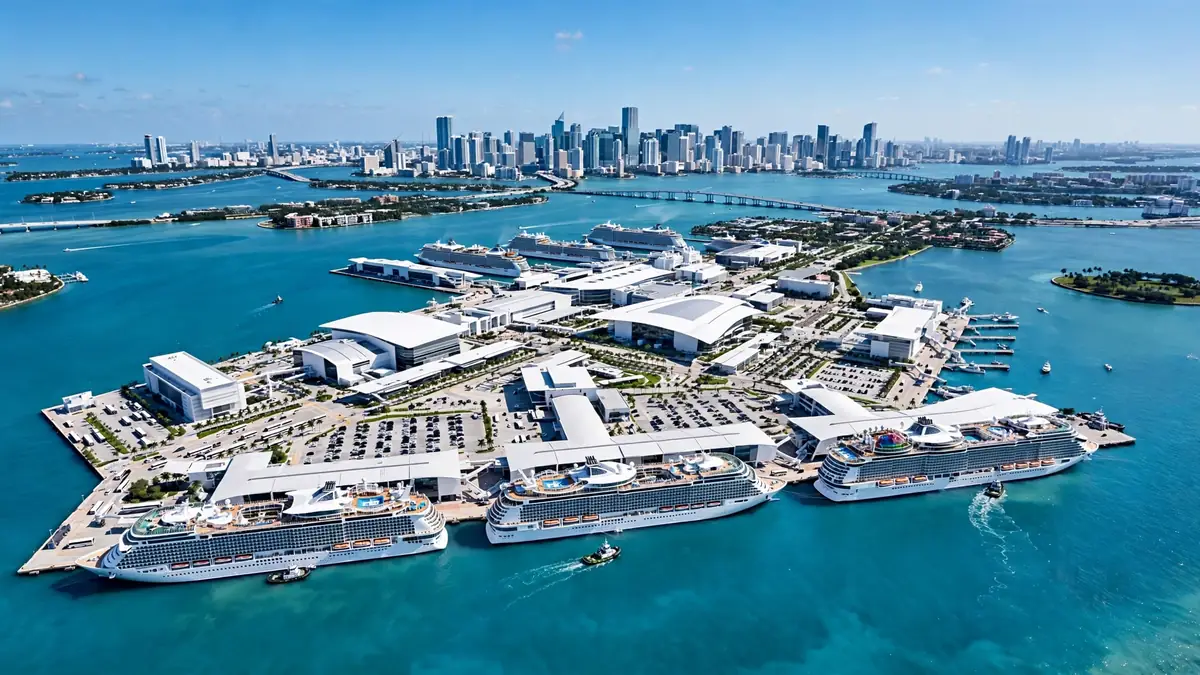
No cruise port in history had ever handled ten million passengers in a single year — until September 14, 2026. On that day, PortMiami counted its ten millionth cruise passenger of fiscal year 2026, smashing its own previous record with more than two weeks of the fiscal year still to run and settling, by a distance, its rivalry with Port Canaveral for the title of the world's busiest cruise port.
The milestone caps a remarkable run for the port that markets itself as the Cruise Capital of the World. The ten-million mark was reached on September 14; the port's fiscal year, which began on October 1, 2025, does not end until September 30, 2026 — giving Miami still more time to push the record higher. Industry observers expect the final figure to land at 10.2 million or above once the last sailings of the year are counted.
The numbers behind the milestone
The scale of the jump is what makes this record genuinely historic rather than merely incremental. PortMiami's previous record, set in fiscal year 2025, was 8,564,225 cruise passenger movements. The port has already added at least 1,435,775 passenger movements on top of that figure — growth of nearly 17 percent. That is more than four times the roughly 4 percent increase recorded from fiscal year 2024 to 2025, when the port handled 8,233,056 passengers.
For scale, ten million passenger movements through a single cruise terminal complex exceeds the annual throughput of most mid-sized international airports. On a rare ten-ship day, the port can move more than 75,000 passengers off and onto ships within a single 12-hour window — a logistical operation closer to running a small city than a harbor.
Port Director and CEO Jonathan Daniels credited the team behind the operation: "I'm immensely proud of our team and cruise and port partners, whose collaborative efforts made this achievement possible," he said. "Reaching 10 million passengers reflects our focus on innovation, efficiency and superior passenger experience, as we continue to modernize PortMiami's infrastructure and expand our capacity for future growth."
Settling the rivalry with Port Canaveral
The record also ends a genuinely close contest. In 2025, PortMiami was the world's second-busiest cruise port, edged out by Port Canaveral up the Florida coast, which handled 8,602,047 passengers — a margin of just 37,822 cruisers, essentially a rounding error on fleets of this size. Miami has now reclaimed the crown by a distance that no single season is likely to close.
Both ports have been expanding terminal capacity aggressively, and both benefit from the same underlying trend: the major cruise lines keep ordering larger ships and homeporting them in Florida. Port Canaveral is projected to welcome around 9 million passengers in fiscal year 2026 — a strong figure that would have won most years, but not this one.
Why Miami scaled so fast
The structural story behind the number is about ship size and terminal design. Cruise capacity growth over the past three years has come disproportionately from very large vessels, and very large vessels need terminals that can turn around six or seven thousand passengers in a single morning. Miami has built several of them, each effectively dedicated to a single cruise line.
The result is a port that functions less like a shared facility and more like a row of private airline terminals — which is why throughput has scaled faster than the physical footprint would suggest. The port credits its modern infrastructure, including recently completed terminals designed to accommodate the world's largest cruise ships, as a key factor: the facilities are built to improve passenger flow and streamline embarkation and debarkation.
The ships tell the story. PortMiami has welcomed some of the industry's biggest vessels, including Royal Caribbean's Icon of the Seas, MSC World America and Carnival Celebration — three ships that alone can accommodate more than 16,000 passengers on a sailing at double occupancy. On September 14 itself, six vessels were in port: Resilient Lady, Norwegian Getaway, Carnival Sunrise, Carnival Conquest, MSC Seaside and Wonder of the Seas.
An economic engine for South Florida
The passenger record translates directly into economic weight. PortMiami is one of Miami-Dade County's largest economic contributors, adding $61 billion to the local economy each year and supporting more than 340,000 jobs. Every sailing fills hotel rooms the night before departure, restaurant tables, taxis and transfer buses — a multiplier effect that makes cruise throughput one of the most closely watched tourism indicators in Florida.
Miami-Dade County Mayor Daniella Levine Cava framed the milestone in those terms: "Breaking the 10 million passenger threshold is a testament to PortMiami's unwavering dedication to service, sustainability and economic vitality," she said. "This extraordinary milestone underscores our port's role as a global gateway and a driver of job creation, tourism and local business growth."
What it means for cruisers
For travelers, a record-breaking port is good news wrapped in a practical warning. The investment in dedicated terminals and streamlined embarkation means the boarding experience at Miami keeps improving even as volumes climb — but ten million passengers also means peak sailing days are genuinely busy.
A few implications are worth building into your plans. Arrive in Miami the day before your sailing rather than the morning of it: with multiple mega-ships turning around simultaneously, transfer and terminal traffic peaks sharply on embarkation days. Allow generous time for the drive to the port, particularly on weekends when several ships sail within hours of each other. And if you are sensitive to crowds, consider shoulder-season sailings or ships homeporting at less congested ports — the record reflects demand, and demand is exactly what fills the pool deck.
The broader signal is that cruising's post-pandemic boom is not tapering. When the world's biggest cruise port grows its throughput by nearly 17 percent in a single year, it is telling you something about where leisure travel demand sits in 2026: firmly, and apparently durably, at sea.
Sources