A buried secret on the far side
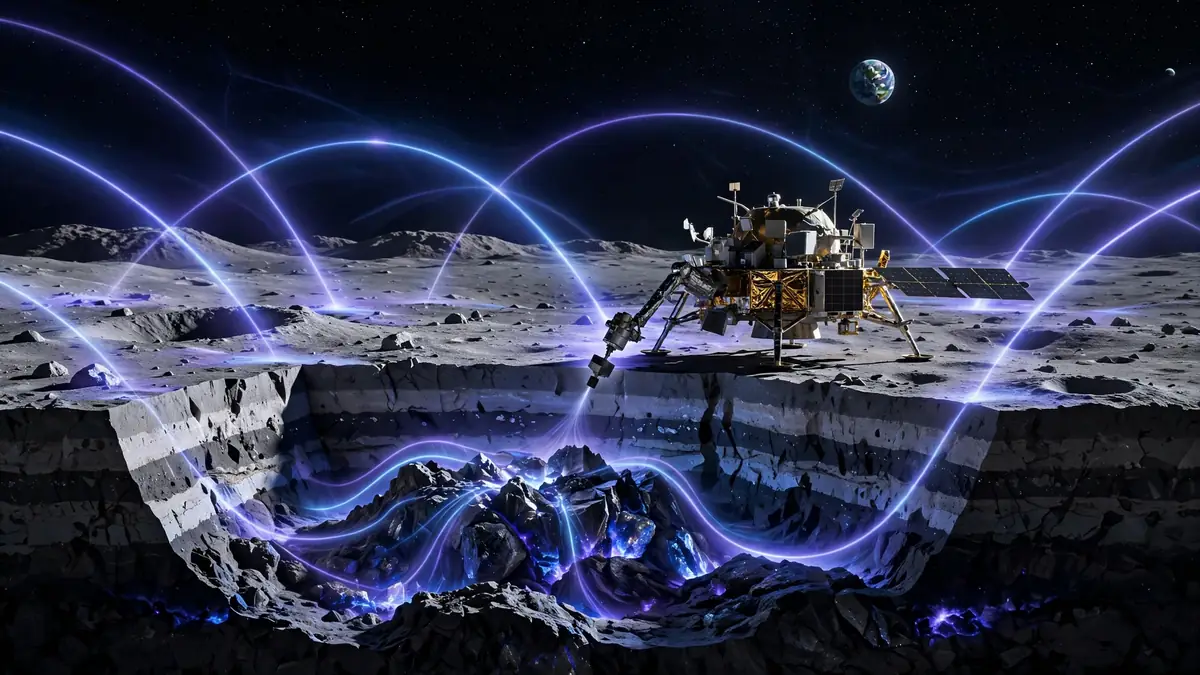
Buried kilometers beneath the Moon's far side, a team of researchers has found something that should not easily be there: a rock formation far denser and far more strongly magnetized than anything around it. The subterranean feature, measuring about 60 kilometers across and roughly 9 kilometers deep, may be an ancient volcanic complex that became magnetized nearly 4.2 billion years ago, when molten rock rose from the Moon's interior and solidified before ever reaching the surface.
The finding, published September 23 in the journal Science Advances, comes from an analysis of data gathered by lunar probes. The researchers concluded that the rock body's characteristics point to a time when the Moon possessed a magnetic field of its own — likely between one-fifth and one-third as strong as Earth's magnetic field is today.
That alone would be a notable result. But it arrived in the same week as a second, entirely independent line of evidence. On September 28, a separate team reported in the Proceedings of the National Academy of Sciences (PNAS) that samples returned by China's Chang'e-6 mission — the first to bring material back from the Moon's far side — contain a previously unrecognized kind of "magnetic fossil": nanoparticles of a rare form of iron that appear to have preserved a record of ancient magnetism for billions of years.
Together, the two studies are sharpening one of planetary science's longest-running puzzles: how a small, now-dead world once generated a magnetic field, and what its silence tells us about the inner lives of planets.
Why a magnetic field matters so much
To appreciate the puzzle, it helps to understand what a magnetic field does for a planet. Life on Earth as we know it would likely be impossible without ours. The field generates the magnetosphere, a vast protective region surrounding the planet that deflects the solar wind — the stream of charged particles constantly flowing from the Sun — along with cosmic rays and harmful radiation. Without that shield, the solar wind would gradually strip away the atmosphere.
Earth's field is generated deep underground, in a process called the dynamo effect. Molten iron and nickel churn in the planet's outer core, and that motion of electrically conductive fluid generates electric currents, which in turn sustain the magnetic field. It is, in mechanical principle, similar to a bicycle dynamo, where a spinning wheel turns magnets inside a generator to produce current for the bike's lights.
The Moon may once have had its own core-powered dynamo. But that activity ceased long ago. According to NASA, about 3.2 billion years ago, as the Moon's interior cooled, its magnetic field weakened dramatically. Without strong protection, solar radiation tore at what little atmosphere the Moon had. Today the Moon has essentially no global magnetic field — which is precisely why finding strongly magnetized ancient rocks on it is so intriguing.
The volcanic complex that time forgot
The Science Advances study approached the mystery from orbit. By analyzing data from lunar probes, the researchers identified a large buried body on the far side whose density and magnetization stood out sharply from the surrounding crust. Their interpretation: an ancient volcanic complex, a place where magma ascended from the deep interior but stalled and froze underground rather than erupting onto the surface.
The timing is what makes it valuable. If the rock became magnetized as it cooled and solidified around 4.2 billion years ago — in the Moon's first few hundred million years of existence — then it captured a snapshot of the lunar magnetic field at an extremely early epoch. The strength implied by the magnetization, between a fifth and a third of Earth's present-day field, suggests the young Moon's dynamo was vigorous, not a feeble afterthought.
That fits with a growing body of evidence that the ancient lunar field was surprisingly strong before it faded. But it also deepens the central question: what powered a dynamo in a body as small as the Moon, and why did it shut down so completely? A planet the Moon's size should have cooled quickly, making a long-lived, Earth-like core dynamo difficult to sustain. Alternative proposals have invoked everything from giant impacts stirring the interior to crystallization of the core. Each new measurement of the ancient field's strength and timing narrows the field of possible explanations.
A magnetic fossil in Chang'e-6 samples
While the orbital study looked at the Moon from above, the PNAS study examined it at the nanoscale. The team, led by Pengfei Liu, analyzed samples collected by Chang'e-6, the Chinese mission that in 2024 achieved the first sample return from the Moon's far side, touching down in the ancient South Pole-Aitken basin.
What they found was a form of iron — gamma-iron, or γ-Fe — existing as tiny nanoparticles with an extraordinary property. Using a technique called off-axis electron holography, which can map magnetic fields at the nanometer scale, the researchers examined the magnetic structure of individual particles. They discovered that relatively large γ-Fe particles had settled into a stable single-vortex magnetic state: the magnetization curls around in a tiny whirlpool that is remarkably resistant to disturbance. Even when exposed to an external magnetic field, the particles maintained a stable magnetic response.
That stability is what makes γ-Fe a potential "magnetic fossil." A mineral that holds its magnetization faithfully across billions of years can serve as a recorder, preserving information about the magnetic environment in which it formed — much like ancient magnetic minerals on Earth allow geologists to reconstruct the history of our planet's field.
The researchers also worked out why this delicate form of iron survived at all. They suggest that trace amounts of carbon and other elements, the rapid cooling of impact-generated melts, and the surrounding glassy matrix of the lunar soil all helped preserve the γ-Fe structure. It is a fragile phase that would not ordinarily be expected to endure, yet the violence of lunar impacts — melting, quenching, and flash-freezing material in glass — created exactly the conditions to lock it in.
The discovery expands the known inventory of magnetic minerals in lunar samples. The researchers note that γ-Fe and the more familiar α-Fe form under different conditions and have different magnetic properties, which means they may preserve information from different stages of lunar impacts. Two recorders, two chapters of the same history.
Two clues, one mystery
What makes this particular week in lunar science so satisfying is the complementarity of the two results. The orbital study provides the big picture: a large, deeply buried structure recording the field's strength billions of years ago. The sample study provides the fine print: a nanoscale mineral that could let scientists read the magnetic history written into the Moon's rocks with unprecedented fidelity.
Both point in the same direction — toward a young Moon with a real, substantial magnetic field, generated by an interior that was once far more dynamic than the cold, quiet world we see today. And both raise the same follow-up questions. How long did the lunar dynamo last? Was it continuous or episodic? Did giant impacts help power it, or eventually kill it? And what does the Moon's magnetic rise and fall imply for other small bodies in the solar system — for Mercury, which still has a weak field, or for Mars, whose global field died billions of years ago?
The researchers behind the PNAS study say future work will help clarify how minerals like γ-Fe contribute to our understanding of ancient lunar magnetism. With Chang'e-6 samples now in laboratories and more far-side material potentially on the way from future missions, the Moon's magnetic past is becoming one of the most precisely readable chapters in planetary history — written in iron, buried in rock, and only now being deciphered.
Sources