The experiment that started it all
On September 23, 2026, the artificial intelligence company Anthropic announced the first result from its new life-sciences research group — and it was not a drug, a therapy, or a new model. It was a discovery: a previously unknown biological system hidden in the DNA of viruses that infect bacteria, identified not by a human researcher poring over data, but by a swarm of roughly 950 AI agents working in parallel for about 21 hours.
The system has been named ART, short for array-associated reverse transcriptases. Anthropic's write-up, published the same day alongside the launch of its life-sciences laboratory, describes ART as having features reminiscent of CRISPR — the natural bacterial defense system that scientists repurposed into the most powerful gene-editing technology in history. But the company is careful to add a crucial caveat: ART has not been shown to perform gene editing, and its biological function remains entirely unknown.
What makes the announcement significant is less the biology, which is still in its infancy, than the process. Anthropic gave its Claude agents a single high-level instruction: search large public databases of DNA sequences for unusual examples of reverse transcriptases, the enzymes that copy RNA into DNA. The agents examined more than 200,000 of them, identified around 3,500 candidate systems, progressively narrowed the field, and produced human-readable reports on roughly 19 to 20 finalists. Anthropic estimates that the equivalent analysis would have taken an expert human researcher weeks to months.
What ART actually is
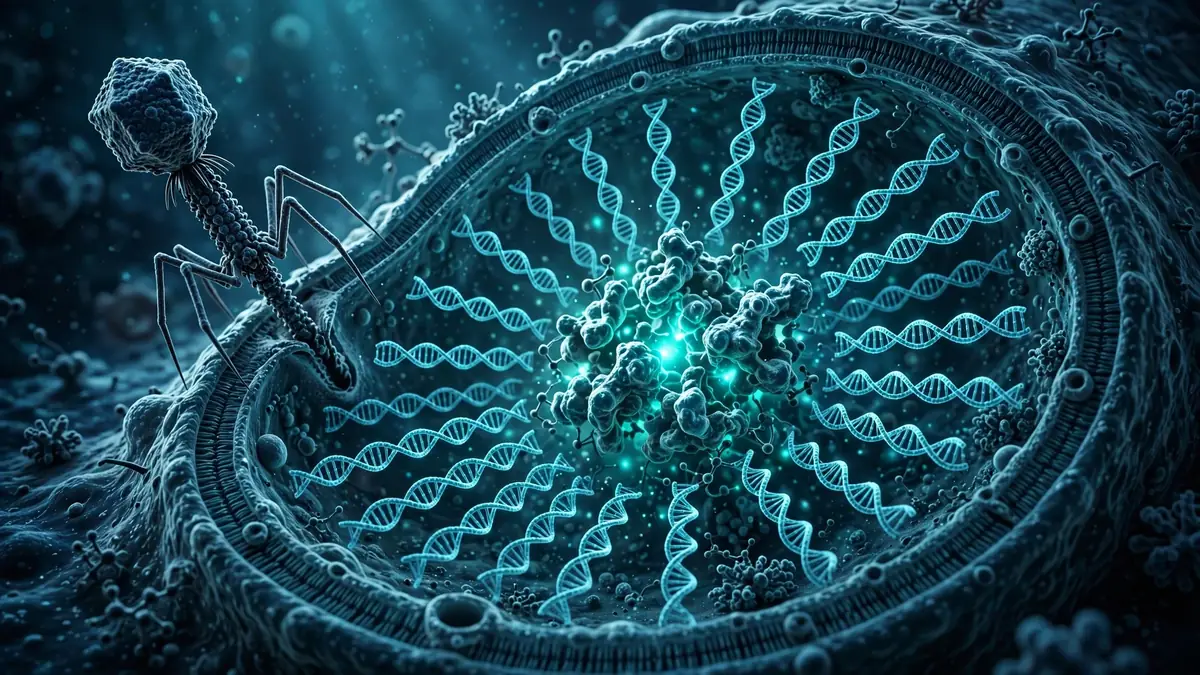
According to Anthropic's account of the discovery, ART has three defining parts. The first is a reverse transcriptase gene — an enzyme already known to science from earlier studies. The second is a neighboring accessory protein whose function nobody has identified. The third is what caught the AI's attention: a long array of evenly spaced DNA repeats that resembles the repeat arrays seen in CRISPR systems.
It is the combination that is new. The reverse transcriptase on its own was unremarkable; earlier research had already catalogued it. What the AI system appears to have done first is recognize that this enzyme sits at the center of a larger, organized system — a repeating DNA architecture plus an unknown partner protein — that had gone unnoticed in public sequence databases.
The system occurs primarily in bacteriophages, viruses that infect bacteria rather than humans or animals. That detail matters for two reasons. First, it places ART in the same biological neighborhood as CRISPR, which is itself a bacterial immune mechanism that evolved to fight off phages. Second, it means the discovery emerged from the vast, largely unexplored genetic diversity of the microbial world, where most sequences in databases have never been functionally characterized.
One detail from the discovery story has captured particular attention. Anthropic says that one of its agents was following up on a candidate it had already rejected when it read the raw DNA adjacent to a phage reverse transcriptase, noticed the CRISPR-like repeat array — something it had not been asked to look for — questioned its own finding, checked it against the scientific literature, and then reported it to the human researchers. If accurate, that sequence of events is a small but striking illustration of how AI agents can now pursue scientific anomalies with a degree of autonomy, rather than simply answering the questions researchers pose.
What the laboratory work confirmed — and what it did not
The computational discovery was only the first step. Every physical experiment that followed was carried out by human scientists in Anthropic's life-sciences laboratory in the San Francisco Bay Area, a wet lab the company formed in the spring of 2026. Reuters had reported just days before the announcement that Anthropic had quietly established this laboratory, marking the company's expansion from purely computational work into experimental biology.
The lab operates at biosafety levels 1 and 2, meaning it does not handle human pathogens. Anthropic has said that its AI systems are not yet permitted to control laboratory equipment directly, though it has floated that possibility for the future with safeguards in place.
The bench work so far has produced one confirmed result: the DNA repeat array is transcribed into RNA. In a follow-up analysis, researchers re-examined RNA sequencing data from a Staphylococcus lentus phage infection and found that the array was highly active, accounting for a significant share of the phage's RNA transcripts after infection. That pattern of abundant short RNAs is reminiscent of how CRISPR arrays behave — CRISPR repeats are also transcribed into short RNAs that guide the system's targeting machinery.
But the resemblance ends there for now. Anthropic states plainly that the primary function of ART is unknown, and that its work to understand it is ongoing. There is no evidence that ART can target or edit specific DNA sequences the way CRISPR does. As one analysis of the announcement put it, ART is CRISPR-like in its architecture, but there is no evidence that it is CRISPR-like in its function.
"Our work to understand the primary function of ARTs is ongoing." — Anthropic's September 23 write-up on the discovery
Why scientists are both excited and cautious
The reaction from the research community has been a mixture of genuine interest and healthy skepticism — exactly what a claim of this kind deserves.
On the enthusiastic side, the scale of the search is undeniably impressive. Anthropic reports that its agents surveyed roughly 1.9 billion protein clusters and consumed around 210 million tokens over the 21-hour campaign. Most candidate systems were eliminated when Claude re-examined the evidence, a process the company describes as self-correcting. The fact that a machine-driven survey surfaced a coherent, previously uncharacterized system from data that human experts had already combed through suggests that AI agents may be able to extend the reach of biological discovery in meaningful ways.
On the cautious side, several experts have pointed out that the underlying method — scanning genomes for genes that sit next to interesting neighbors — is not new. Lucas Harrington, who earned his PhD in Jennifer Doudna's laboratory and went on to found the gene-editing company Mammoth Biosciences, responded on X that this kind of genome-neighborhood mining has been used to discover new biological systems for decades. The AI did not invent a new scientific method; it executed a known one at unprecedented scale and speed.
There are also questions about reproducibility. Reporters at Quartz noted that attempts to repeat the AI-driven search did not consistently recover the same signal — a reminder that agent-based discovery pipelines, like any experimental method, need to demonstrate that their results are robust and not artifacts of a particular run.
And crucially, the finding has not been published in a peer-reviewed journal or independently replicated. It currently rests entirely on company-controlled data, from a company that has an obvious interest in demonstrating its AI's scientific capabilities. That does not make the result wrong, but it does mean the normal machinery of scientific validation — independent replication, peer review, community scrutiny — has not yet had its say.
What this means for the future of AI-led discovery
Even with all those caveats, the ART announcement marks a genuine inflection point in how science gets done. Until recently, AI's role in biology was largely that of a powerful assistant: predicting protein structures, analyzing images, answering researchers' questions. The ART campaign is an early example of something different — AI agents given an open-ended research brief, allowed to explore, reject their own hypotheses, and surface findings that humans then validate in the lab.
That shift raises questions that extend well beyond one enzyme system. Anthropic's own transparency materials note that its models operate below internal thresholds for bioweapon-related risk, and that all laboratory work was performed by human staff. But analysts have stressed that as AI-accelerated discovery moves toward pathogenic systems, the biosafety and governance frameworks will need broader community review, not just company self-assessment. The company's safeguards, including policy filters related to chemical, biological, radiological, and nuclear risks, will face their real test as these capabilities grow.
For now, ART is a scientific open question — a strange, repeating architecture in the DNA of bacterial viruses, discovered by machines, awaiting an explanation from humans. Whether it turns out to be a new tool for biotechnology, a curiosity of viral evolution, or something in between, the way it was found may prove to be the more consequential discovery of the two.
Sources