Disclosure: Meridian has not independently tested the Insta360 X6. This review is an informed analysis based on Insta360's published specifications and reviews from established technology and outdoor outlets — with every source cited at the end.
The 360 camera has always sold a seductive promise: shoot first, frame later. Never miss the moment because you pointed the camera the wrong way. The Insta360 X6, launched worldwide on August 12, 2026, is the most serious attempt yet to make that promise match the image quality of a conventional action camera. With dual 1/1.1-inch sensors — 33 percent larger than its predecessor's — 8K50 360 video, and a claimed 140 minutes of battery life, it is Insta360's flagship by a clear margin. It is also, at $699.99 for the standard bundle, the most expensive small 360 camera on the market. That tension between capability and cost defines everything about it.
Image quality: bigger sensors, better light
The X6's headline upgrade is its imaging hardware. The dual 1/1.1-inch square Sony sensors admit a claimed four times more light than the previous generation, which should translate directly into cleaner low-light footage and better colour fidelity — historically the weakest points of 360 cameras. Maximum 360 video resolution is 8K (7680 x 3840) at up to 50fps, with 120MP 360 photos, 10-bit colour, I-Log and the first native in-camera Dolby Vision in the category. A dedicated PureVideo mode targets low-light shooting, and the f/2.0 aperture lenses gather as much light as the compact form factor allows.
For creators, the single-lens mode matters almost as much: 5K at 60fps or 4K at 120fps turns the X6 into a capable conventional action camera, while 4K240 bullet-time enables dramatic slow-motion effects. The 2.32-inch OLED touchscreen is larger and brighter than before. Published reviewers have been enthusiastic about the image quality step forward — TechRadar's reviews recap named the X6 among its five-star products of the season, with its tester calling it "the most capable small 360 camera [he's] tested to date" and "the finest all-round performer in its class." That is about as strong an endorsement as the category gets.
The editing advantage: AI Director and InstaFrame 2.0
Hardware is only half the 360 story; the other half is the hours of reframing footage afterwards. Insta360's answer is software. AI Director and Auto Edit 2.0 can automatically select angles and cut raw 360 footage into polished flat videos, while InstaFrame 2.0 creates ready-to-share flat videos at capture time while preserving the 360 source for later reframing. In practice, this addresses the single biggest reason 360 footage goes unedited: the time cost. Reviewers have noted the AI editing occasionally makes odd choices on long shots — a matter of taste that manual reframing still solves — but as a starting point it is a genuine differentiator that rivals have yet to match.
Design, durability and battery
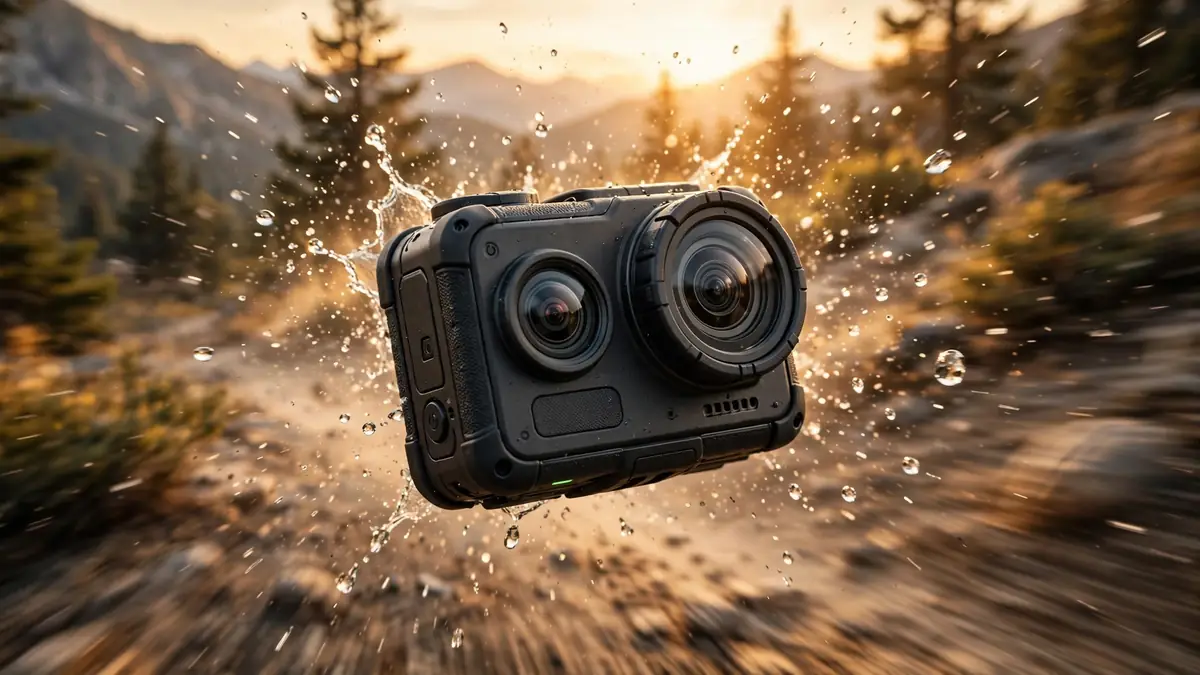
The X6 is smaller than its predecessor at 50 x 100 x 40mm and 196 grams — addressing the "unicorn horn" helmet-mount complaint levelled at older tall-and-skinny models — and it is now only slightly larger than competing action cameras. Durability is a strong suit: IP68 rating, waterproofing to 20 metres without a case (60 metres with the optional dive case), and replaceable lenses that Insta360 claims are five times more scratch-resistant than the X5's. For a camera designed to be crashed on mountain bikes and dunked in surf, user-replaceable lenses are a genuinely practical feature.
Battery life is rated at up to 140 minutes of 8K30 recording from the 2,600mAh Xtreme battery — a 50 percent improvement over the previous generation — with 80 percent fast charging in a claimed 24 minutes. Storage is 64GB built in (47GB usable) plus microSD expansion, and connectivity covers Wi-Fi 6, Bluetooth 5.3 and USB-C 3.0. The built-in storage is welcome, though 8K footage consumes it quickly; a high-capacity microSD card remains effectively mandatory.
Price and the competition
The standard bundle costs $699.99 / £619 / AU$1,049.99 and includes the camera, a USB-C cable, protective pouch, lens cloth and quick-start guide. The Essentials Bundle at $799.99 / £709 / AU$1,159.99 adds a second battery, a 114cm invisible selfie stick, a rubber lens cap, a fast-charge case and extended warranty — arguably the sensible starting point for serious users.
The price is the X6's biggest vulnerability. It is a significant jump from the X5's $549.99 launch price and puts real distance between the X6 and its rivals: the DJI Osmo 360 launched from £409.99, and the GoPro Max 2 costs $499.99. Digit's comparison with the DJI Osmo 360 II is instructive — the DJI offers 8K60, more internal storage (105GB) and a lower price, while the X6 counters with longer battery life, better waterproofing and superior editing software. TechRadar scored the X6's price proposition at 3.5 out of 5, reflecting exactly this tension.
Considerations and open questions
No review roundup would be complete without the caveats. TechRadar's full review headline flags a steep price and a buggy app — the mobile app experience has been a recurring criticism, with the desktop app reportedly faring better but lacking the AI auto-editing tools. The camera runs hot in use, which can make handheld shooting uncomfortable. And while the sensors are bigger, a 360 camera's image quality still trails a dedicated single-lens action camera at the same resolution — physics favours the simpler optical path.
There is also the question of who actually needs 8K50. Reframed 360 footage viewed on a phone rarely exceeds 4K equivalent detail, so the resolution headroom matters most for creators who crop aggressively or future-proof their footage. For casual users, the X5 or a discounted previous generation may deliver 90 percent of the experience for considerably less money.
Based on published specifications and expert reviews, the Insta360 X6 is the best 360 camera available for creators who will use its strengths: class-leading image quality, genuinely useful AI editing, rugged replaceable-lens design and the longest battery life in the category. The premium is real — $150 more than its predecessor and hundreds more than rivals — and it is only justified if you value best-in-class capture and the software that makes 360 footage actually get edited. For cyclists, skiers and travel creators who shoot constantly, the published verdicts suggest it earns its price. For everyone else, the smart move is to weigh how often you would really reframe footage before paying the flagship premium.
Sources