A recovery, but only in the right places
September's commercial property data tells a story of two office markets. Nationally, the US office vacancy rate stood at 17.8 percent in August — a figure that still reflects the deep scars of remote work. But beneath the headline, a genuine, if uneven, recovery is under way: in Phoenix, vacancy held at 17.2 percent, unchanged from a year earlier and below the national average, with office-using employment posting its strongest annual growth since 2022 and nearly $1 billion in office sales so far this year. In San Francisco, vacancy sits at 25.9 percent; in Seattle, 24.7 percent.
Seyfarth Shaw's Real Estate Market Pulse for September 2026, published September 22, captures the split: "office recovery varies significantly by region and asset class, and opportunities are concentrated in markets with strong long-term demand drivers and infrastructure capacity." AI investment is boosting demand in technology-focused markets — Boston and San Francisco are seeing technology investment support office activity alongside data centres and multifamily. Texas remains a standout, fuelled by population growth and corporate relocations. But there are localised headwinds everywhere: softer office conditions in New York and Chicago, and federal workforce reductions weighing on office and multifamily demand in Washington, DC.
The era of treating "the office market" as a single national asset is over. The question for 2026 is no longer whether offices come back, but which offices, in which cities, and for which tenants.
The strategic imperative: repurpose, don't just hold
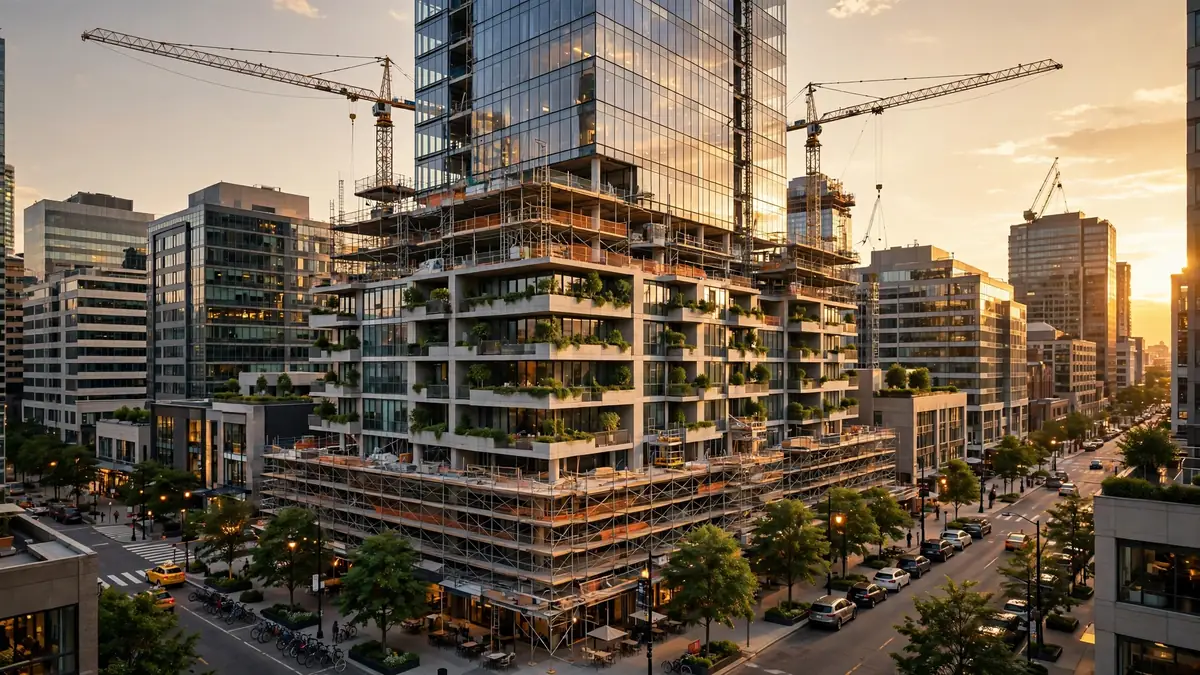
For the large stock of obsolete buildings, the industry's answer has crystallised into what one widely shared market briefing this month called a strategic imperative: adaptive reuse. Global property investors are pivoting from new development to converting obsolete office and retail space into life sciences laboratories, hotels and mixed-use residential hubs.
The economics explain why. With construction costs elevated and traditional office demand soft in many markets, ground-up development is hard to underwrite — but well-located older buildings, bought at a discount, can be repositioned for uses where demand is real. The market, in the briefing's phrase, "is ruthlessly rewarding operational discipline and punishing passive holding strategies." Landlords who simply wait for the old market to return are being left behind; those who convert, upgrade and reposition are capturing the premium.
Energy efficiency has become part of that premium. Updated investment models demand a tactical approach to securing premium, energy-efficient assets — tenants and investors alike are paying up for buildings with lower operating costs and stronger sustainability credentials, while inefficient stock trades at a discount.
Phoenix is emerging as one of the more resilient major office markets in the West, according to CommercialCafe's latest national office report using Yardi Research data. At 17.2 percent, the city's August vacancy rate beat the national 17.8 percent and stood out in a region where most major markets tracked at 20 percent or higher. Only Los Angeles, at 14.5 percent, posted a lower vacancy rate among Western markets analysed.
Affordability is Phoenix's edge. Average full-service equivalent asking rates reached $29.78 per square foot in August — up 1.7 percent year over year, but still well below the national average of $33.20. Portland, Phoenix and Denver were the only major Western markets in the report with asking rates around or below $30 per square foot. For companies weighing expansion, the arithmetic is attractive: Sun Belt talent pools, lower occupancy costs, and an employment base in office-using sectors growing at its fastest clip since 2022.
The pattern extends beyond Phoenix. Across the Sun Belt — Dallas, Atlanta, Houston — industrial and office fundamentals remain healthy, supported by population growth and corporate migration. The geography of American office demand is being redrawn around affordability and growth, not legacy prestige.
The mixed signals: when vacancy rises and falls at once
Not every market is moving in one direction. In The Woodlands, Texas, September data showed commercial vacancy rising in retail and industrial sectors while office space actually tightened — a split that captures how uneven conditions remain even within a single submarket. Retail vacancy edged upward as smaller storefronts sat empty, though asking rents held mostly steady; industrial availability increased slightly, giving tenants more negotiating room after a long stretch of tight conditions. Office vacancy, by contrast, moved lower, suggesting demand from smaller firms and medical users.
Market watchers caution that a single month does not define a trend. But the divergence illustrates a broader truth of 2026: sector and submarket selection now matters more than broad market calls. Prime logistics real estate, for instance, remains exceptionally tight — under 4 percent vacancy in prime international trade nodes — as supply-chain resilience and nearshoring guarantee long-term tenant demand, even as secondary retail and industrial space softens.
What landlords and investors are doing about it
The playbook emerging from September's data has three pages. First, buy or hold only where the demand drivers are structural: AI and technology investment (Boston, San Francisco), population growth and corporate relocations (Texas, the Sun Belt), or irreplaceable logistics locations near major transport corridors. Second, reposition rather than wait: convert obsolete office and retail into life sciences, hospitality or residential where the local market supports it. Third, sweat the operations: energy efficiency, disciplined capital expenditure and active leasing are the difference between premium pricing and a stranded asset.
Capital is following the same logic. Data centres and industrial remain the dominant targets for new investment, but office is no longer a blanket "avoid." The $1 billion in Phoenix office sales this year shows buyers will pay for the right buildings in the right markets. The losers are generic, ageing towers in softening downtowns with no plan beyond hoping for 2019 to return.
The bottom line for 2026's final quarter
Commercial real estate enters the fourth quarter of 2026 as a stock-picker's market. The national office vacancy rate of 17.8 percent says "crisis"; Phoenix's 17.2 percent and Los Angeles's 14.5 percent say "recovery"; San Francisco's 25.9 percent says "not yet." The investors making money are the ones who stopped asking whether offices work and started asking which ones do — and who are willing to turn the ones that don't into something else entirely. In a market that rewards operational discipline and punishes passive holding, the most valuable skill in real estate this autumn is imagination backed by a spreadsheet.
Sources