What happened
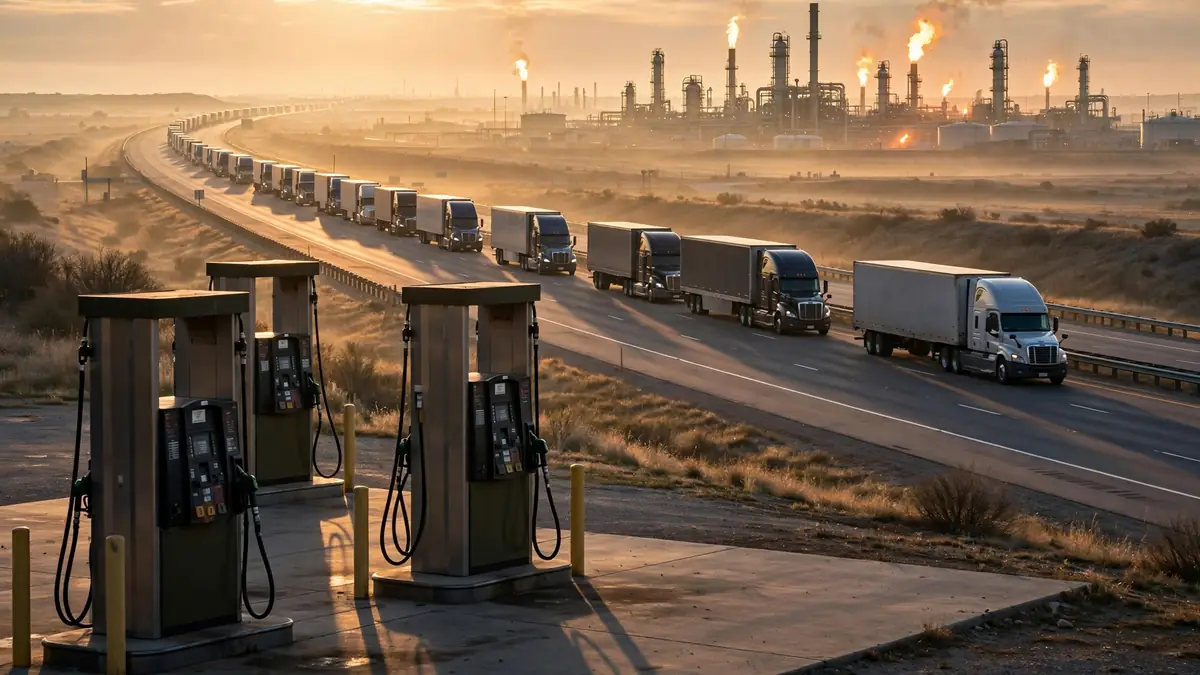
American diesel prices have smashed through a barrier they had never crossed before. The national average retail price for on-highway diesel topped $6.50 a gallon for the first time in history, reaching $6.505 as of September 19, according to the American Automobile Association. The climb has been swift and relentless: prices gained more than 87 cents in September alone, rising almost every day, and moving decisively beyond the previous record of $5.82 a gallon set in June 2022 during the energy crunch that followed Russia's invasion of Ukraine.
Other trackers show the same picture. Seeking Alpha reported the US average at a record $6.529 a gallon, up 88 cents in four weeks and up 74% year over year, with diesel in California approaching $8.25. The US Energy Information Administration recorded a national weekly average of $6.285 for the week ending September 14. GasBuddy reported that the $6 mark was first breached on September 10 — and AAA confirmed it the following day at $6.06. Regional disparities are stark: the West Coast and Northeast sit far above $6, while the Gulf Coast remains lower.
Why it matters — even if you don't drive a truck
Most American drivers put gasoline in their cars, not diesel. But diesel is the fuel that moves virtually everything they buy. Freight trucks, cargo trains, container ships, agricultural machinery, power generators, boats, and home-heating systems all run predominantly on diesel. The fuel powers the freight that moves roughly three-quarters of America's goods.
That is why economists treat diesel differently from gasoline. Diane Swonk, chief economist at KPMG, has noted that the cost of diesel affects everything shipped across the economy. Joseph Brusuelas, chief economist at RSM, has observed that consumers should expect to pay higher prices for goods that require transport. When diesel gets more expensive, trucking companies add fuel surcharges; grocery chains face higher costs on everything from ground beef to fresh produce; farmers pay more to run harvesters and tractors; and the costs compound at each leg of the supply chain until they land on the store shelf.
The timing could hardly be worse for American households. Broader inflation indicators showed prices rising 3.4% in the 12 months to August 2026, with fuel contributing significantly, and real average hourly earnings actually declined 0.3% over the past year — meaning workers are paying more while earning less in inflation-adjusted terms. An earlier measure of economy-wide inflation had already spiked 6.4% annualized in the second quarter. At the current pace of fuel price increases, third-quarter readings will look worse still.
The backstory: wars, refineries, and a global diesel crunch
The surge is not a mystery — it is the direct consequence of a chain of geopolitical shocks landing on an already tight market.
The largest factor is the war involving the United States and Iran, which began in early March and has now stretched into an eighth month. Fighting has restricted flows through the Strait of Hormuz, the waterway through which much of the region's oil moves, and cargoes of crude from the region have not fully recovered to pre-war levels. That has limited how much fuel the world's refineries can produce.
Compounding the squeeze, Russia has banned most exports of diesel and may extend the curb through October, while Ukrainian drone strikes have continued to pound Russian refining capacity. One recent attack on the Moscow Oil Refinery was part of the largest overnight barrage of the year. With winter demand and harvest season typically lifting diesel consumption, the market entered September with little cushion.
There is an additional wrinkle: American refiners are exporting record volumes of diesel to a world that is short of it, and the profit margins on those exports — measured by so-called crack spreads — are at record levels on top of already high crude oil prices. That has prompted a political backlash. Some Republican lawmakers have called for a ban on diesel exports, arguing that American fuel should first ease American prices. The White House has made clear it is considering imposing restrictions on fuel exports — a step that would be dramatic, market-shaking, and legally fraught.
One piece of context is worth keeping in mind: on an inflation-adjusted basis, diesel prices are still below their 2022 highs, according to analysis by the Washington-based think tank the Institute for Progress. The nominal record is real, but it has not yet surpassed the purchasing-power pain of the earlier shock.
What happens next
The near-term outlook depends on forces nobody fully controls. The first is the war. Any progress toward a ceasefire or a reopening of the Strait of Hormuz would take pressure off crude prices quickly — oil markets have swung sharply on every headline about negotiations. Conversely, any escalation, or a Russian decision to extend its export ban, would tighten supplies further.
The second is the export question. If the White House moves to restrict fuel exports, it would redirect supply toward the domestic market and could bring prices down — but it would also squeeze allied countries that depend on American diesel, invite retaliation, and distort refinery economics. Export curbs are a tool of last resort, and markets will treat any announcement as a serious escalation of government intervention.
The third is politics. With midterm elections just weeks away, record diesel prices are a liability for the party in power. In agricultural states like Iowa, where fourth-generation farmer Mark Mueller has warned that elevated fuel and fertilizer costs are endangering farm economics, and in heating-oil-dependent states like Maine, the price of diesel could translate directly into votes. The White House has already floated a series of consumer-relief ideas — tariff-free beef imports, a diesel export ban, even $5,000 checks for Americans — each of which has run into resistance from farmers, oil companies, or budget analysts.
For households, the practical effect is straightforward: expect higher prices on groceries and goods that move by truck, train, or ship for as long as diesel stays elevated. Economists caution that the full effect of a fuel price surge can take weeks or months to show up in store prices — which means the sticker shock many shoppers are already feeling may only be the beginning.
Key takeaways
- US diesel averaged more than $6.50 a gallon in mid-September — a record — with California approaching $8.25.
- Diesel moves about three-quarters of America's freight, so the price shock feeds into groceries, goods, and heating costs even for people who never buy it.
- The causes are the months-long US-Iran war restricting the Strait of Hormuz, Russia's diesel export ban, and Ukrainian strikes on Russian refineries.
- Politicians are debating a diesel export ban; the White House is weighing fuel export restrictions.
- With midterms approaching, fuel prices are now a central political issue in farm and heating-oil states.
Sources