The first green shoots since the credit ended
For a year, the American electric-vehicle market has been a story of subtraction. The $7,500 federal tax credit for EV buyers expired on September 30, 2025, and sales fell hard in the months that followed. But new data released on September 23, 2026, suggests the market may finally be finding its floor — and, notably, the charging network never stopped growing.
The Alliance for Automotive Innovation, the trade group that represents nearly all major automakers in Washington, published its quarterly Get Connected Electric Vehicle Report for the second quarter of 2026. The headline number: EVs represented 7.9 percent of new U.S. light-duty vehicle sales in Q2 2026 — up 1.6 percentage points from the first quarter, and the first sequential gain since the third quarter of 2025.
The rebound is real but partial. Compared with the second quarter of 2025, EV market share was still down 1.6 percentage points, and sales volume declined about 15 percent — roughly 56,200 vehicles — even as total U.S. light-duty sales grew 2 percent. Through the first half of 2026, automakers sold 556,477 EVs, representing 7.1 percent of new-vehicle sales — down 26.8 percent, or about 204,250 vehicles, from the first half of 2025, when the tax credit was still available.
What changed in the second quarter
Several things moved in the EV market's favor at once. Gasoline prices rose steadily through the spring and summer: according to AAA figures reported by USA Today, the national average climbed from $2.98 a gallon on February 28 to $4.49 on September 25, with USA Today linking the rise to the United States and Israel engaging in a war with Iran. Expensive fuel is the oldest and most reliable driver of EV interest, and it appears to have done its work again.
Prices of the cars themselves also moved in buyers' favor. The average transaction price for a new EV fell 4.5 percent year over year in June to $56,238, while manufacturer incentives averaged nearly $7,300 per vehicle — about 13 percent of the transaction price — as automakers discounted to move metal without the federal credit. Choice expanded, too: 161 electric models were available for sale in the U.S. in Q2, up from 154 in the first quarter and nearly back to the 164 on sale at the end of 2025.
The geographic breadth of the rebound is striking. EV market share increased in 47 states plus the District of Columbia compared with the first quarter, and declined in only four states, according to the Alliance's state-by-state analysis. California remained the national leader, with EVs accounting for 21.2 percent of registrations in Q2, followed by Washington at 17.5 percent and Nevada at 15.4 percent. Oregon, Colorado, and the District of Columbia also cleared 10 percent.
The charging network that kept building
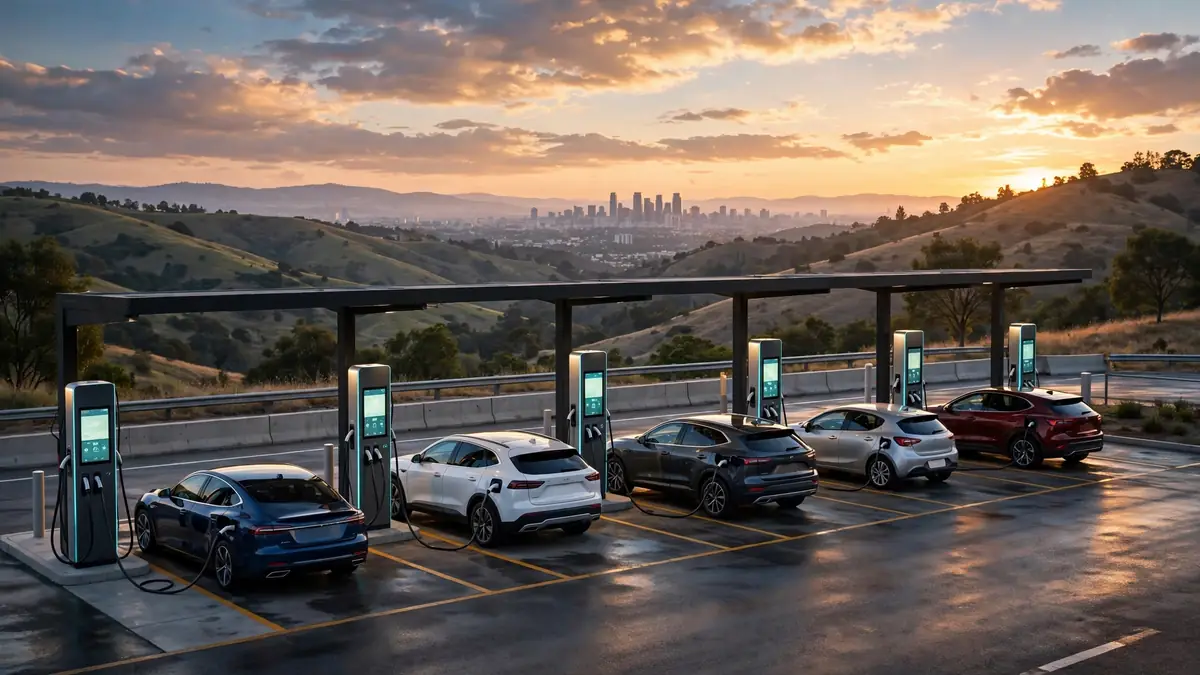
Perhaps the most encouraging data in the report concerns infrastructure. While vehicle sales wobbled, the buildout of public charging continued through the first half of 2026. Public Level 2 chargers — more powerful than most home chargers — increased 3.2 percent over the first quarter. DC fast chargers, the most powerful units, grew 9 percent since the end of 2025. The total number of public charging ports rose 6 percent from the end of last year.
The composition of the network is shifting toward speed. The Alliance reported:
"Public charging infrastructure continued to expand during the first half of 2026. The composition of the charging network also continues to evolve. DC fast charging ports accounted for 29 percent of all public charging ports in Q2 2026, up from 22 percent in 2021, reflecting the growing role of higher-powered fast charging as the network expands." — Alliance for Automotive Innovation, Get Connected Electric Vehicle Report Q2 2026
The state rankings reveal both progress and concentration. California leads by an enormous margin with 10,278 unique public charging locations, followed by New York (4,151), Florida (3,338), Texas (2,856), and Massachusetts (2,420). Colorado, Washington, Georgia, Michigan, and North Carolina round out the top ten. The concentration in coastal and populous states remains the network's biggest weakness — but the direction is unambiguously positive.
The fleet keeps electrifying, slowly
New-car sales get the headlines, but the vehicle fleet turns over slowly — and there the electric transition continues its steady march. The Alliance counted about 7.8 million registered EVs as of June 30, equal to 2.63 percent of the nearly 296 million registered light-duty vehicles on American roads. That share was 2.48 percent at the end of 2025 and 2.54 percent after the first quarter. The number of registered EVs grew by nearly 1.2 million over the past 12 months, even as new EV sales fell after the end of federal purchase incentives.
Notably, the Alliance counts battery-electric, plug-in hybrid, and fuel-cell vehicles in its EV figures — and the hybrid portion of the story is booming. Hybrid market share grew 4.9 percentage points year over year to 22.2 percent, up from 17.3 percent, as buyers who were not ready to go fully electric chose the middle path. Light trucks made up 81 percent of Q2 EV sales, down from a first-quarter record of 86 percent, as passenger-car and van sales grew.
North of the border, the infrastructure story got its own milestone on September 28, when Tesla opened its 3,000th Supercharger stall in Canada — a 24-stall site at Montée Ryan in Mont-Tremblant, Quebec, featuring a special illuminated maple-leaf design, opened ahead of the Thanksgiving holiday weekend on October 12. It is a reminder that the charging buildout is a continental story, not just an American one.
Reading the recovery honestly
How should a prospective EV buyer read these numbers? First, the market is healing but not healed. A 7.9 percent share that is growing quarter over quarter is genuinely good news; a 26.8 percent first-half decline versus last year is a genuine wound. Both are true at once.
Second, the economics of EV ownership in America have fundamentally changed. The $7,500 federal credit is gone, and nothing has replaced it at the national level. What has replaced it, partially, is a combination of lower transaction prices, fatter manufacturer incentives, and higher gasoline prices. That is a more fragile foundation than a federal subsidy — gas prices can fall, and incentives can dry up — but it is also a more honest one. EVs that sell without subsidies are EVs with a durable future.
Third, infrastructure is no longer the constraint it once was. Six percent growth in charging ports in six months, a fast-charging share approaching a third of the network, and marquee milestones like Canada's 3,000th Supercharger all point the same way. Range anxiety has not disappeared, but the data suggests it is increasingly a perception problem rather than an infrastructure problem — at least in the states where most EVs are sold.
The American EV market spent a year learning to walk without its federal crutch. The second quarter of 2026 was its first steady step. Whether it turns into a stride will depend on prices, fuel costs, and the continued buildout of the plugs that make it all work.
Sources