From dead packs to new cars
Eighty dead electric-vehicle batteries went into a recycling plant in Ohio. What came out is now powering brand-new cars on their way to customers. On September 22, 2026, General Motors and Cirba Solutions announced they had completed a closed-loop EV battery recycling pilot — and that the first GM vehicles built with the recycled materials rolled off the production line this month.
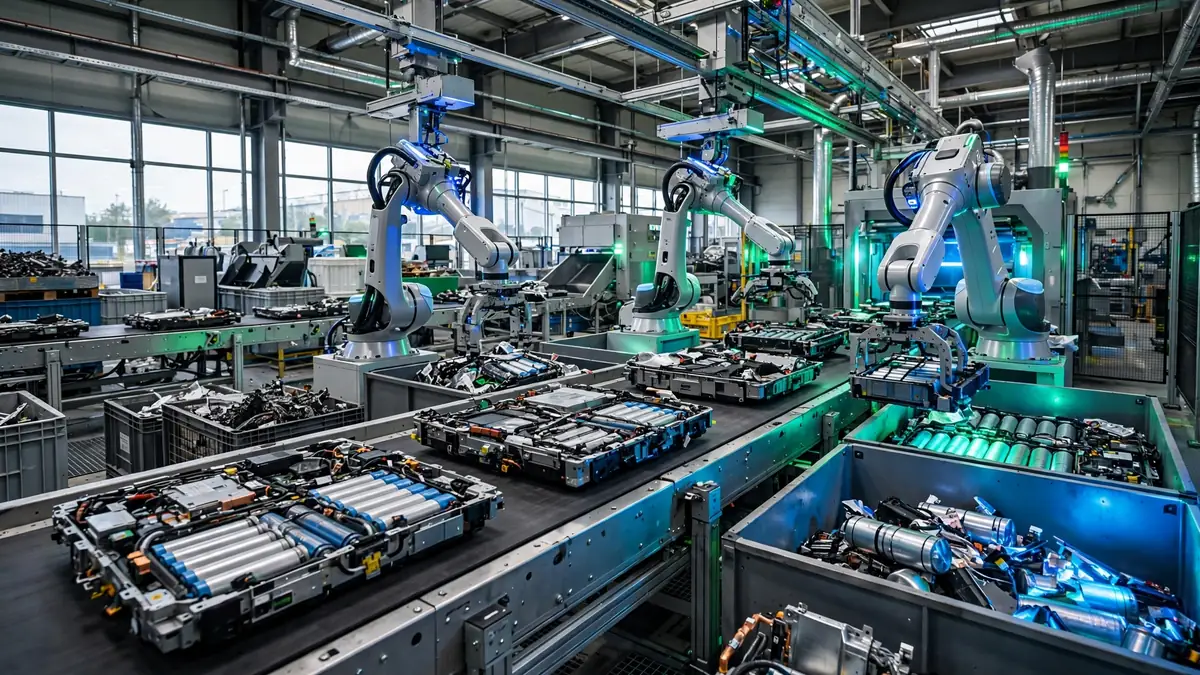
The mechanics of the pilot are straightforward in concept and demanding in execution. End-of-life GM battery packs were sent to Cirba Solutions' lithium-ion recycling and recovery facility in Ohio, where they were disassembled and processed into "black mass" — a concentrated intermediate material rich in critical minerals, produced when lithium-ion batteries are shredded and processed. Through a separate strategic partnership, that black mass was refined into more than 12 metric tons of cathode active material containing 100 percent recycled nickel, cobalt, and manganese.
These are, according to the companies, the first GM EV batteries made with cathode active material containing 100 percent recycled nickel, cobalt, and manganese. Ultium Cells — the joint venture between GM and LG Energy Solution — manufactured new battery cells using the material, and GM assembled the cells into modules and packs at its Factory ZERO plant in Detroit and its Spring Hill facility in Tennessee.
Recycled, but not second-rate
The critical question for any recycling program is whether the recovered material can match virgin material. According to GM, the recycled cathode material went through the same validation process required for new battery materials — testing for quality, safety, and performance — and cells built with it met requirements comparable to cells made from newly mined minerals.
That validation is what elevates the pilot from a sustainability gesture to an industrial proof point. Battery makers have long known how to recycle cells in principle; the hard part has been producing recycled material pure and consistent enough for automotive-grade cells at a cost that makes sense. GM's claim is that this pilot cleared that bar — at least for nickel, cobalt, and manganese.
Melissa Flaherty, GM's Director of Sustainable EV Battery Ecosystem, framed the achievement in a press release from Cirba:
"This pilot shows that the value of an EV battery can extend well beyond its first life — and that strong partnerships across the battery ecosystem are essential to building a more circular, resilient future for battery technology." — Melissa Flaherty, Director of Sustainable EV Battery Ecosystem at GM
Cirba Solutions' president and CEO David Klanecky added that "battery recycling is an important, intersecting component across the battery supply chain, and this program effectively demonstrates the value that recycling end-of-life batteries brings to creating a closed-loop supply of critical minerals."
Which cars got the recycled cells
The recycled materials did not go into a single demonstration vehicle. According to GM, via reporting by WardsAuto, a range of EVs built this month at Factory ZERO and Spring Hill received the recycled-content cells — including variants of the Cadillac Lyriq, Vistiq, and Escalade IQ, as well as the Chevrolet Silverado EV Trail Boss and the GMC Sierra EV AT4. The company confirmed the vehicles are headed to customers, with a GMC Sierra EV appearing in the photographs accompanying the announcement.
That matters. Putting recycled-content cells into customer-bound vehicles — rather than test mules — is the industry's way of saying the material is ready. It is one thing to prove recycling works in a laboratory; it is another to stake vehicle warranties and brand reputations on it.
Reading the fine print
As with any industry announcement, the details deserve scrutiny. The "100 percent recycled" claim applies exclusively to the nickel, cobalt, and manganese in the cathode active material — not to the entire battery, and not to lithium, which is absent from the claim. The partner that performed the crucial step of converting black mass into cathode material was not named in the announcement. And the companies disclosed no vehicle or pack counts, no recovery yields, and no purity specifications.
None of that invalidates the achievement, but it defines its scale: this was a pilot, not a production system. Eighty batteries and 12 metric tons of cathode material are a rounding error against the volumes the industry will need. The question is not whether closed-loop recycling works — this pilot suggests it does — but whether it can scale economically to handle the coming wave of retired EV batteries.
That wave is coming. Industry estimates cited in the announcement suggest close to 14 million EV batteries will reach the end of their working life worldwide by 2040, while annual demand for lithium-ion batteries is forecast to reach between 4.2 and 6.8 terawatt-hours over the coming decade. The raw material to feed a recycling industry will exist. The economics of recovering it are the open question.
Why recycling is a strategic asset
For GM, recycling is about more than sustainability credentials. Nickel, cobalt, and manganese are globally traded commodities with concentrated, geopolitically sensitive supply chains — more than 70 percent of the world's cobalt comes from the Democratic Republic of Congo. Every ton of these metals recovered domestically is a ton GM does not need to buy on volatile world markets or source from jurisdictions with documented labor abuses.
There is also a cost dimension. Current recycling processes can recover up to 95 percent of nickel, cobalt, and manganese, and up to 80 percent of lithium, depending on the chemistry and the process, according to industry reporting. As those recovery rates improve and scale increases, recycled cathode material could become cheaper than mined material — turning what is today a sustainability story into a straightforward cost advantage.
GM is clearly thinking in these terms. Beyond this pilot, the company's battery strategy includes remanufacturing and refurbishment programs designed to reuse more than 70 percent of pack components, and a collaboration with Redwood Materials to deploy roughly 10,000 second-life batteries in energy infrastructure — including a large battery microgrid. The vision is a hierarchy of value: reuse whole packs where possible, remanufacture components where practical, and recycle the rest back into new cells.
What it means for the industry
GM is not alone in pursuing closed-loop battery recycling, but it is among the first major automakers to put recycled-content cells into customer vehicles and say so publicly. The announcement puts competitive pressure on rivals to demonstrate their own circular-economy credentials — and gives regulators, particularly in Europe and California, a concrete example to point to when tightening battery-recycling requirements.
For consumers, the immediate impact is invisible: a Cadillac Lyriq with recycled-content cells drives exactly like one without. The longer-term impact could be significant. If closed-loop recycling scales, it would reduce the auto industry's exposure to critical-mineral price spikes, weaken the link between EV growth and mining expansion, and answer one of the most persistent criticisms of electric cars — that they simply trade tailpipe emissions for mining damage.
Eighty batteries will not change the world. But the first customer cars rolling off the line with recycled hearts just might mark the moment the EV industry started to close its own loop.
Sources