A 17-year journey to the opening day
When the doors of the Lucas Museum of Narrative Art swung open in Los Angeles on September 22, 2026, the crowd that filed into Exposition Park was not simply attending the launch of another cultural building. It was witnessing the end of one of the most protracted and closely watched sagas in modern museum-making — a project first announced in 2010 that wandered through three American cities, survived bitter legal battles and design revisions, and finally landed in South Los Angeles as a sweeping, spaceship-like structure that has already become a landmark of the city's skyline.
The opening day was a deliberately personal affair. Founders George Lucas and Mellody Hobson marked the occasion alongside the building's architect, Ma Yansong of MAD Architects, and the museum's chief executive, Tracey Bates. More than 100 students from the University of Southern California, the Los Angeles Technology Center, Otis College of Art and Design, and Los Angeles City College were surprised with free tickets to join the opening programme, and the founders themselves were on hand to greet the first 100 visitors through the doors. The museum described its first day as sold out, with the galleries, the park, the gardens, and the building itself all open to the public.
The institution's premise is ambitious. It presents itself as the first museum dedicated to the tradition of visual storytelling, tracing its history across cultures and centuries — from prehistoric cave paintings through illustration, comics, and cinema to murals. The opening displays bring together more than 1,300 works drawn from Lucas's private collection of some 30,000 items assembled over five decades, alongside new commissions and institutional holdings.
The building: Ma Yansong's first US cultural project
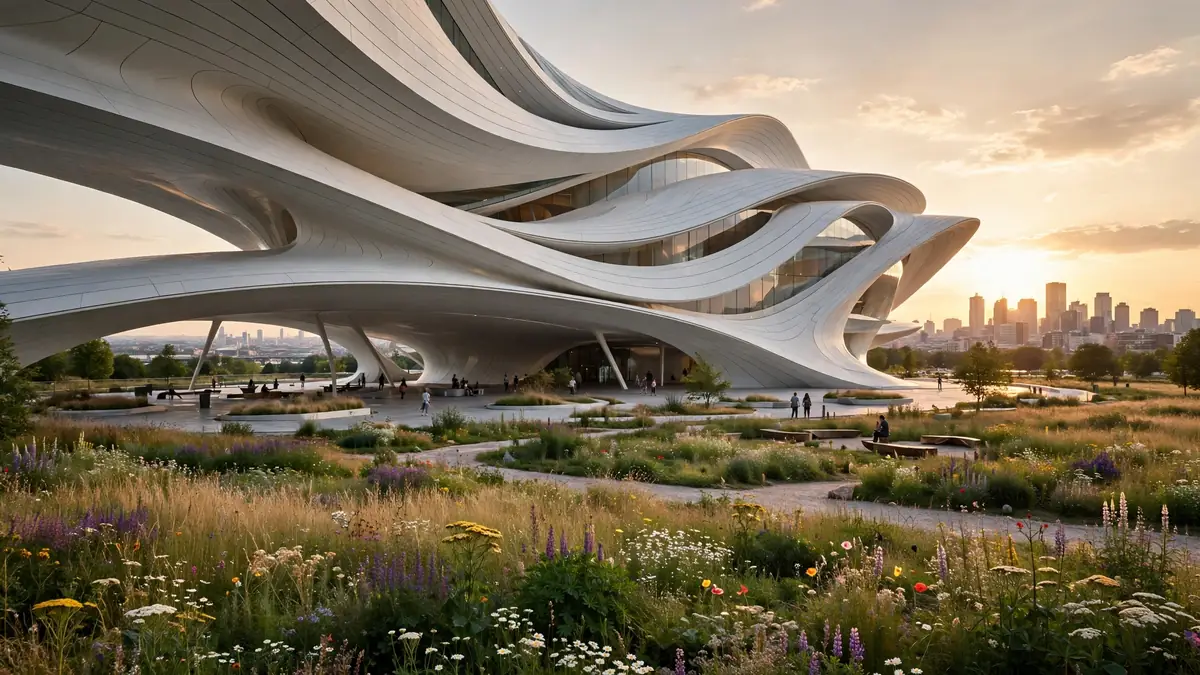
Designed by Ma Yansong of MAD Architects with Stantec as executive architect, the five-storey, 300,000-square-foot building is clad in more than 1,200 unique fibreglass-reinforced polymer panels that give it its fluid, organic silhouette. The form has already drawn comparisons to a spacecraft — an almost unavoidable association given the founder's most famous creation — and the building is reported as MAD's first cultural project in the United States.
Inside, the museum holds more than 100,000 square feet of gallery space across more than 30 galleries. The programme extends well beyond exhibition rooms: two 299-seat theatres run continuous film programming, a free public research library holds more than 30,000 comic books along with some 3,000 art books from Steve and Ann Martin and more than 2,900 volumes from the personal library of mythologist Joseph Campbell, and a full-service restaurant, Skywalker Grill, serves visitors on site.
The building sits on a 13-acre campus in Exposition Park, where landscape architect Mia Lehrer of Studio-MLA designed 11 acres of park and gardens that replace a former asphalt car park with indigenous plantings, a meadow, an amphitheatre, and a waterfall. Ten monumental outdoor sculptures greet visitors before they even cross the threshold. For a corner of South Los Angeles that has long been short of public green space, the landscape is as significant as the architecture — a genuinely public front porch for a privately funded institution.
The collection: far more than film memorabilia
The Star Wars association is inescapable, but the museum has worked hard to make clear that film memorabilia is a minority interest within its walls. Reports put Star Wars holdings at around seven per cent of the total collection. The complete Lucas Archives from 1971 to 2012 are housed at the museum, and a dedicated exhibition titled "Star Wars in Motion" presents concept designs, props, and vehicle builds from the first six films — but the opening displays also include works by Vincent van Gogh, Frida Kahlo, Norman Rockwell, N.C. Wyeth, Diego Rivera, Frank Frazetta, Gordon Parks, Charles Schulz, and Judith F. Baca.
For the comics world, the opening may be the most significant cultural event of the year. The museum has dedicated galleries to comics, manga, and graphic novels — and its research library's 30,000-plus comic books place sequential art on the same institutional footing as painting and sculpture. Contemporary commissions feature too, including a set of new works by Banksy installed on the fifth-floor rooftop. The curatorial argument is that every image, from cave painting to cinema, belongs to humanity's oldest creative language — and the building's opening roster is the institution's attempt to prove it in one visit.
A privately funded giant
The museum is reported to have cost around US$1 billion, funded entirely by Lucas and Hobson with no public money used for construction. California granted the museum a 99-year lease on the Exposition Park site at $30 a year — a symbolic figure that reflects the project's status as a gift to the region. The cost puts it among the most expensive museum projects ever built, and the private-funding model sets it apart from almost every comparable institution: there is no city or state bond debt, no public referendum, and no taxpayer exposure if attendance softens.
That independence cuts both ways. The museum has already endured leadership turnover before its doors opened — founding president Don Bacigalupi stepped down in 2019, director and CEO Sandra Jackson-Dumont departed in 2025, and chief curator Pilar Tompkins Rivas left in December 2025. As of the opening, Tracey Bates serves as CEO. How the institution sustains an audience after the novelty of opening year fades, and how it positions itself against Los Angeles's already crowded museum landscape, will be watched closely by the cultural world.
Why it matters for architecture
For architecture, the Lucas Museum is the most significant museum opening of the decade. It is a rare case of a major American cultural building designed by a Chinese practice at a time when starchitect-driven museum architecture has cooled in favour of more modest, community-oriented buildings. The decision to pair a high-spectacle building with an unusually generous public landscape — and to open it in a historically underserved neighbourhood rather than on the city's wealthy west side — suggests a model for how big-budget cultural architecture might justify itself in the 2020s: spectacle at the top, public space at the ground.
The 17-year gestation also offers a cautionary tale. Projects announced in 2010 in San Francisco and later fought over in Chicago before the Los Angeles move show how fragile major cultural commissions remain — dependent on philanthropic will, political luck, and an architect willing to see a decade-long design process through. That Ma Yansong stayed with the project from concept to completion gives the building a rare continuity. Whether the collection inside can hold its own against the architecture is a question the coming months will answer, one sold-out day at a time.
Sources