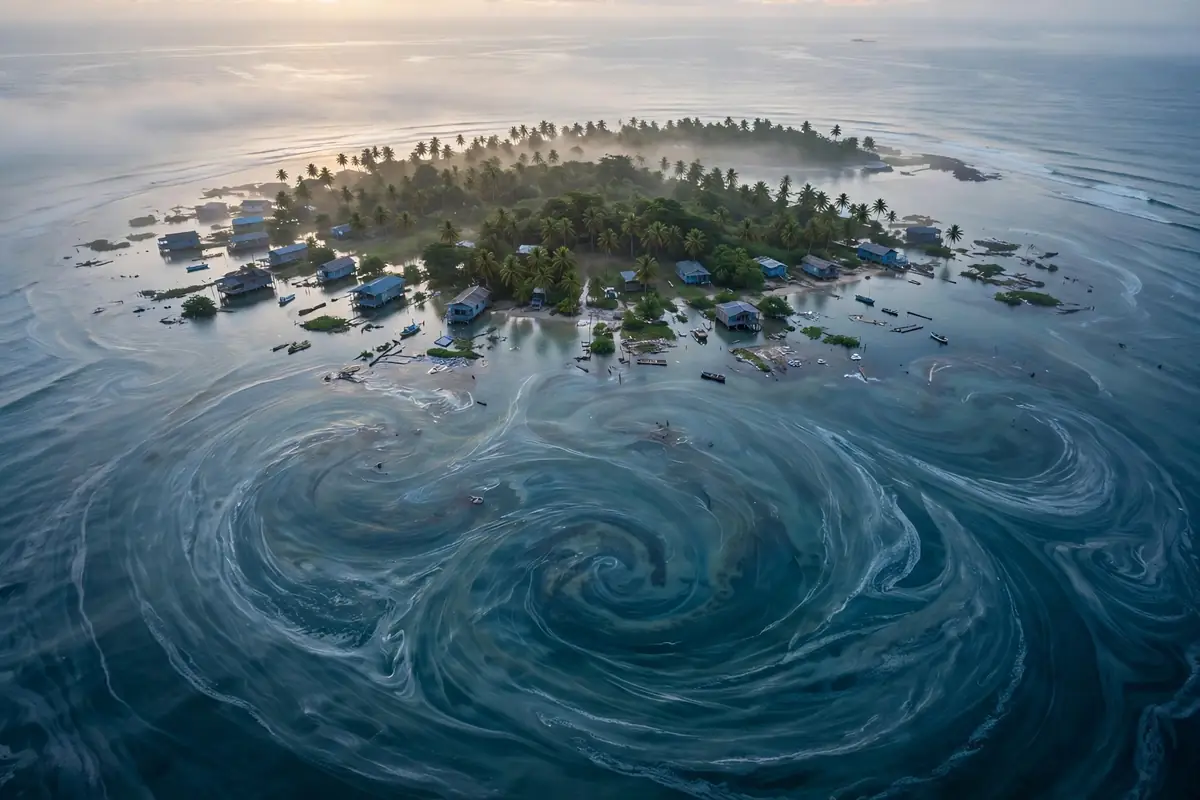
On September 24, 2026, during a high-level plenary meeting in New York, the United Nations General Assembly adopted the UN Declaration on Sea Level Rise — the first global declaration of its kind to confront one of the most irreversible challenges of this century. For the nearly 770 million people who live less than five meters above the high-tide line, the declaration is more than diplomatic language: it is the closest thing the international system has yet offered to a survival plan for coastal nations.
The declaration arrived in the middle of the 81st session of the General Assembly, which opened on September 8 under the theme Restoring Trust, Managing Transformation: A United Nations That Delivers for All. With the session's president, Khalilur Rahman of Bangladesh, the declaration's adoption signaled that climate adaptation — not just climate mitigation — now sits at the center of the UN's agenda.
What the declaration actually says
The declaration calls for stronger international cooperation, data sharing, disaster risk reduction, and long-term adaptation in the face of rising seas. It urges countries to improve early warning systems, invest in comprehensive risk assessments, and plan for the long-term resilience of vulnerable coastal populations using the best available science.
Its most consequential provisions, however, are legal rather than environmental. The declaration affirms that maritime zones established under the United Nations Convention on the Law of the Sea (UNCLOS) remain legally stable despite physical shifts in coastlines caused by sea-level rise. In plain terms: a country's exclusive economic zone and territorial waters do not shrink simply because its beaches are disappearing.
It goes further still, addressing the existential question that has haunted low-lying island nations for decades — whether a state continues to exist, and retains its UN membership, if its territory is submerged. The declaration supports the continuity of statehood for nations facing submersion risks, a clarification long sought by small island developing states such as Palau and others across the Pacific.
A legal lifeline for sinking states
For years, Pacific island nations have warned that the loss of physical territory could trigger a cascade of legal catastrophes: the loss of fishing rights, the loss of seabed resources, and ultimately the loss of statehood itself. The declaration does not erase those risks, but it provides a collectively endorsed legal interpretation that pushes back against them.
The foundation for this position was laid by the UN International Law Commission, whose study on sea-level rise and international law ran from 2019 to 2025. The commission examined the legal implications of rising seas across three areas: the law of the sea, the continuity of statehood, and the protection of affected persons. The declaration builds directly on that six-year body of work, converting technical legal analysis into political commitment.
Whether the declaration changes behavior on the ground will depend on how aggressively states and international institutions translate it into funding and planning. Declarations are not treaties; they do not bind governments in the way that conventions do. But in international law, repeated collective statements of this kind shape how courts, tribunals, and future negotiators interpret existing obligations — including under UNCLOS itself.
The numbers behind the urgency
According to the World Meteorological Organization, around 770 million people — nearly one-tenth of humanity — live less than five meters above the high-tide line. That figure captures the human scale of the crisis in a single number: megacities, delta farming regions, island communities, and port cities all sit inside the risk zone.
The declaration frames the risks as extending well beyond flooded shorelines. UN Secretary-General António Guterres has emphasized that sea-level rise threatens not only the environment but also economies, trade routes, infrastructure, and food systems. Coastal flooding and saltwater intrusion already damage farmland and freshwater supplies in vulnerable regions; as seas continue to rise, entire economic models built around coastlines will need rethinking.
What makes the crisis particularly unforgiving is its irreversibility. Even if global emissions were stabilized tomorrow, the oceans would keep rising for centuries as heat already trapped in the climate system continues to expand seawater and melt ice sheets. Adaptation, in other words, is not a complement to emissions cuts — it is a necessity regardless of how quickly the world decarbonizes.
How the world got here
The declaration did not emerge from nowhere. Small island developing states have raised the alarm at every major climate summit for more than three decades. The Alliance of Small Island States has been a persistent voice in the General Assembly, and Pacific leaders have repeatedly warned that their nations face an existential threat no adaptation budget can fully neutralize.
The International Law Commission's work gave those warnings a rigorous legal backbone. By systematically examining how existing international law applies to a world in which coastlines move inland, the commission offered states a shared vocabulary — and shared answers — to questions that once had none. The 2026 declaration is the political ratification of that analytical work.
The 81st session's opening provided the moment. The Assembly's president, Khalilur Rahman, has made restoring public trust in the institution a defining goal of his tenure:
"We must make the United Nations fit for the future. We have a situation where trust is in deficit. This is not 1945. This is the 81st session. The world has moved on. The Organization must move on, and I'll help that process." — Khalilur Rahman, President of the UN General Assembly's 81st session, September 8, 2026
The sea-level declaration offers an early test of whether that promise translates into substance.
What happens next
Declarations set direction; they do not build seawalls. The practical questions now are familiar ones: who pays for adaptation, how quickly funds reach vulnerable communities, and whether early warning systems and risk assessments actually get built where they are needed most.
The declaration's calls for enhanced data availability and comprehensive risk assessments point to a real gap. Many of the countries most at risk have the least reliable elevation data and the fewest resources for long-term planning. Closing that gap — through satellite mapping, shared databases, and technical assistance — is one of the least expensive and most consequential steps the international community can take.
There is also the harder question of displacement. If some low-lying communities ultimately cannot remain where they are, the declaration's protection framework for affected persons will be tested. The legal study underpinning the declaration explicitly examined the protection of persons affected by sea-level rise, recognizing that climate displacement is not a hypothetical future — it is already happening.
For coastal residents from Bangladesh to the Netherlands, from Miami to Manila, the declaration is a milestone, not a finish line. It puts the full weight of the General Assembly behind a simple proposition: the seas may rise, but the rights of the people living beside them do not disappear with the tide.
Sources