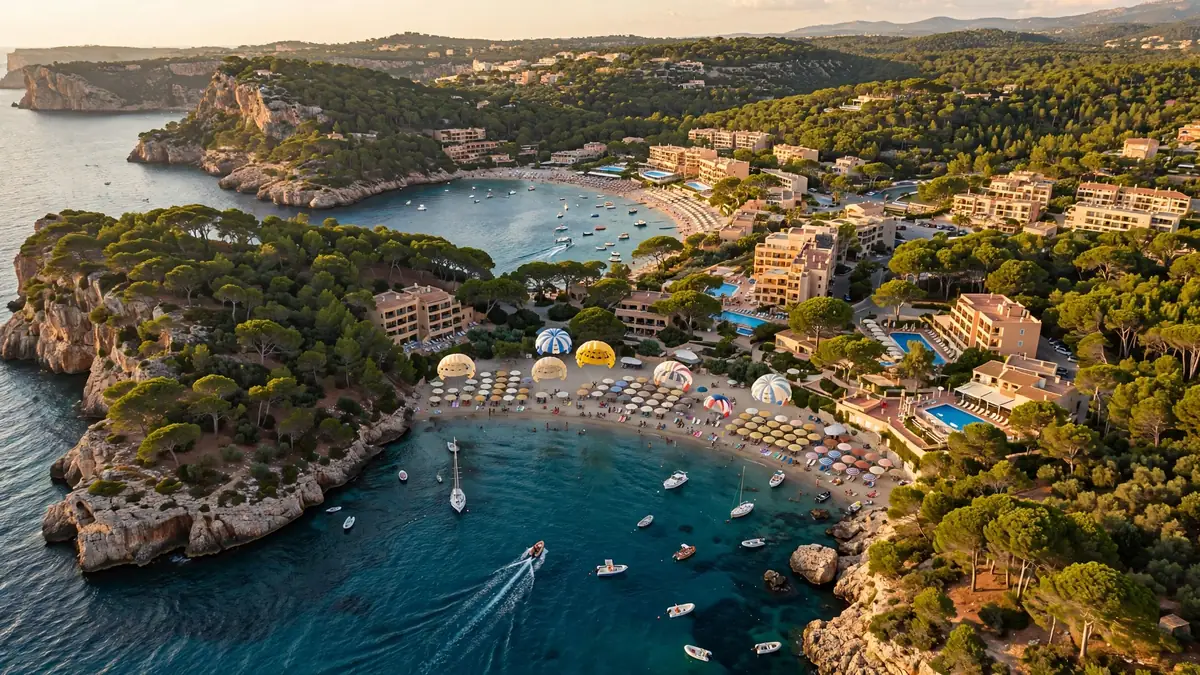
Spain has closed out a record summer for its hotel industry. The country's National Statistics Institute recorded 48.8 million hotel overnight stays in August 2026, up 1.4 percent year on year, with international visitor nights rising 2.8 percent. Hotel prices climbed 6.3 percent and average revenue per occupied room reached €166.90, up 7.3 percent. And the pressure is not easing with the season: forward hotel bookings across Europe for September 2026 are running ahead of last year's pace.
The figures, reported in late September, confirm what anyone who tried to book a room in Mallorca or Barcelona this summer already suspected: peak-season travelers were competing for beds in exactly the regions that already carry Europe's heaviest tourism volumes — and paying more for the privilege.
48.8 million nights: where the demand landed
Spain's August numbers show demand clustering tightly around familiar tourism centers. The strongest foreign demand was concentrated in a handful of regions: the Balearic Islands generated 33.0 percent of all foreign hotel nights, Catalonia accounted for 20.6 percent and the Canary Islands represented 18.2 percent. Mallorca alone exceeded 8.5 million hotel nights in the month.
That concentration matters more than the headline growth. Rising overnight stays on their own would be a straightforward success story; rising stays alongside climbing occupancy and climbing prices indicate genuine capacity pressure. The Balearics, Catalonia and the Canaries are not just popular — they are, in peak season, close to full.
Prices are climbing with demand
The pricing data completes the picture. Spain's Hotel Price Index increased 6.3 percent, while average revenue per occupied room — the industry's preferred measure of how much money each available room actually generates — reached €166.90, up 7.3 percent year on year.
For travelers, the translation is simple: the Spanish summer cost more this year, and the increase was driven by demand rather than just inflation. When revenue per room grows faster than the price index, it means hotels are filling more of their rooms at those higher prices — the classic signature of a market where demand is outrunning supply.
It is not just Spain
Spain is the clearest example, but the pattern extends across the continent. Forward-looking hotel booking data for September 2026 shows on-the-books occupancy across Europe tracking at 25 percent, compared with 22 percent at the same point last year — an early but meaningful signal of sustained traveler commitment heading into the autumn.
The pricing backdrop is equally firm. Average daily rates held at approximately $215 across Europe over the past twelve months, peaking at $249 in June 2025, with France leading the major markets at $441 in June and $391 in July. Continental hotel occupancy held at or above 73 percent from May through October 2025, reaching approximately 80 percent in September. The completed 2025 performance has now been followed by the stronger September 2026 forward position.
Broader momentum is supported by UN Tourism data: international arrivals in Europe rose 4 percent in the first quarter of 2026, with 6 percent growth in Central and Eastern Europe, 4 percent in Northern Europe and Southern Mediterranean Europe, and 2 percent in Western Europe. Within booking datasets, Czechia and Iceland emerged as the fastest-growing booked destinations among major European markets, with year-on-year gains of 18 percent and 11 percent — a sign that travelers are looking beyond the established hotspots as prices rise and crowds thicken.
Why the concentration matters
The combination of rising nights, rising occupancy and rising prices in Spain's core regions is the number to watch for European tourism policy. It suggests that Europe's most tourism-dependent regions are absorbing ever-greater volumes without a proportional expansion of capacity — which is precisely the dynamic behind the overcrowding debates that have shadowed Barcelona, the Balearics and the Canaries in recent years.
The industry's response, visible in the booking data, is diversification. Search interest is surging for destinations beyond the traditional circuit — Uzbekistan and Tajikistan topped recorded search growth at 64 percent each, while Switzerland, Sweden, Denmark, Ireland, Belgium and Norway all posted search growth above 30 percent. City culture, distinctive landscapes and less conventional itineraries are getting greater attention as established hotspots become more expensive or crowded. For destination marketers, that is an opportunity; for travelers, it is a hint about where value and space still exist.
What it means for fall and winter bookings
The practical takeaway for anyone planning European travel this autumn or winter is to book accommodation earlier than instinct suggests. September's forward bookings are already ahead of last year, and the summer's pricing momentum — a 6.3 percent hotel price increase in Europe's biggest beach market — rarely reverses quickly.
A few strategies follow directly from the data. First, consider the shoulder-season sweet spot: late September through October still delivers warm weather across southern Spain, the Algarve and Greece, often at prices below the August peak. Second, look sideways rather than just earlier — the fastest-growing booked destinations in the data (Czechia, Iceland, the Nordics) are precisely the places where availability remains healthier and the experience less congested. Third, if your heart is set on Mallorca, Barcelona or the Amalfi Coast, lock in refundable rates now rather than gambling on last-minute deals that the occupancy data suggests will not materialize.
Europe's tourism machine is running hotter than ever. The travelers who plan around that heat — rather than walking straight into it — will have the better trip.
The record also lands at a moment when European tourism officials are openly debating how to manage success. Several Spanish regions have spent 2026 experimenting with measures to spread visitors more evenly — from timed entry at the most crowded attractions to marketing campaigns aimed at inland and northern destinations. Whether those efforts can meaningfully redistribute 48.8 million August nights remains an open question, but the data makes the stakes clear: Europe's most loved destinations are not just recovering, they are operating at the edge of their capacity, and the travelers who benefit most will be the ones who plan accordingly.
Sources