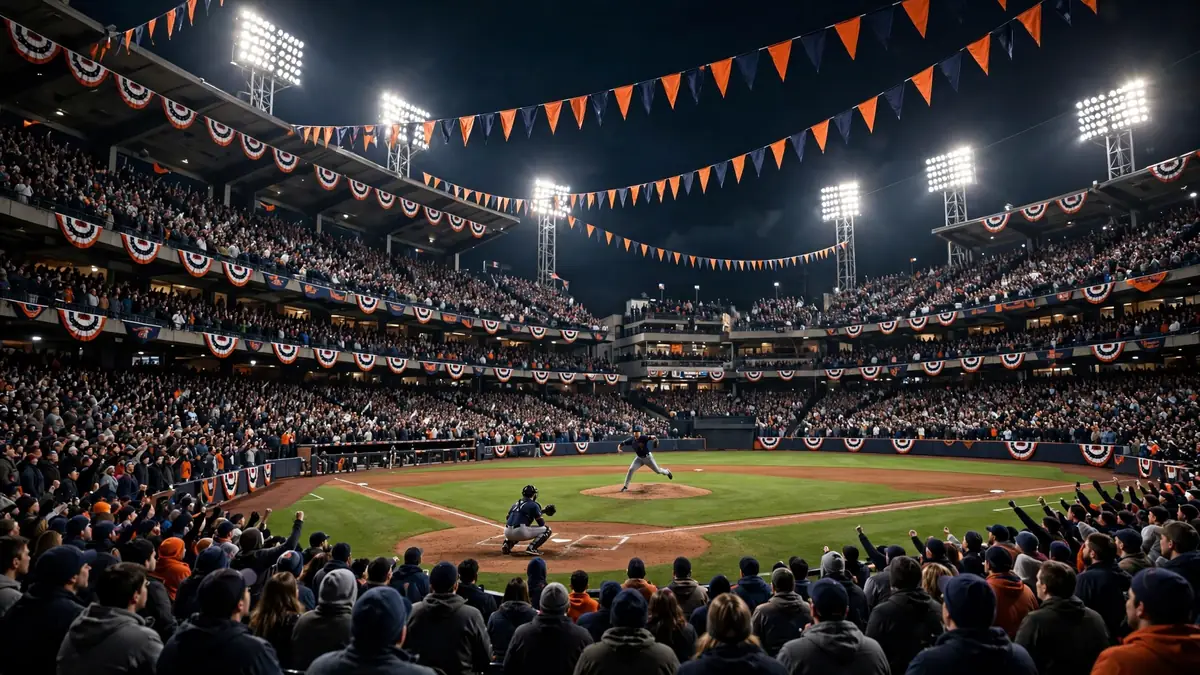
Twelve teams, four series, one trophy
After 162 games and six months of baseball, the 2026 Major League Baseball postseason is officially set. The bracket is final, the schedule is locked, and on Tuesday, September 29, four best-of-three Wild Card Series open across the country in a postseason quadruple-header that stretches from an afternoon first pitch in Atlanta to a late-night finale in San Diego. For the next five weeks, baseball belongs to October.
The format is the one fans have come to know: twelve teams, six from each league, with the top two seeds in each league earning a first-round bye straight to the Division Series. Eight teams open their campaigns in the Wild Card round, where a single three-game series — all games hosted by the higher seed — decides who survives and who goes home. There is no margin for error, no slow build into form. Win two games or watch the rest of October from the couch.
The American League bracket
The Tampa Bay Rays, owners of the best record in the American League, are the No. 1 seed and will rest while the Wild Card round plays out. The Cleveland Guardians take the No. 2 seed and the other bye. Beneath them, the matchups are rich with recent history.
The Houston Astros, who clinched the AL West on the final day of the regular season, are the No. 3 seed and host the No. 6 Chicago White Sox. The winner advances to face the Guardians. Meanwhile, the No. 4 New York Yankees host the No. 5 Boston Red Sox in a renewal of baseball's most storied rivalry, with the winner moving on to face the top-seeded Rays.
Consider the final records: the Yankees finished 93-68, the Red Sox 87-75, and the White Sox 84-78. The Red Sox–Yankees matchup, in particular, carries the weight of decades of October tension. As Baseball Hall of Famer and World Series champion CC Sabathia noted ahead of the series, offense is going to be tough to come by between these two clubs — a sign that this one could be decided by a handful of pitches rather than a flurry of home runs.
The National League bracket
In the National League, the Milwaukee Brewers secured the No. 1 seed with the best record in the league, and the Los Angeles Dodgers — winners of the NL West — are the No. 2 seed. Both teams skip the opening round.
The Atlanta Braves, NL East champions and the No. 3 seed, host the No. 6 Philadelphia Phillies in an all-NL East Wild Card Series. Philadelphia clinched the final NL playoff spot on the last day of the regular season, finishing 88-74. The winner of that series earns a date with the Dodgers. On the other side, the No. 4 San Diego Padres (91-71) host the No. 5 Chicago Cubs (89-73), with the winner advancing to face Milwaukee.
Every Wild Card Series follows the same compact rhythm: Game 1 on Tuesday, Game 2 on Wednesday, and a decisive Game 3 on Thursday if necessary. The Division Series then begin on Saturday, October 3, running through October 10, followed by the Championship Series from October 11 to 20. The World Series opens on Friday, October 23, and can stretch to a Game 7 on Saturday, October 31 — Halloween baseball, if it goes the distance.
How to watch: NBC returns to October baseball
This postseason carries an extra layer of significance for television viewers. The Game 1 schedule on Tuesday, September 29, reads as follows (all times Eastern): Phillies at Braves at 2:00 p.m. on NBC, White Sox at Astros at 5:00 p.m. on Peacock, Red Sox at Yankees at 8:00 p.m. on NBC, and Cubs at Padres at 10:00 p.m. on Peacock.
Every Wild Card game will also be carried across NBC Sports platforms, including NBC Sports Network. The arrangement marks the first postseason baseball on NBC since the 2000 American League Championship Series — a gap of 26 years — and arrives under a new multi-year rights deal that also covers Sunday Night Baseball. For a generation of fans who grew up hearing a different broadcast soundtrack to October, this is a genuine changing of the guard in how the sport is presented.
The storylines that will define October
The Dodgers' three-peat bid
The headline storyline of the 2026 postseason is the Los Angeles Dodgers' pursuit of a third consecutive World Series title. Back-to-back championships already place them among the modern era's great teams; a third straight would move them into territory occupied by only a handful of dynasties in the sport's long history. The bye gives them rest, but it also gives them rust — the eternal October trade-off. Their first opponent will be the survivor of the Braves–Phillies series, and neither club will be intimidated.
The first-timers: Brewers and Rays
At the other end of the emotional spectrum are the Milwaukee Brewers and Tampa Bay Rays. Both finished with the best records in their respective leagues, and both are still chasing their first World Series championship in franchise history. The Rays won the American League East by 4.5 games over the Yankees, while the Brewers topped the National League Central. For fan bases that have watched contenders come and go, this October carries a particular kind of hope — the best regular-season team either franchise has fielded, with the trophy still unclaimed.
The Yankees without Judge
New York's path is complicated by absence. The Yankees got just 66 games from superstar Aaron Judge this season, and their 93-win campaign was built on depth and resilience rather than their captain's bat. Now they face Boston in a best-of-three where one cold night can end a season. The Yankees beat their Pythagorean expectation by only a modest margin, but they earned the right to host this series. Whether they can advance without their most dangerous hitter at full strength is one of October's defining questions.
The teams that defied the math
Every season produces clubs whose records don't match their run differentials, and 2026 was no exception. The Cincinnati Reds didn't make the playoffs, but they led baseball in outperforming their Pythagorean expectation — winning 75 games, 9.8 more than their runs scored and allowed suggested. The Rays beat their expectation by 7.8 games. On the other end, the Detroit Tigers sputtered to a 76-86 record, missing their expected win total by 12.6 games — the largest gap in baseball. Detroit's midseason trade of Cy Young winner Tarik Skubal played a role, but the Tigers had been underachieving even with their ace. October, of course, has a way of rendering all of that math irrelevant.
What to watch in the Wild Card round
The best-of-three format is baseball's most unforgiving. A team's third starter suddenly matters as much as its ace. Bullpens get stretched. One bad inning can erase six months of work. Here are the dynamics worth following in each series:
- Phillies at Braves: A divisional rivalry with genuine bad blood, opening the entire postseason at 2:00 p.m. Eastern. The Braves' home-field advantage matters, but the Phillies have the rotation depth to steal two games on the road.
- White Sox at Astros: Houston's experience in October is unmatched among the Wild Card participants. The White Sox, the lowest seed in the field, have nothing to lose — historically the most dangerous kind of underdog.
- Red Sox at Yankees: The marquee matchup of the round, in prime time. Expect pitching, tension, and a stadium that will be shaking by the seventh inning of Game 1.
- Cubs at Padres: The nightcap, with two rosters built to win now. San Diego's 91 wins were the most of any Wild Card team, and hosting all three games is a genuine edge.
The road to the trophy
The winners of the Wild Card Series advance to the Division Series on October 3: in the AL, the Red Sox/Yankees winner faces the Rays and the White Sox/Astros winner faces the Guardians; in the NL, the Phillies/Braves winner faces the Dodgers and the Cubs/Padres winner faces the Brewers. From there, the Championship Series (October 11–20) decide the pennant winners, and the World Series (October 23–31) decides everything.
Twelve teams entered the bracket. In five weeks, one will be spraying champagne. The Dodgers are chasing history, the Brewers and Rays are chasing their first, and eight clubs are chasing the right to keep playing past Thursday. October baseball, at last, is here.
Sources