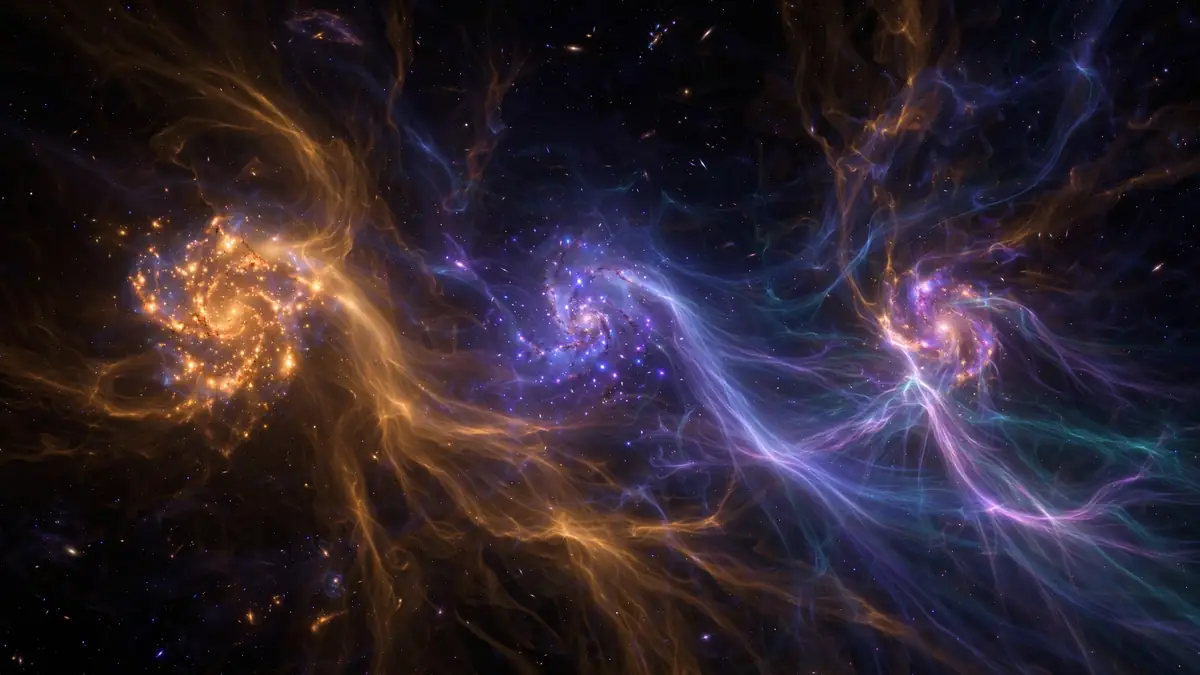
Three galaxies at the edge of time
Only a few hundred million years after the Big Bang, some of the universe's first galaxies were already spilling newly forged chemical elements into the space around them. That is the conclusion of a new study based on observations from NASA's James Webb Space Telescope (JWST), published September 24, 2026, in the journal Nature Astronomy — and it is forcing astronomers to rethink how quickly the young cosmos grew chemically complex.
The research, led by astronomers at the University of Arizona, examined three distant galaxies whose light has traveled for more than 13 billion years to reach us. We see them as they appeared roughly 500 million years after the Big Bang, during an era known as the Epoch of Reionization, when the first stars and galaxies were lighting up the cosmic dark. Using nearly 30 hours of spectral data from JWST's Near-Infrared Spectrograph (NIRSpec), the team found clear evidence that carbon, oxygen, and silicon — elements forged in the hearts of stars — were already being expelled from these young galaxies into their surroundings.
The implication is profound. The standard picture held that gas surrounding the earliest galaxies should have remained nearly pristine — mostly hydrogen and helium, the raw materials of the Big Bang — for an extended period. Instead, the chemical enrichment of the universe appears to have begun far earlier than previously accessible observations could establish.
Reading the wind with galaxy backlights
The technique behind the discovery is as clever as the result is striking. First author Yongda Zhu, a postdoctoral researcher in the University of Arizona's Department of Astronomy and Steward Observatory, began by manually searching public repositories of JWST spectra — hundreds of them — looking for a specific telltale pattern. He found just three galaxies with the blueshifted absorption signatures he was hunting for.
The method works like this. The researchers used the light of the galaxies themselves as backlights to probe the gas surrounding them. As a galaxy's light travels toward Earth, it passes through clouds of gas flowing outward from the galaxy. Atoms in that gas absorb light at specific wavelengths characteristic of each element, leaving subtle fingerprints in the spectrum. Because the gas is moving toward us — flowing out of the galaxy — those fingerprints are shifted slightly toward the blue end of the spectrum, a phenomenon called blueshift.
In the three galaxies, the team detected blueshifted absorption features corresponding to oxygen, silicon, and carbon in multiple ionization states — neutral, low-ionization, and high-ionization gas all sharing outflow velocities of roughly 50 to 250 kilometers per second. That is the unmistakable signature of chemically enriched material being actively driven out of young galaxies and into intergalactic space.
What surprised the researchers was how familiar the fingerprints looked. The spectral patterns associated with these primordial galaxies were remarkably similar to those seen in galaxies from much later in cosmic history — suggesting that the machinery of chemical enrichment was already operating in much the same way, just 500 million years after the beginning of everything.
Baryon cycling, almost from the beginning
The process the team observed has a name: baryon cycling. Galaxies are not sealed boxes. They constantly exchange material with their surroundings — gas flows in, stars form, stellar winds and explosions drive enriched gas back out, and some of that material eventually rains back down to fuel new generations of stars. It is one reason galaxies are not isolated systems but interconnected parts of a larger galactic ecosystem, with material produced by one generation of stars recycled and redistributed through the whole.
Until now, astronomers could only guess when this cycling began. The new study, titled "Early metal-enriched baryon cycling before the midpoint of cosmic reionization," provides direct evidence that it was already underway remarkably early. Zhu offered an everyday analogy for what the team is seeing:
"Think of these elements, which originated from the galaxies' stars, as food dye dropped into a cup of water. The color begins to spread through the water, and, in a similar fashion, these heavy elements from early galaxies began to escape into space and 'enrich' their surroundings." — Yongda Zhu, first author, University of Arizona
"We observed that heavy elements escaped from galaxies very, very early in cosmic time," Zhu added. "Not only were the galaxies producing these elements, but they were also dispersing them, possibly seeding other galaxies."
That last phrase — seeding other galaxies — captures why the finding matters beyond a single process. The carbon in our cells, the oxygen we breathe, the silicon in the device you are reading this on: every one of those atoms was forged in a star and scattered into space. This study shows that the great redistribution of those elements, the process that ultimately made planets and life possible, was already in motion when the universe was barely four percent of its current age.
The mystery of the missing first stars
The discovery may also help solve one of astronomy's most stubborn puzzles: the case of the missing first stars.
The very first generation of stars — known as Population III — is thought to have formed from truly pristine gas containing only hydrogen and helium, before heavier elements had been produced and dispersed. Astronomers have long expected to find traces of these stars, or at least pockets of untouched primordial gas. Yet despite decades of searching, convincing evidence has remained elusive.
The new results suggest a reason why. If galaxies were already enriching their surroundings within 500 million years of the Big Bang, truly pristine gas may simply not have lasted long enough to be observed — it was seasoned with heavy elements almost as soon as it existed. As Zhu memorably put it:
"If you start out with pure vanilla ice cream but start mixing in sprinkles soon after, it won't be long until you can no longer find any pristine, plain, vanilla ice cream." — Yongda Zhu, University of Arizona
It is a vivid image for a serious scientific point: the window during which the universe was chemically simple may have been far narrower than models assumed, closing before astronomers' best telescopes could peer through it.
What the findings don't yet prove
As with any result based on a small sample, caution is warranted. The study rests on just three galaxies — and not typical ones, but three unusually bright objects that were luminous enough for their faint absorption features to be detected at all. Whether early enrichment was a universal phenomenon or something that happened first and fastest around the brightest early galaxies is something these observations cannot yet determine.
The authors are also careful about what "early" means here. The detection of outflowing metals shows that enrichment and dispersal were underway 500 million years after the Big Bang — but the enrichment could have begun earlier still, in galaxies too faint for even JWST to characterize this way. Future observations of larger samples, including fainter galaxies, will be needed to map out how widespread and how rapid the process really was.
Still, the direction of travel is clear. Each new JWST result from cosmic dawn seems to push the milestones of galaxy evolution earlier: earlier star formation, earlier black holes, earlier chemical complexity. The young universe, it turns out, was in far more of a hurry than anyone expected — already manufacturing the ingredients of planets and life while the cosmos was still in its infancy.
Sources