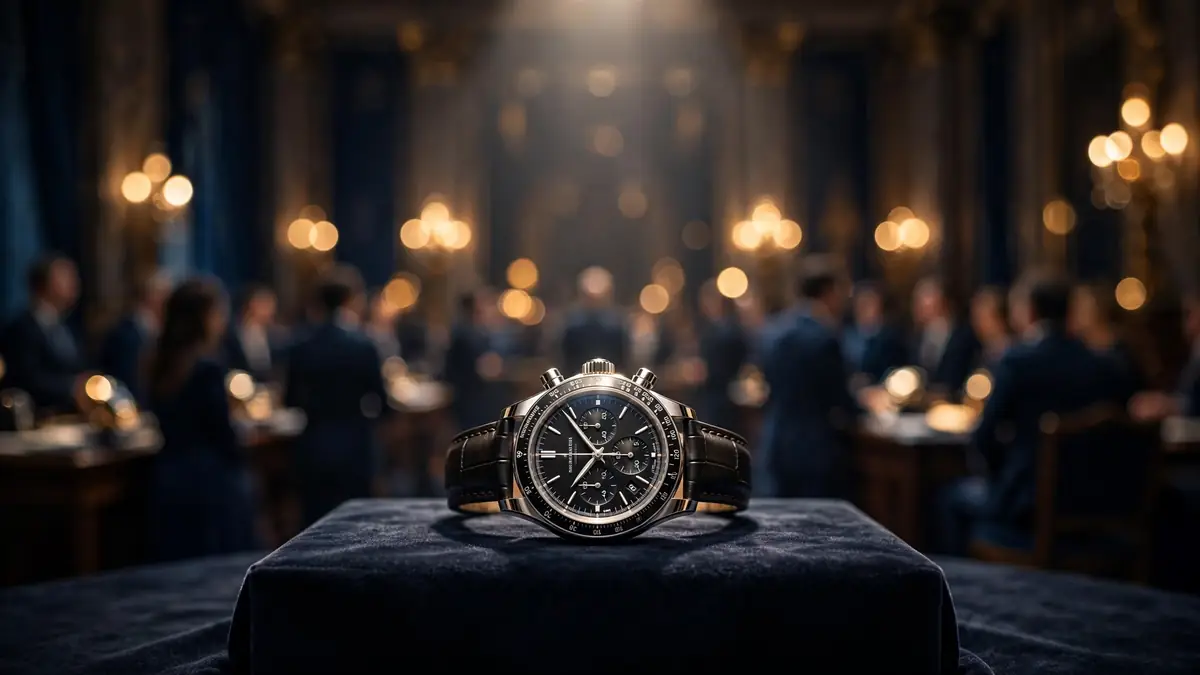
A London evening that rewrote the record books
On the evening of September 28, 2026, the Phillips saleroom in London became the stage for a result the watch world will discuss for years. Four piece-unique Rolex Oyster Perpetual Cosmograph Daytona chronographs, offered as separate lots in a single-consignment charity sale conducted by Phillips Senior Consultant Aurel Bacs, sold for a combined $49,467,260 — roughly £37.3 million. It is the highest amount ever raised for a watch charity event.
The sale was no ordinary auction. Rolex, a manufacture famous for its restraint — one that rarely confirms the existence of unique watches and almost never places its own name at the center of an auction — partnered directly with Phillips to create the “Four Seasons” collection: four chronographs, each interpreting a different season through rare natural-stone dials, precious metals and high-jewelry gem-setting.
All four watches are 40 mm Cosmograph Daytonas powered by Rolex’s in-house Calibre 4131 automatic chronograph movement, running at 4 Hz with approximately 72 hours of power reserve. Each pairs a precious-metal case and Oyster bracelet with a natural-stone dial, a gem-set bezel and elaborate stone and gemstone detailing, finished with diamond-set lugs and crown guards and Superlative Chronometer certification.
That the four references were sold individually rather than as a single set was a deliberate and commercially significant decision. It allowed four different collectors to acquire a unique Rolex, created competitive bidding across four distinct configurations, and gave the market a separate public valuation for each watch.
Winter, Spring, Summer and Autumn
The collection’s seasonal concept gave each watch its own character. The platinum Winter reference carried a blue opal dial with lapis lazuli sub-dials and a bezel set with blue-to-fuchsia sapphires in a 950 platinum case; it sold for $13,262,000, or £10,000,000. The 18 ct white gold Spring edition paired a chrysoprase dial with lepidolite counters and purple sapphires, achieving $9,018,160 (£6,800,000).
Leading the evening, the 18 ct Everose gold Summer model commanded $13,659,860 (£10,300,000) with its turquoise dial, heart-of-ruby sub-dials and pink sapphires. The 18 ct yellow gold Autumn edition closed the quartet at $13,527,240 (£10,200,000), combining a mookaite dial with chrysoprase counters and green tourmalines.
Even the lowest result of the four — Spring’s $9 million — would be an extraordinary outcome for any modern Rolex Daytona, and it underscores how far collectors will reach when rarity, provenance and purpose converge in a single lot.
Rolex steps into the spotlight
For many collectors, the most striking aspect of the sale is not the numbers but the sender. Rolex has long understood the power of restraint: the Geneva manufacture rarely confirms unique watches, almost never attaches its name directly to an auction, and generally allows its products to acquire cultural significance over time rather than through announcement. On September 28, it abandoned that familiar distance.
The shift matters because manufacturer involvement changes what a watch is. A vintage trophy watch carries the romance of survival; a manufacturer-created unique piece carries something rarer still — the house’s own hand in the creation, offered with full institutional blessing. That distinction is part of what drove bidders to treat these Daytonas as the blue-chip assets they are.
The sale also continues Rolex’s quiet embrace of natural materials at the very top of its range. Hard-stone dials — opal, chrysoprase, turquoise, mookaite — and high-jewelry gem-setting have traditionally belonged to the maison’s dress and jewelry lines; transplanting them onto the Daytona, the brand’s most sporting icon, gave even seasoned collectors something they had never seen before.
Where the money goes
One hundred percent of the proceeds will be split between two causes. The first is the Roger Federer Foundation, which supports early childhood education across Southern Africa and Switzerland. The second is Re:wild, the environmental initiative associated with Leonardo DiCaprio and dedicated to global ecosystem restoration.
Charity auctions have long been the watch world’s most glamorous meeting point between collecting and conscience, but scale matters. At $49.4 million, the Four Seasons sale more than doubled the total set by Paul Newman’s personal Daytona, which sold for $17.75 million in 2017 and stood until now as the most important Daytona auction of the modern era.
The pairing of the two causes is worth noting. Early childhood education and ecosystem restoration rarely share a billing, yet both reflect the long time horizons that serious collectors claim to value — the idea that the best things, whether a watch or a forest, are built to outlast their makers.
What the sale signals for the Daytona market
Auction records set by unique pieces should be read carefully. A four-lot charity result is an isolated benchmark of peak collector appetite — it does not revalue every steel Daytona in a safe-deposit box. What it does confirm is the depth of demand at the very top: four collectors, competitive bidding across four configurations, and a combined total that eclipsed the pre-sale conversation entirely.
It also confirms the market’s appetite for Rolex’s more artistic experiments. Stone dials, gem-set bezels and precious metals on a Daytona were once a curiosity; after September 28, they are a proven formula — and every collector holding a stone-dial Rolex will have taken notice.
Beyond the headline total, the sale offered a masterclass in how modern charity auctions are constructed. A single-consignment format gave the evening a narrative arc that a mixed sale could never match; four separate lots turned one story into four competitions; and the presence of two globally recognized causes broadened the bidder base beyond the usual watch-collecting circles. Auction houses have long known that charity sales run on emotion as much as economics, but the Four Seasons result suggests a refinement of the formula: pair a manufacturer willing to break its own rules with causes that resonate far beyond horology, and the room will do the rest.
Sources