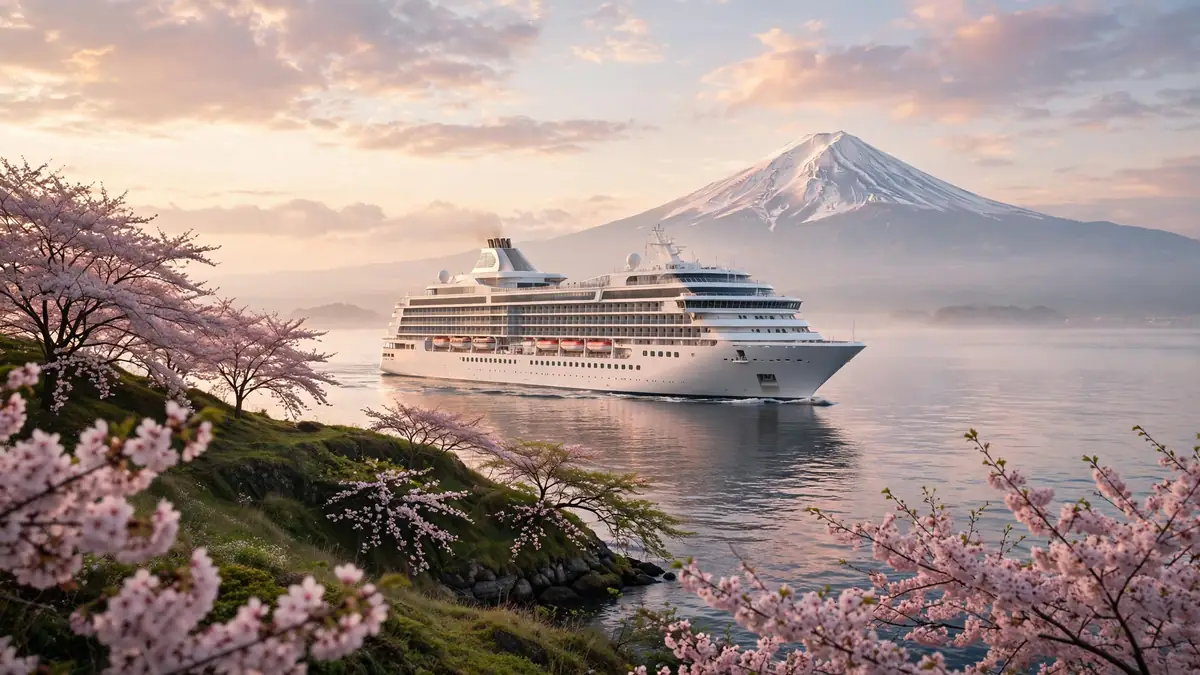
Japan's luxury cruise scene has a new flagship. On Saturday, September 19, 2026, Mitsui Ocean Sakura departed Yokohama Port at 5 p.m. on her inaugural cruise, officially entering service and doubling the fleet of Mitsui Ocean Cruises — a brand barely three years old — to two vessels for the first time.
The debut caps an emotional week for the young line. On September 16, the ship was named in a ceremony at Yokohama's Hammerhead cruise terminal — with the line's own crew and employees serving collectively as the ship's namers rather than a single celebrity godparent. Captain Satoshi Ninomiya, the vessel's inaugural captain, broke the traditional bottle, and the City of Yokohama hosted a ceremony on board ahead of the September 19 departure, including the traditional plaque exchange between the ship and the port.
Small ship, Japanese soul
At 32,477 tons and 650 feet long, Mitsui Ocean Sakura is deliberately intimate: 458 guests in all-suite accommodation, with ocean views from every suite. Her compact size is strategic — it allows access to a diverse range of ports throughout Japan, including smaller destinations and harbours within easy reach of city centres that mega-ships cannot attempt.
As a Japanese-registered ship, Sakura will initially focus on short- and medium-length domestic voyages. The schedule is ambitious for a newcomer: 29 cruises during her first three months through December 2026, spanning one- to three-night Autumn Scenic, Christmas and New Year sailings. In total, 61 cruises have been announced through September 2027, giving travellers a wide menu of opportunities to explore Japan by sea.
Funatabi: beautiful encounters with Japan
The ship's defining concept is Funatabi — "Beautiful Encounters with Japan" — Mitsui Ocean Cruises' signature philosophy, brought to life through cuisine, hospitality, entertainment and destination experiences inspired by Japanese culture. Where international luxury lines adapt a global template to Japanese waters, Sakura inverts the formula: a Japanese ship, Japanese hospitality, Japanese aesthetics, sailing Japanese coasts.
Dining is central to the expression. Among the ship's new culinary experiences is Sushi Bar Shiosai, an intimate specialty restaurant on Deck 5 with counter and table seating, where guests enjoy carefully curated multi-course menus of sushi, seasonal small dishes and sake — a showcase of the craftsmanship and attention to detail at the heart of Japanese cuisine. The counter format, in particular, honours the omakase tradition: the chef's choices, the guest's trust, the seasons on the plate.
Another distinctly Japanese touch awaits on Deck 8, where the Grand Pool area includes an open-air footbath — a restorative retreat where guests can relax while remaining comfortably dressed between sightseeing and on-board activities. It is a small detail that says a great deal about the ship's sensibility: luxury expressed through culture rather than scale.
Why Japan, why now
Sakura's arrival reflects a broader bet on Japan as a cruise destination. The country's coastline — from Hokkaido's summer festivals to the subtropical Ryukyu Islands, from the art islands of the Seto Inland Sea to autumn foliage along the coasts — is among the most varied cruising grounds in Asia, yet it remains underserved by luxury tonnage relative to demand. Domestic Japanese travellers, famously discerning and loyal to quality, represent a deep home market; inbound visitors, meanwhile, increasingly seek Japan beyond the golden-route cities.
The short-voyage format is shrewd. One- to three-night sailings lower the barrier for first-time luxury cruisers, function as tasters for longer 2027 itineraries, and suit the domestic market's holiday patterns. The Christmas and New Year cruises, in particular, tap into a period when Japanese travellers traditionally seek special year-end experiences.
The small-ship moment
Sakura's debut is part of a wider small-ship surge in luxury cruising. Just days before her maiden voyage, Seabourn Ovation made her maiden call at Quebec City on September 23, arriving during a 12-day Canada and New England sailing from New York City to Montreal — complete with the traditional plaque-exchange ceremony between captain and port authority, and an overnight stay that gave guests far more time in the historic city than a standard port call. The message from the industry is consistent: luxury cruisers increasingly want smaller ships, deeper port time and culturally rich itineraries over sheer scale.
Europe's autumn cruise season tells the same story. Malaga is preparing for 164 cruise calls by 102 ships between September and December, with 61 of those calls by luxury and ultra-luxury ships, yachts and high-end expedition vessels. September alone brings the Scenic Eclipse II — an ultra-luxury expedition yacht carrying two helicopters and a submarine — alongside Ponant's Le Champlain, Silversea's Silver Ray and Cunard's Queen Anne. December will see the luxury debut of the first yacht from the Four Seasons hotel group. The through-line is unmistakable: across continents, the growth is in intimate, experience-rich vessels, not floating megaresorts.
Sakura fits this movement precisely. At 458 guests she is a fraction of the size of mainstream newbuilds, her all-suite configuration guarantees space and calm, and her Funatabi concept gives the intimacy a cultural purpose. In a season crowded with ultra-luxury debuts, a ship that is unmistakably, specifically Japanese has a clear lane.
A fleet of two — and a statement
For Mitsui Ocean Cruises, doubling the fleet three years after launch is a statement of confidence in the luxury segment's trajectory. The line now has the capacity to build genuine brand loyalty — guests who sail the first ship returning to try the second — and the operational scale to refine its Funatabi concept across two distinct itineraries.
For the traveller, Sakura offers something increasingly rare in luxury cruising: a ship that could only belong to one country. In an industry of ever-larger vessels chasing ever-more-generic notions of luxury, a 458-guest all-suite ship with a sushi counter, an open-air footbath and a crew that named her themselves is a reminder that the most compelling luxury experiences are the most specific ones. Japan, by sea, the Japanese way — that is a voyage worth taking.
Sources