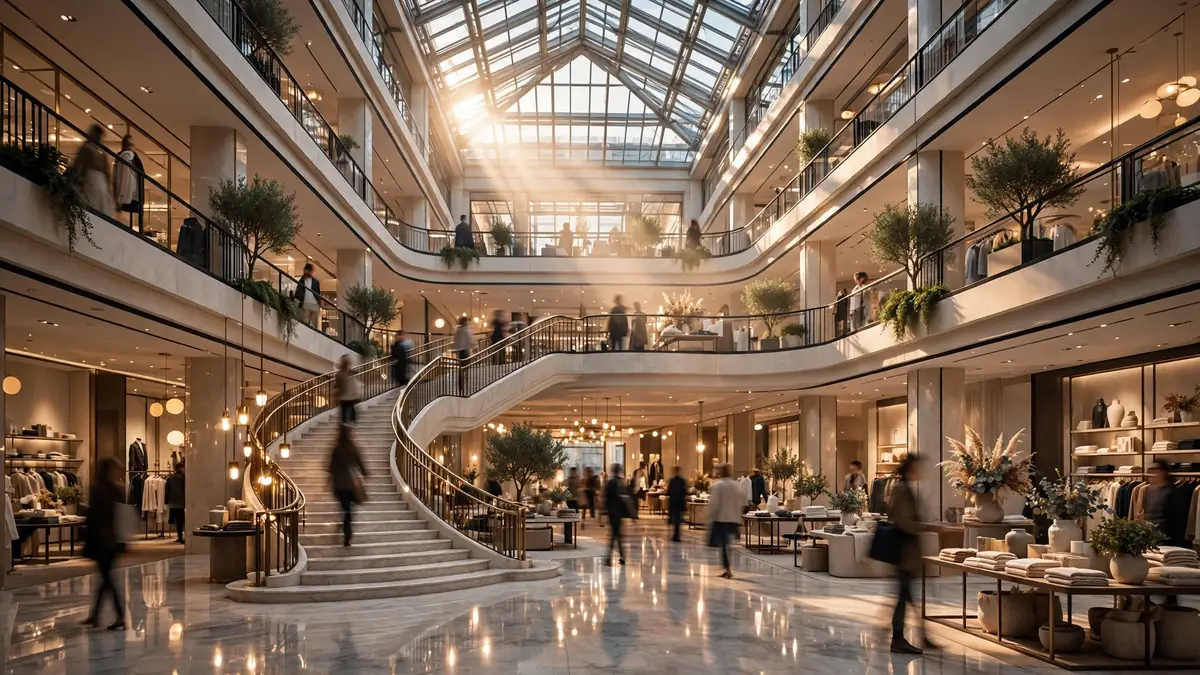
For more than a decade, the American department store has been treated as a casualty of the internet age — a grand, marble-floored relic waiting for its final markdown. Recent headlines have done little to challenge that verdict, as former titans of the sector have fallen away. Yet one of the retail industry's most interesting counter-narratives is being written in real time by Bloomingdale's, the 150-year-old American institution that has spent the past three years quietly redesigning what a department store is actually for.
At the centre of that project is Olivier Bron, the French chief executive who took the top job in 2023 after a career spent inside Europe and Asia's most demanding retail rooms: twelve years as a management consultant with Bain & Company, a stint as director of strategy and then chief operating officer of Paris's Galeries Lafayette, and a spell as chief executive of Central and Robinson department stores in Thailand for Central Group. In late September 2026, Bron spoke from Paris with Monocle chairman Tyler Brûlé for "The Chiefs", Monocle's business interview series, and laid out a philosophy that runs against almost every instinct of modern American retail.
Meridian did not conduct this interview. This feature is an editorial reading of Bron's published on-record remarks, with every quotation taken from the interviews cited in the sources below.
The commercial context matters. Comparative sales at Bloomingdale's rose 10.2 per cent in the first quarter of 2026 — part of what Monocle describes as a steady stream of positive growth figures — while the chain prepares one of the most ambitious store renovation programmes in its recent history. Bron's argument is that the format's troubles were never really about the format at all.
The dinosaurs that aren't
Asked by Monocle whether the department store is back or gone for good, Bron refused both obituary and nostalgia. His answer framed the entire conversation that followed:
"It's a mixed picture. But when I hear people saying that department stores are dinosaurs, that's not true. The department stores that we used to run 30 or 40 years ago are gone forever but the challenge, as in every aspect of retail, is about reinvention. If you go back to the source of department stores, they are meant to be places of discovery, where you can experience the products and have a close connection with them. This is still very relevant for customers."
— Olivier Bron, in a September 2026 interview with Monocle
The distinction is doing real work. Bron is not arguing that the 1980s mall anchor, with its discount racks and fluorescent gloom, deserves a second life. That version, he says, is "gone forever". What survives is the older, deeper idea: a place of discovery, where the customer builds a physical relationship with the product. In an era when almost everything can be bought from a phone in minutes, that in-person encounter has to be the product — the reason the trip is worth making.
Repositioning for international standards
The most striking line of the interview may be the one in which Bron turns American retail exceptionalism on its head. Asked why shoppers should visit Bloomingdale's, he answered:
"We want to bring back the DNA of the Bloomingdale's brand — something that's very special. The US is the biggest market in the world, with the biggest department-store players. Yet none of the world's best department stores are in the US right now — and that's crazy, when you think about it. So what we want to do is reposition Bloomingdale's in terms of international standards. We have to deliver the same kind of experience in the US as they do in Asia and Europe. So we have to rethink the way that we're designing department stores in the US and that's exactly what we're doing at Bloomingdale's. We're positioning our model from premium contemporary to high luxury and we want to bring this storytelling from the brands cascading down to the customer."
— Olivier Bron, in a September 2026 interview with Monocle
Two ideas are packed into that answer. First, the diagnosis: the United States, the world's biggest retail market, currently hosts none of its best department stores — a verdict from a man who ran celebrated stores on two other continents. Second, the prescription: move Bloomingdale's up the value ladder, from premium contemporary to high luxury, and make brand storytelling — not discount signage — the connective tissue between the shop floor and the customer. It is a bet that American shoppers, like their counterparts in Paris, London and Bangkok, will pay for inspiration.
In an earlier conversation with McKinsey partner Joëlle Grunberg, Bron traced the roots of the problem to an American mindset that prizes the immediate. "One thing that surprised me in the US market is the mindset that is very, very focused on the short term," he said — a theme that runs through his entire programme: patience over quarterly pressure.
Every city is a different market
Pressed on where the company is actually investing — the beloved Third Avenue flagship in New York or the wider estate — Bron rejected the idea of a single formula:
"Every city is a different market with different needs. We're not selling the same thing in the same way in all the different cities. So being able to adapt your assortment, service and experience in the store in these different cities is extremely important. Right now, we're renovating our flagship in New York to differentiate it from anything else that you can experience in the US, which is a massive step because it's a landmark for us. We're triggering the renovation of 10 stores in the next five years to re-elevate this experience and bring the best to the customer."
— Olivier Bron, in a September 2026 interview with Monocle
Ten store renovations in five years is a serious capital commitment for a chain of 31 full-line US stores. The logic is that a department store cannot be a national spreadsheet: assortment, service and atmosphere have to bend to the city they serve. The New York flagship — a landmark building that functions as both shop and symbol — is meant to set the standard everything else is measured against.
Picking battles in the mall
On the question of America's struggling malls, where Bloomingdale's often serves as the anchor among empty, boxy spaces, Bron was disarmingly candid — and revealed a strategy of deliberate concentration:
"That's fair. But we have the privilege and chance with Bloomingdale's to only be in prime malls that are doing well. Most of them have strong traction and strong traffic. It's very important for us to pick our battles and where we want to operate — and to be very clear on our positioning and what our customers target. This is exactly what's happening."
— Olivier Bron, in a September 2026 interview with Monocle
The language of "picking our battles" is revealing. Rather than trying to rescue every address, Bloomingdale's is concentrating its firepower where footfall and intent already exist. Clarity of positioning — knowing exactly who the customer is — replaces the old model of being everything to everyone.
Stop squeezing every inch
The most philosophically loaded question Monocle put to Bron concerned the role of food — restaurants, cafés, places to sit — inside the store. His answer became a manifesto against the spreadsheet view of retail:
"If you're obsessed about getting a yield out of every inch of the store then that's a problem because, honestly, you're not thinking about the experience. When you're overwhelmed by so much density, products and solicitation, you don't have any moment to pause, to sit, to eat, to drink. You're missing something. The best way of thinking about the customer relationship is in the long term. It's about having customers who just spend time in our store. If it's only about dollars, products and transactions, that's a short-term perspective. We must rethink the way that we're designing our store and our space to address the current needs of our customers."
— Olivier Bron, in a September 2026 interview with Monocle
There it is: the whole strategy in one paragraph. A customer who simply spends time in the store — eating, sitting, pausing — is worth more over years than a customer squeezed for this quarter's dollars. It is the opposite of the yield-per-square-foot thinking that hollowed out so many American stores, and it explains why food, seating and space itself are now strategic assets rather than wasted rent. Whether that long-term bet survives the pressures of a listed parent company, Macy's Inc., is the test Bron's tenure will ultimately be judged on. For now, the numbers — and the queues at the renovated flagships — suggest the reinvention is working.
Sources