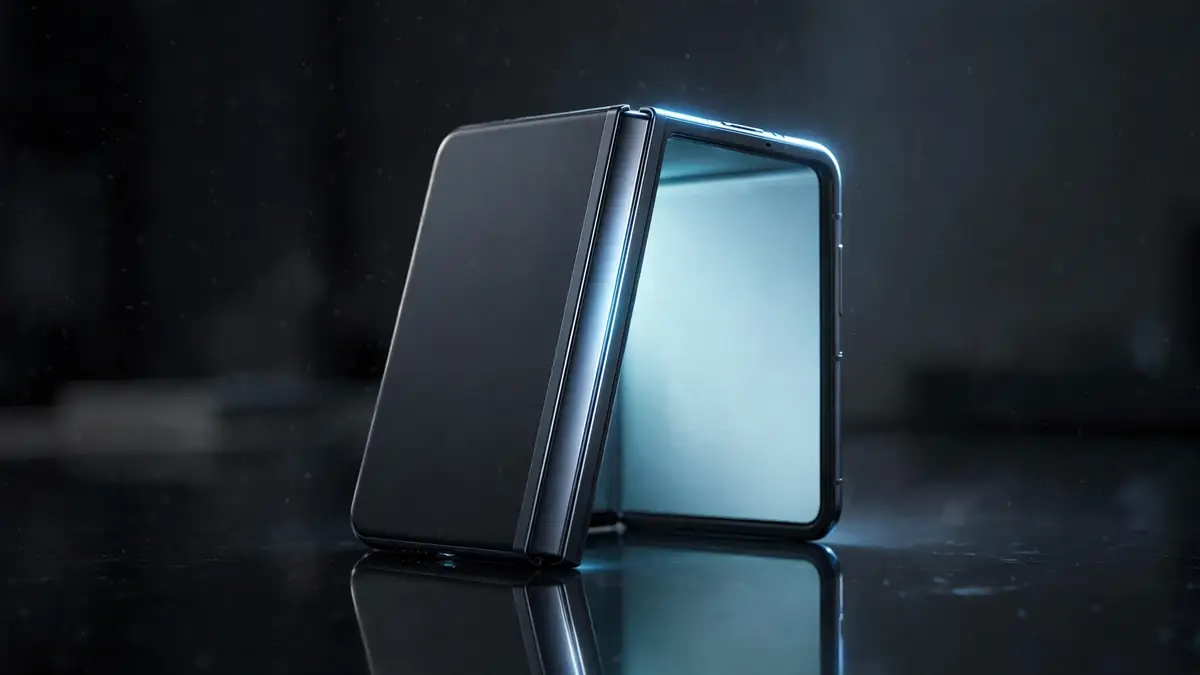
A month into one of the most scrutinised executive transitions in corporate history, John Ternus sat down for his first major interview as Apple's chief executive. The setting was Clique, the Canal+ talk show hosted by Mouloud Achour, recorded after Apple's September event and published on 21 September 2026. It was a wide-ranging conversation: the foldable iPhone Duo that headlined his first keynote, the future of Vision Pro, the offer he never expected — and how Apple thinks about living with artificial intelligence.
For context: Ternus, a 25-year Apple veteran and former head of hardware engineering, took over from Tim Cook as chief executive on 1 September 2026. Days later he stood on stage at Apple's "Surprise and Shine" event on 9 September and delivered the company's first foldable phone, the iPhone Duo.
Meridian did not conduct this interview. This feature is an editorial reading of Ternus's published on-record remarks, with every quotation taken from the coverage cited in the sources below.
Why the Duo doesn't look like other foldables
The defining product question of Ternus's early tenure is why Apple's foldable doesn't look like everyone else's. On Clique, he explained that the design started not from the category's conventions but from a large-screen experience Apple already understood — the iPad:
"I think it's something new and unique, right? But I think we didn't want to just do what we'd seen other people do, which is sort of take two phone shapes and stick them together and then you get this weird square thing. We came at it from we want to build a large screen experience that feels right to us. And obviously we've been doing that for a long time with iPad. And so we knew kind of the shape, you know, we came up with this new aspect ratio."
— John Ternus, in a September 2026 interview with Canal+'s Clique, as reported by MacRumors
The result is a device whose two halves connect into a single continuous frame with a consistent aspect ratio whether open or closed — wide and canvas-like when unfolded, phone-like when shut. It is a characteristically Apple move: refuse the inherited form, find the geometry the company already knows, and engineer everything else around it.
Hinges, displays and patience
Ternus was open about how hard the Duo was to build. Developing it, he said, threw up "so many problems" — and gave Apple's engineers the chance to "be really clever" and "come up with entirely new things". The hardware challenges he named were the hinge and the inner display, and making both reliable — the two problems that have dogged every foldable maker. His favourite detail, though, is pure Apple whimsy:
"I mean, this is really fun, you know, the animation that you get as you open it across from one side to the other. It's just sort of whimsical and fun. And it brings a smile to your face."
— John Ternus, in a September 2026 interview with Canal+'s Clique, as reported by MacRumors
The anecdote tells you a lot about Ternus's product philosophy. After the engineering mountain of hinge, display, software continuity across two screens and dual battery cells, the detail he chooses to show off is the moment of delight — the animation that makes the machine feel alive. Products, for him, are not finished when they work; they are finished when they make people smile.
"Siri is not designed to be your friend"
One of the interview's most quoted moments concerned AI companions — the trend of chatbots designed to simulate friendship. Ternus reiterated Apple's stance, previously articulated by Craig Federighi, that Siri AI is "not designed to be your friend". He went further, explaining why Apple refuses to build technology that replaces human relationships:
"They're how we learn, they're how we grow, they're how we find joy and happiness."
— John Ternus, on human relationships, in a September 2026 interview with Canal+'s Clique, as reported by MacRumors
It is a philosophical position with commercial teeth. In an AI era where competitors are racing to make assistants more intimate, Apple is drawing a line: its AI is a tool, not a companion. Ternus's argument is that the deepest human goods — learning, growth, joy — come from people, and technology that displaces them is a failure of imagination, not a feature.
Vision Pro: the early days of a long journey
The interview also gave Ternus his best opportunity yet to address Vision Pro — a device under scrutiny after questions about its commercial performance and Apple's commitment to the platform. Asked directly whether the headset should be considered a failure, he reached for a historical analogy:
"You know, Vision Pro, to me, is an amazing device, right, it's an absolutely amazing device, but I think of it as, like, the early days of computers. It is the early days of a long journey, that's how I feel about Vision Pro."
— John Ternus, in a September 2026 interview with Canal+'s Clique, as reported by AppleInsider
He pointed to early adopters who love the device and to increasingly specialised uses: surgeons using Vision Pro during procedures as a better tool than a conventional monitor, and film production teams using it for set development. "We're going to continue to grow and find more and more compelling use cases," he said, arguing the headset has a "very bright future". The framing deliberately echoes the Mac's own history: desktop publishing gave the early Mac its reason to exist, and new use cases — not mass-market sales — are how a new computing platform earns its future.
The call he never expected
The most personal passages of the interview concerned the transition itself. Ternus said that when Tim Cook and Apple's board asked whether he would consider becoming chief executive, the question came as a complete surprise:
"When Tim asked me if it was something I would consider, I would say the good news is I was sitting down, because I never in a million years would have imagined that happening."
— John Ternus, in a September 2026 interview with Canal+'s Clique, as reported by MacRumors
He expanded on the moment in the full interview: "To me it's always just been: be here, focus on the work, build great things, love every minute of it. To be given this opportunity, to be asked about it was pretty mind-blowing. It's beyond words." And on the lessons he carries from his two legendary predecessors, Steve Jobs and Tim Cook, he offered a single phrase: "focus on the future". "Yesterday was an amazing day. It was so exciting. We launched a product. Today it's onto the future, onto the next thing."
He also described a small, symbolic thrill from his first keynote — saying "one more thing" on stage: "I've seen Steve say it, and I've seen Tim say it. And so having the opportunity for me to say it was pretty magical. Kind of goosebumps."
No radical change
For anyone expecting an engineer's revolution at Apple, Ternus offered a gentle correction. Asked whether the company was returning to its roots under his leadership, he said continuity — not rupture — was the plan:
"I don't think anything's really changed. Sure, I'm new in this job, but the focus on innovation, the focus on products, the focus most importantly on our customers, that has never changed. That's been here from the beginning."
— John Ternus, in a September 2026 interview with Canal+'s Clique, as reported by MacRumors
He added: "I am super passionate about products. I love building things. That's why I've been here so long." And on the AI moment he now inherits, he was unmistakably excited: "Generative AI, it is a really powerful technology that means this is the most exciting time in my career to be building products because there's so many new things we can do, things that previously were just science fiction." The message of the interview, in the end, was steady: new CEO, same obsession — products first, and the future always ahead.
Sources