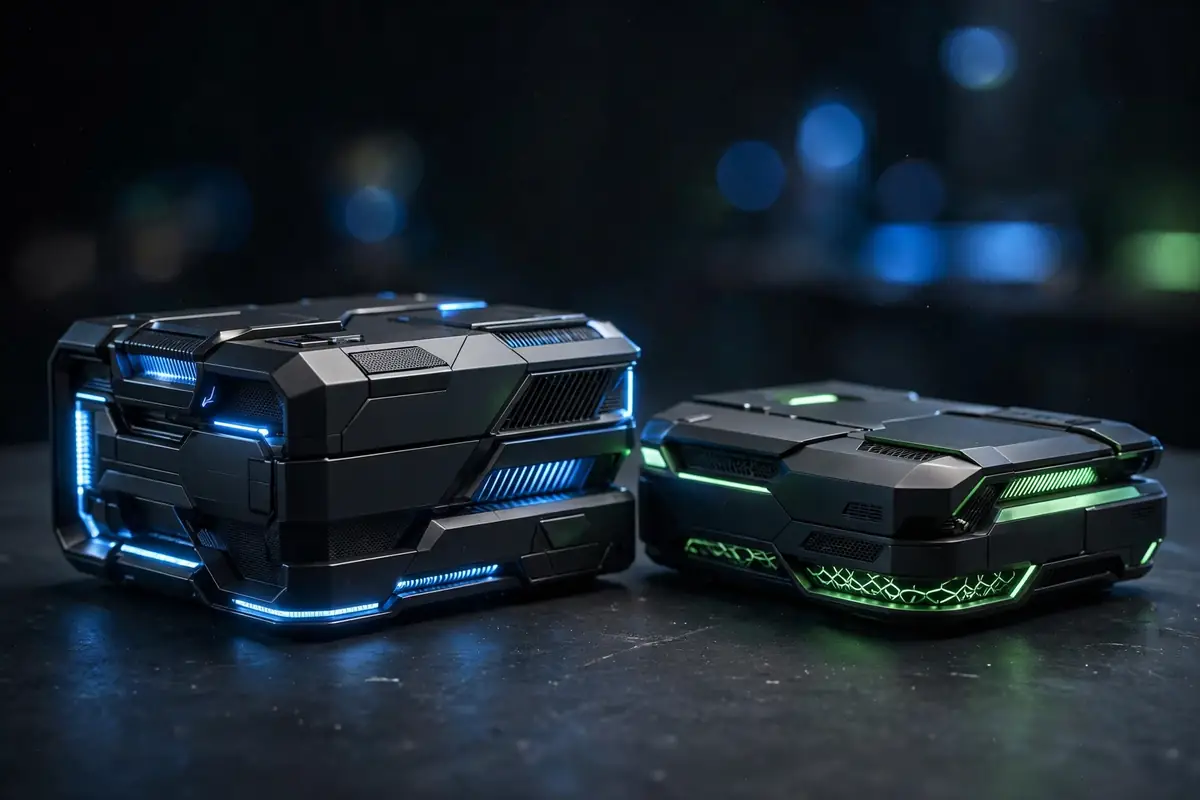
The current console generation is not even six years old, but the industry's rumour mill has already moved on. This week, claims from a well-known hardware insider sent the gaming world into a familiar frenzy: the chips for both Sony's PlayStation 6 and Microsoft's next-generation Xbox — reportedly codenamed Project Helix — have been "taped out", meaning their silicon designs are complete, verified and sent for manufacturing. If the reports hold, the next console war is no longer a distant hypothetical. It is a production schedule.
Before going further, the necessary caveat: none of this has been officially confirmed by Sony or Microsoft. What follows is a careful look at what the leaks claim, what they would mean if true, and why the headline numbers deserve more scrutiny than the headlines suggest.
What the Leaks Claim
The reports originate with KeplerL2, a hardware leaker with a track record of accurate silicon predictions, who posted on the NeoGAF forum that the PS6 will deliver 40 teraflops of compute performance while Xbox's Project Helix will reach 56 teraflops. Both chips, the leaker says, are taped out. In semiconductor terms, tape-out is a major milestone: it means the design is locked and the first physical chips can be manufactured for testing and validation.
Tape-out does not mean launch is imminent — there is typically a long road of stepping revisions, yield optimisation and mass-production ramp-up between a first tape-out and retail shelves. But it does mean the specifications are, for practical purposes, decided. And the specs being decided this early in the cycle is what has fuelled speculation, reported by outlets including Push Square, that both machines are targeting a November 2027 launch.
The PS6: Double the PS5, Plus a Handheld
According to the leak, the PS6 will offer roughly double the raw power of the PS5, with ray tracing performance claimed to be 12 times faster, built on a far more efficient RDNA 5 graphics architecture. It would also benefit from an upgraded version of Sony's proprietary PSSR upscaler — the AI-assisted reconstruction technology that debuted on the PS5 Pro — which can deliver higher image quality while massively reducing the computational cost of rendering.
Perhaps the most intriguing element is the reported portable model. Details are thin on what kind of experiences it would deliver and how it would fit into Sony's product portfolio, but the direction of travel is unmistakable: following the success of the Nintendo Switch line, the Steam Deck and a wave of PC handhelds, Sony appears to be betting that the next generation is not only about the living room. A PS6 handheld would mark the company's most serious return to portable gaming since the PlayStation Vita era.
The price question
The figure likely to dominate discussion is cost. The bill of materials for the PS6 is estimated at around $960 — before manufacturing, distribution, retail margin and Sony's own margin decisions. To state the obvious: that does not mean a $960 console. Platform holders routinely subsidise hardware, and component prices shift constantly. But it does explain why analysts keep warning that the next generation could be the most expensive yet, particularly with AI-related demand for advanced chips and high-bandwidth memory threatening to push component costs higher over the next 12 months. Sony's more modest overall design, the reports suggest, could let it undercut Microsoft on price — a potentially decisive advantage.
Project Helix: Microsoft's 40% Power Advantage?
On paper, Microsoft's machine looks like the brute of the pair. At a claimed 56 teraflops versus the PS6's 40, Project Helix would be 40% more powerful in raw compute — a gap far larger than anything seen between the PS5 and Xbox Series X. The console is described as a hybrid gaming PC, which would align with Microsoft's long-running strategy of blurring the line between Xbox and Windows gaming, and backwards compatibility is expected to remain a central pillar of the platform.
That framing matters. If Helix genuinely functions like a PC, some of its extra horsepower will be absorbed by operating-system overhead and the flexibility of an open platform rather than translating directly into prettier games. Raw teraflops have never been a clean proxy for delivered performance, and a hybrid device complicates the comparison further.
Why Teraflops Are Not the Whole Story
This is where the veterans urge caution. PlayStation system architect Mark Cerny has spoken at length about what he calls "flopflation" — the tendency to treat teraflops as a definitive measure of power when architecture, memory bandwidth, data throughput and upscaling technology matter at least as much. The current generation is the proof: the PS5 is technically around 20% less powerful than the Xbox Series X on paper, yet in real terms that gap has rarely factored into how games actually look or run.
A 12x improvement in ray tracing, a more efficient RDNA 5 architecture and a mature AI upscaler could easily matter more to players than the raw compute figure — particularly as developers increasingly lean on reconstruction techniques to deliver 4K-class visuals without native 4K rendering costs. The console that wins the next generation is unlikely to be decided by a spec sheet alone; it will be decided by price, games, services and timing.
What Happens Next
If the late-2027 window is accurate, expect the official drumbeat to begin in earnest next year. Sony and Microsoft will need to answer the questions the leaks cannot: exact pricing, the handheld's capabilities and positioning, how Project Helix's hybrid nature works in practice, and — most importantly for players — what games will define the launch window.
For now, the sensible reading is this: the silicon is reportedly done, the rough shapes of both machines are coming into focus, and the industry is quietly preparing for the most interesting console transition in over a decade. Just do not pre-order anything yet. The only thing officially confirmed about the next generation is that nothing is officially confirmed.
Sources