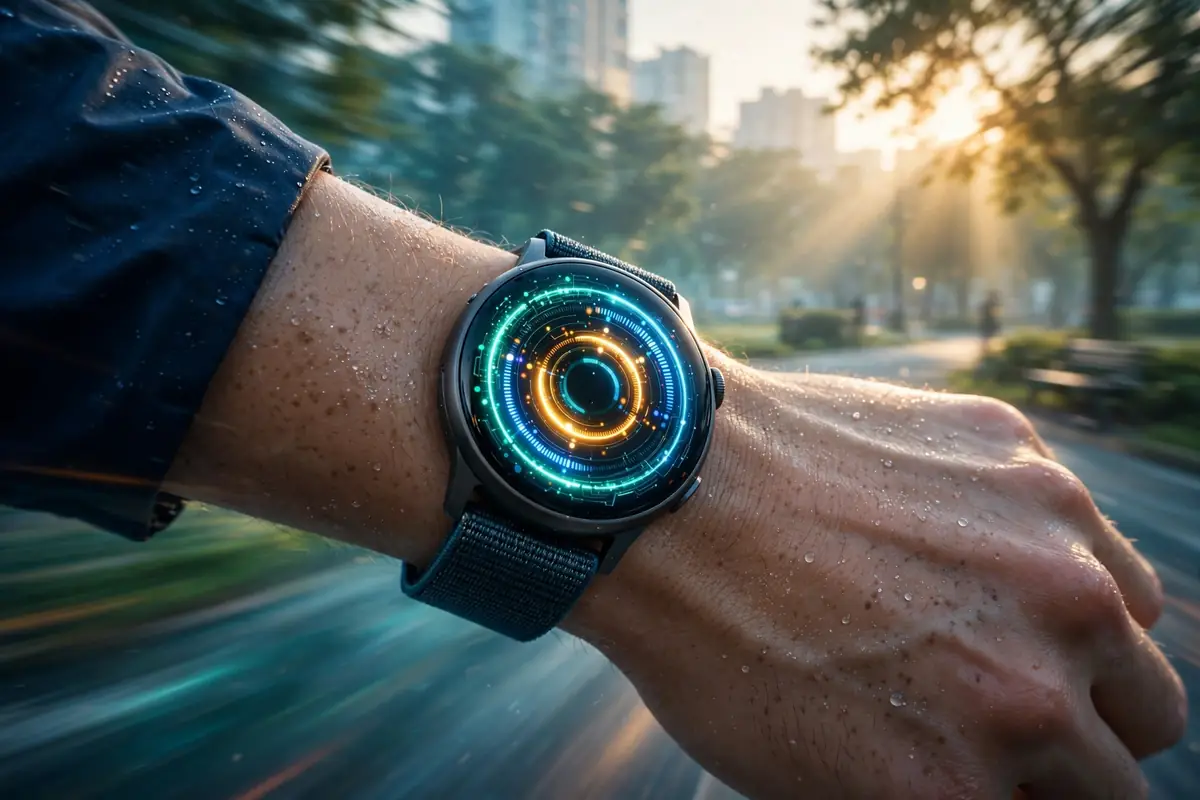
Your smartwatch tells you, with apparent confidence, exactly how many calories you burned on that run. The number feels precise. It is also, according to a new study covered by NPR on September 22, probably wrong — and the error is not random. The research found that smartwatches and fitness trackers systematically overestimate calorie burn, with a typical error of 15% to 25%, and that the inaccuracy grows with the wearer's body fat percentage.
What the study found
The lead author of the study is Jason Kostrna, an associate professor of exercise science at Florida International University. In an interview with NPR's Leila Fadel, he described the central finding plainly: the devices' calorie estimates carry a typical error of about 15% to 25%, and that error varies with individuals' body fat percentage.
"There's a typical error of about 15% to 25%. And that varies in our study based on individuals' body fat percentage," said Jason Kostrna, associate professor of exercise science at Florida International University, in an interview with NPR.
The direction of the error is what makes it consequential. For people with higher body fat percentages, the watches were less accurate in a specific way: they told wearers they had burned more calories than they actually had. As Kostrna put it:
"So the watch was telling them that they burned more calories. So in our study, if you were in a high body fat percentage of 35% or 40%, you might look down and see 100 calories on your watch. And in reality, you might've only burned 50 or 60," Kostrna told NPR.
That is not a rounding error. It is a device potentially reporting double the actual energy expenditure — for the very users who may be relying on those numbers most, such as people managing weight or training around health conditions.
Why the watches get it wrong
To understand the error, it helps to understand what a smartwatch actually measures. The device on your wrist does not measure calories. It measures proxies: heart rate via the optical PPG sensor, movement via the accelerometer and gyroscope, and occasionally skin temperature or GPS-derived speed. Calories are then estimated by an algorithm that combines those signals with your age, sex, height and weight.
Every step in that chain introduces uncertainty. PPG heart-rate sensing works by shining light into the skin and measuring blood-volume changes; it is less reliable during high-intensity movement, on tattoos, on darker skin tones, and — as this study highlights — across different body compositions. The algorithm then maps an imperfect heart-rate reading onto an imperfect model of human metabolism. Errors compound.
The body-fat correlation is particularly revealing. It suggests the estimation models are tuned for an average body composition and drift as the wearer diverges from that average. That is a design problem, not just a sensor problem — and it means the people whose calorie data matters most for health management are getting the least reliable numbers.
The timing: wearables want to do more with your data
This study lands at an awkward moment for the wearables industry — or perhaps exactly the right one. September 2026 has been one of the biggest smartwatch launch months in years. Apple announced the Watch Series 12 and Watch Ultra 4 with a new Readiness app for daily health and recovery insights, richer strength-workout tracking and upgraded optical sensing. Huawei's new Watch GT 7, launched September 29, introduces a Physical Readiness Score and even a Diabetes Risk Study built on PPG pulse-wave signals.
The industry is moving from raw metrics to synthesized guidance: scores, readiness ratings, risk assessments. That is a genuinely useful direction — but it makes the Kostrna study's warning more urgent, not less. The more these devices tell us what to do, the more the accuracy of their underlying estimates matters. A readiness score built on a calorie model that can be off by 25% deserves scrutiny, and manufacturers should be publishing their validation data.
What you should actually trust on your wrist
None of this means smartwatches are useless. It means the numbers have a hierarchy of reliability, and calorie burn sits near the bottom:
- Heart rate: generally the most reliable sensor reading, especially at rest and during steady-state exercise. Resting heart rate trends over weeks are genuinely informative.
- Sleep duration and consistency: reasonable for tracking patterns, though sleep-stage breakdowns are estimates, not measurements.
- Step counts and active minutes: directionally useful for comparing days against each other.
- Calorie burn: treat as a rough estimate with a wide margin — and if you are using it to plan food intake, assume the real number is lower than displayed.
- Readiness and recovery scores: useful as relative indicators (today versus your baseline), less meaningful as absolute verdicts.
The most valuable thing a smartwatch can do is show you trends: is your resting heart rate drifting up? Are you sleeping less than last month? Is your activity declining? Those relative comparisons survive sensor error far better than any single absolute number.
The practical takeaway
If you use your watch's calorie numbers to decide what to eat, build in a margin — or better, base nutrition decisions on a food diary and a scale rather than the wrist. If you are training, use heart-rate zones and perceived effort rather than the calorie readout. And if you are choosing between the new generation of watches — Apple's Series 12, Huawei's GT 7, Samsung's latest — judge their health features by what the companies can validate, not just what they can announce.
The Kostrna study is a useful corrective at exactly the moment the industry needs one. Wearables are becoming health advisors. It is fair — and overdue — to ask how good their advice actually is. None of these cautions require you to take the watch off; they simply ask you to read its numbers the way a scientist would: as estimates with error bars, shaped by the body wearing the device.
Sources