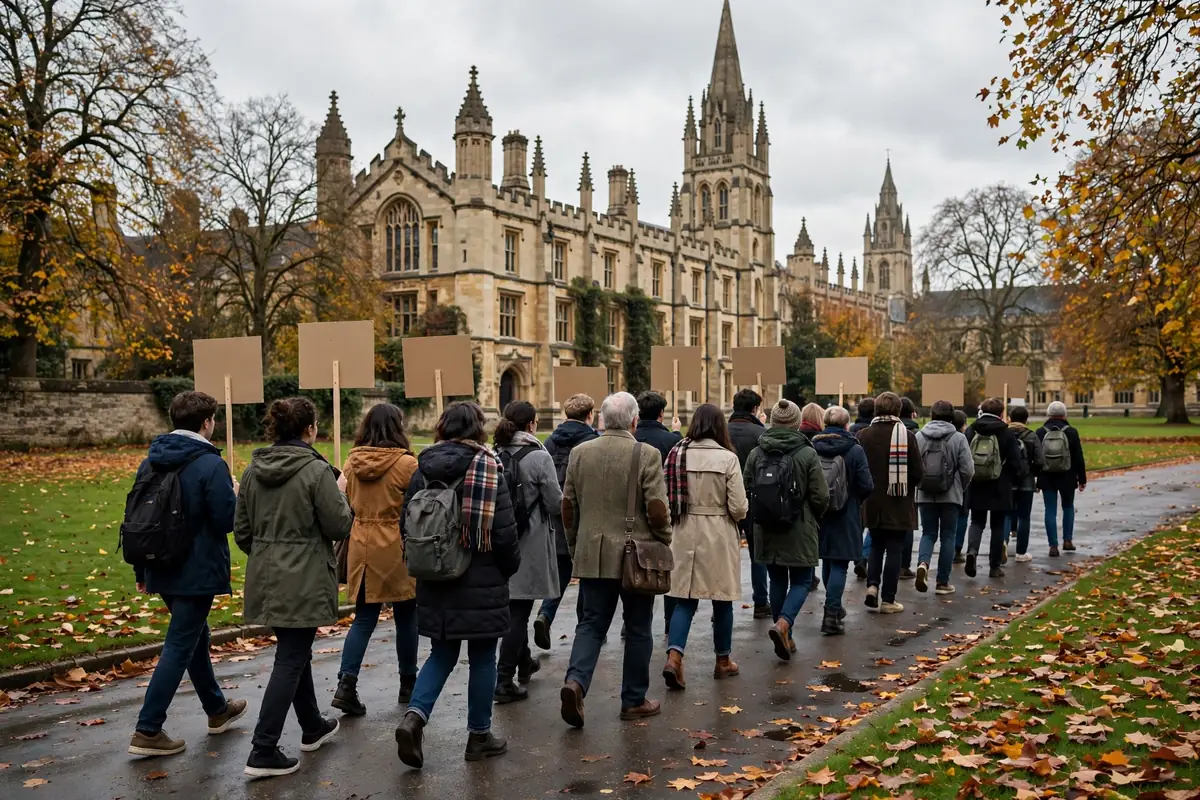
Eight universities, five weeks, one crisis
Eight UK universities have announced plans for strike action in the 2026/27 academic year, including three Russell Group institutions, in what is shaping up to be one of the most disruptive autumns in British higher education in years. The strikes are not about pay in the traditional sense. They are about jobs — thousands of them — and about a financial crisis that university leaders say is the worst to hit the sector since the Second World War.
The dispute crystallizes a slow-burning emergency. British universities have faced years of frozen domestic tuition fees, falling international student numbers, rising costs, and shrinking government support. The result is a sector-wide deficit that has pushed some institutions to the brink — and pushed staff, who have watched colleagues depart in successive rounds of "voluntary" redundancies, to the picket line.
University of Dundee: five weeks on strike
The University of Dundee sits at the sharp end of the crisis. After a long-running dispute over budget cuts and compulsory redundancies, staff are striking on weekdays during the first five weeks of term, from September 21 to October 23.
The numbers are stark. The university culled 675 jobs through so-called voluntary redundancy schemes between November 2024 and mid-2026, then announced plans in June to cut another 200 positions. Interim vice-chancellor Professor Nigel Seaton told BBC Radio Scotland Breakfast: "We have been in the worst financial crisis to affect any British university at least since the Second World War." He added: "We're committed to ensuring the university recovers from this very deep financial crisis and unfortunately, very regrettably, we can't afford to pay the level of staff for the level of staffing we have now."
For Dundee's students, the strike means five weeks of disrupted teaching at the start of the academic year — a period when first-year students are settling in and final-year students are beginning the work that will determine their degree classifications.
University of Edinburgh: 90 programmes scrapped, five weeks of strikes
At the University of Edinburgh, one of Scotland's — and the world's — most prestigious institutions, the dispute is even larger in scale. Staff took part in a marking and assessment boycott over the summer, and are striking on weekdays from September 28 to October 30. The local branch of the University and College Union says the industrial action is over "a long-running dispute over £140 million cuts and 1,800 job losses" and "the refusal of management to rule out compulsory redundancies."
After the union voted to strike, the university announced it will scrap 90 degree programmes from autumn 2027 — a contraction of academic offerings on a scale rarely seen at a major research university. Vice-chancellor Sir Peter Mathieson said: "We are extremely disappointed that, despite ongoing discussions, the University and College Union has given notification of five weeks' strike action, which will unfairly and deliberately target students' first semester of the academic year."
The programme closures raise profound questions about what a university is for. Ninety degree programmes represent not just courses but departments, research groups, and career paths for academics — and choices for students. Their elimination suggests that even elite institutions are being forced to retreat from the comprehensive ideal of the modern university.
University of Essex and the wider wave
At the University of Essex, professional services staff — administrative workers and IT technicians, the people who keep a university running day to day — walked out on September 21, the day of the University of Essex Court Annual Meeting. The timing was deliberate: a protest staged at the university's own governance ceremony.
Five more institutions are in the announced strike wave, bringing the total to eight, three of them in the Russell Group — the self-selecting club of 24 research-intensive universities that has long defined the top tier of British higher education. When Russell Group universities start cutting hundreds of jobs and facing picket lines, the crisis can no longer be described as a problem of weaker institutions. It is systemic.
Why students are caught in the middle
Every strike in higher education places students in an impossible position. They are not the employer, they cannot resolve the dispute, and yet they bear its costs: cancelled lectures, delayed feedback, disrupted assessments, and the anxiety of paying tuition — up to £9,535 a year for domestic undergraduates in England — for an education that is not being delivered.
Unions argue they have no other leverage. Years of below-inflation pay, casualized contracts, and now mass redundancies have left staff feeling that strikes are the last resort. Universities argue that strikes "unfairly and deliberately target students," as Edinburgh's vice-chancellor put it, and that industrial action cannot conjure money that does not exist.
Both things can be true. The strikes are a symptom, not the disease. The disease is a funding model that no longer works: domestic fees frozen in cash terms since 2017 (with only modest recent movement), international student revenue hit by visa restrictions and global competition, and costs — energy, pensions, estates — rising relentlessly.
The global context: Britain is slipping
The strikes are unfolding against a backdrop of declining international standing. In the latest QS World University Rankings, 54 UK universities fell — 61 percent of those ranked. Oxford dropped from third to fourth, Cambridge from fifth to sixth. Imperial College London now sits above both Oxbridge institutions for the second year running. Universities UK, the body representing 141 institutions, has warned that a lack of funding and investment risks a structural decline in the sector.
Chief executive Vivienne Stern put it bluntly: British universities "provide a first-rate education to students, bring better jobs and higher wages to their communities and export British values abroad. But other governments around the world are making the decision to invest in their universities at a time when our government is being slow to do so."
The Times and Sunday Times Good University Guide 2027 told a similar story domestically: for the first time in the guide's 32-year history, neither Oxford nor Cambridge made the top three, with the London School of Economics first, St Andrews second, and Durham third. When the sector's flagship brands are sliding in the league tables at the same time as its staff are striking over redundancies, the message to international students — whose fees keep the system afloat — is not a reassuring one.
What happens next
The immediate question is whether the strikes will spread or settle. The Dundee action runs to October 23, Edinburgh's to October 30. If those disputes are not resolved, further ballots and further action in the spring term are likely. Students applying for 2027 entry will be watching: a university that cannot guarantee teaching, that is cutting 90 programmes, is a harder sell at any price.
The deeper question is whether the UK government will act. Universities UK has made the funding plea repeatedly; the response so far has been limited. Without a sustainable funding settlement — whether through higher fees, direct teaching grants, or a rethink of the international student model — the current wave of cuts and strikes looks less like a one-off crisis and more like the new normal for British higher education.
For a sector that has long sold itself as a global leader, autumn 2026 is a reckoning. The picket lines outside Dundee, Edinburgh, and Essex are not just about this year's job cuts. They are about what kind of university system Britain will have left when the cuts are done.
Sources