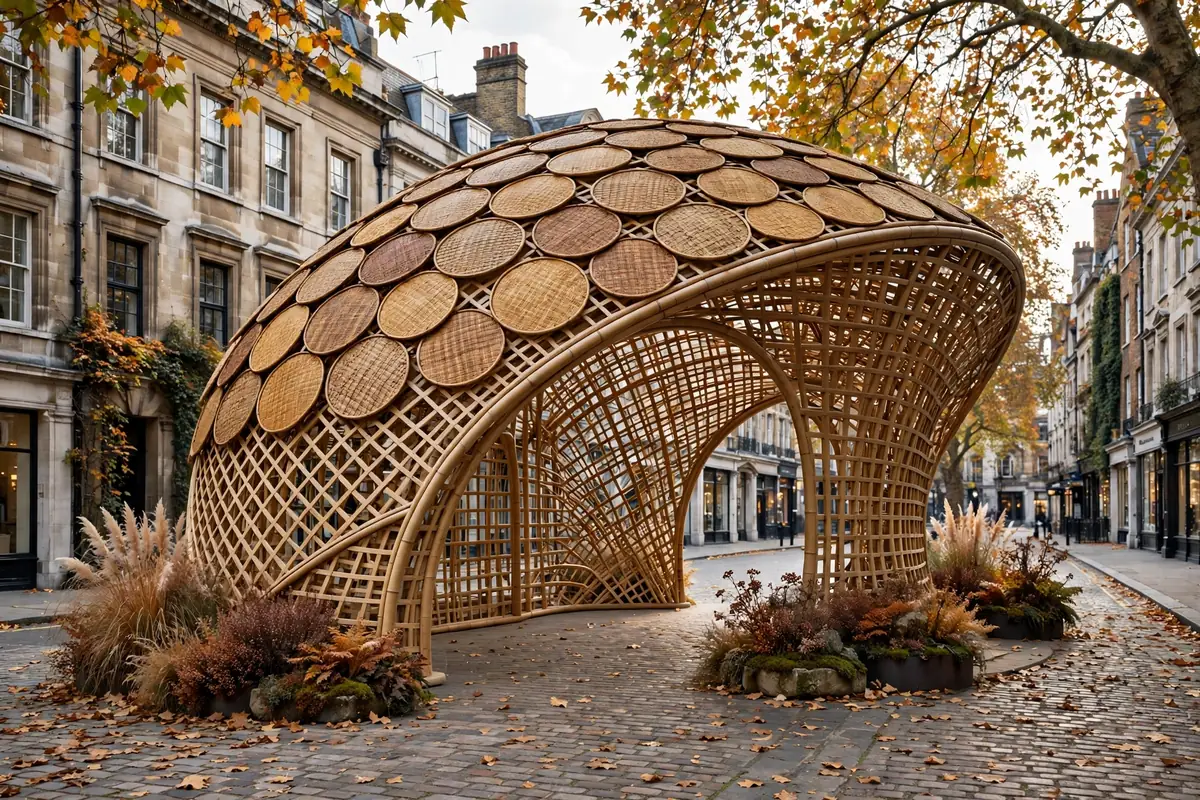
The Pangolin Shield: a pavilion about protection and power
London Design Festival 2026 ran from September 12 to 20, marking the 24th edition of the city's annual design celebration across 11 participating districts. The programme — fairs, exhibitions, installations, talks, workshops, tours, and open studios — was described by Dezeen as one of the strongest since the pandemic. But one project dominated the conversation: the festival's landmark commission, The Pangolin Shield, a bamboo pavilion on The Strand that uses design to confront Britain and India's colonial history.
Designed by Studio Saar with structural engineers Atelier One, led by founder Neil Thomas, the pavilion sits on a newly pedestrianised stretch of The Strand, outside Somerset House and near India House. The location was chosen with intent. As Studio Saar co-founder Ananya Singhal told Dezeen:
"The Strand is right next to Somerset House and right next to India House. Somerset House is where the British Navy was administered from during the colonial period, and India House is where the Indian High Commission is. So this site has a very interesting history behind the relationship between India and the UK." — Ananya Singhal, co-founder of Studio Saar, speaking to Dezeen
The pavilion also faces a bust of India's first prime minister, Jawaharlal Nehru — another layer of meaning in an already loaded site. For Singhal, the project was an opportunity to underline the new relationship India has with the UK and the world. Studio Saar is itself an Indo-UK practice working with a British engineer, and Singhal noted that the combination gave the project a particular resonance on this site.
Named after the pangolin — the scaly mammal — the pavilion is built as a bamboo grid shell, chosen for the material's many positive characteristics. "It's lightweight, it's durable, it grows very quickly; once you finish with it, it's biodegradable, and you can make super interesting shapes from it," Singhal told Dezeen. The roof, however, is what makes the project unforgettable: it is clad in two types of shield — traditional Indian police shields constructed from lathis, and woven rain shields known as knups. Shields are objects of both protection and aggression, and the pavilion holds that tension at the center of one of London's most historically charged streets.
Lighting, sound, and the sensory turn
Beyond the landmark project, this year's festival reflected a broader shift in how designers use exhibitions: less as product displays, more as atmospheres. Designer Lee Broom created The Chant Chambers in his Shoreditch showroom, an "atmospheric environment" showcasing his glass-block Chant lighting collection in a setting he described as "an elegant yet surreal lounge." Wood-panelled walls, tactile wall-to-wall carpeting, stone plinths, and sculptures framed the modular light in its various forms — portable lamp, wall lamp, linear pendants, and oversized chandeliers.
"I wanted the Chant Chambers to feel like an atmospheric environment rather than a display of individual lights," Broom told Dezeen. The installation's moody, smoky palette was inspired by the latest iteration of the Chant collection: a smoked-glass finish, darker than previous versions, that nods to the late 1970s and early 1980s, when glass blocks were prevalent in modern architecture. Broom also noted a practical shift in how clients buy lighting: people increasingly want fixtures adapted to their interiors rather than single fixed objects — a sentiment the modular Chant system is built to serve.
Sound had its own showcase. Fritz Hansen opened the Fritz Hansen Sound Club at 78 Cowcross Street, a series of Bauhaus-style listening spaces pairing the Danish brand's furniture — including Poul Kjærholm's PK31 sofa and PK80 daybed, a 1930s drinks trolley, and PK61 coffee tables — with a turntable setup completed by a matching Technics SL 40CBT. Photography was by Dunka Opalko, and the club was open daily to the public until September 20. The presentation also featured a new version of Cecilie Manz's Monolit chair, a more compact wall-mounted take on the Kaiser Idell lamp, and an upholstered version of Japanese studio Nendo's N02 Recycle chair.
Young talent and playful references
The festival's emerging-designer programming was equally strong. The One Tool Stool exhibition by students from the Royal College of Art was singled out as a highlight, alongside the debut show of new design platform Collate Lobby — a fictional 1930s hotel suite created as the backdrop for its first editions collection. Canadian brand Bocci collaborated with British designer Bethan Laura Wood on Labyrinth Dreams, an installation at 15 Bateman Street spotlighting the new purple colourway of the brand's 14p light. Wood's starting point was delightfully specific: the light reminded her of David Bowie in the film Labyrinth, and the installation's smoky lilac, pink, and blue tones play on that association.
Elsewhere, design gallery Slancha curated Hanging Baskets, an exhibition in which ten designers reinterpreted the humble hanging basket — the suspended planter typically used for growing flowers — as a collectable design object. Shown in the Hackney studio of fashion agency Awaykin, the pieces ranged from laser-cut steel to melted polystyrene waste. French designer Nicolas Zanoni's Pyrofoam Planter was made by melting industrial polystyrene waste into an organic, caramelised form, while London-based Coline Le Quenven's Tri-diatreta combined a steel armature with three 3D-printed cups, drawing on references from Roman cage cups to the neo-Greek bronze furniture of France's Villa Kérylos. "We invited 10 contemporary designers to work from the same loose framework of bracket, suspension and vessel," co-founder Findlay MacDonald told Dezeen.
Dezeen's own pick of fourteen must-see exhibitions captured the festival's range: Awakenings at the Victoria and Albert Museum, where the Emerging Design Commission put artificial intelligence center stage — Playfool's game reflecting on human labour in the age of AI, Nina Davies's installation on bodies mimicking AI-generated movement, and Aziza Kaydri's Sender Unknown combining Uzbek embroidery with a bespoke AI model. At Aram, the non-profit collective Design Everything transformed the shop's downstairs gallery into the flat of a young designer, populated exclusively with objects made by 102 emerging practitioners — a vivid visualisation of the barriers facing independent creatives in London.
What this year's festival signals
Stepping back, London Design Festival 2026 suggested a discipline in a reflective mood. The strongest work engaged with history rather than escaping it — whether the colonial legacies addressed by The Pangolin Shield, the 1970s references in Lee Broom's smoked glass, or the craft traditions reinterpreted through AI at the V&A. Materials told their own stories: bamboo chosen for its lifecycle, polystyrene waste melted into beauty, hand-woven shields carrying political weight.
There was also a notable emphasis on atmosphere over object. Installations that visitors could inhabit — listening rooms, surreal lounges, game-like AI meditations — outshone conventional product launches. For designers watching from the US, Canada, Australia, or elsewhere in Europe, the message is clear: the most compelling design work right now is not asking "what should this look like?" but "what should this make you feel — and what should it make you remember?"
Sources