Seven editions in, design as a national duty
France Design Week 2026 closes today, September 30, after thirteen days of events across the country. The seventh edition of the festival ran from September 18 to 30, bringing together designers, businesses, schools, public institutions, and cultural organisations under a theme that set the tone for everything else: "D for Design, D for Duty."
Nearly 500 events took place throughout France — exhibitions, conferences, workshops, studio visits, open houses, and networking events — coordinated by the APCI, the Agency for the Promotion of Industrial Creation, and delivered through a growing national network of regional partners. The framing was deliberate: this was not presented as a showcase of creativity alone, but as an argument that design is a strategic tool for innovation, inclusion, and sustainable transformation. The theme asked how design helps address the environmental, social, and economic challenges shaping the future, and the programme was built to answer with examples rather than slogans.
The opening ceremony took place in Paris on September 18, alongside the France Design Impact Award, which celebrates projects demonstrating the positive impact of design on society, the economy, and the environment. The national closing event is being held at the Galerie Nationale du Design in Saint-Étienne — a choice that reinforces the festival's ambition to connect territories rather than concentrate everything in the capital, and to strengthen the French design community as a genuinely national network.
Paris Design Week: the city as exhibition
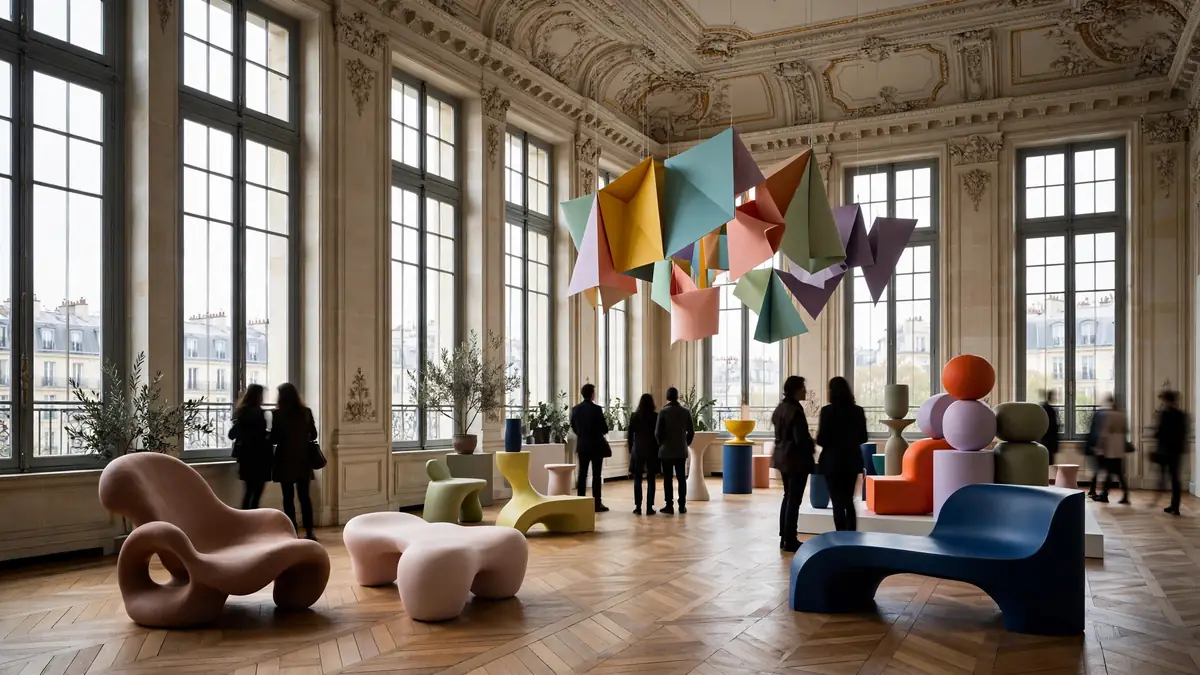
Running in parallel, Paris Design Week 2026 took over the capital from September 10 to 19 with its own edition, themed around motion and gathering. According to the organisers at Maison&Objet, the 2026 edition brought together 500 participants across 320 locations in the city's primary creative districts — Le Marais, Saint-Germain-des-Prés, Opéra, and Bastille — with galleries, showrooms, schools, and cultural institutions opening their doors, and design entering into dialogue with the capital's historic heritage.
Several anchor exhibitions defined the edition. Paris Design Week Factory, running September 10 to 14, showcased more than 150 emerging designers across four galleries in Le Marais, curated as a laboratory for new talent and collectible design rather than a conventional fair. The Design Conversations debuted on September 16 at the Musée de la Chasse et de la Nature, with five discussions on contemporary French design and a screening of a documentary dedicated to Andrée Putman. The Pavilion of Time, hosted in the Jardin du Palais-Royal, offered an immersive installation exploring the interplay between light and matter. Vivement Demain #5, organized by the Mobilier National, centered on the next generation of design and the talents interpreting its future. A public art intervention, La Re-prise de la Bastille, displayed 196 flags across the city center as an urban collective installation. And a newly introduced trail, Appartements, opened exceptional private Parisian apartments and interiors to the public through a design lens.
The dialogue with historic sites produced some of the edition's most striking moments. At the Grand Palais, the studio Uchronia transformed the Rotonde d'Antin with Le Grand Bouquet, a monumental bloom inspired by the building's architecture and decorative vocabulary, created in collaboration with several French craft houses. At the Musée Bourdelle, Anthony Guerrée's Contrepoint created a sensitive dialogue between furniture and Antoine Bourdelle's sculptures, working in wood, glass, textiles, and clay.
Maison&Objet Pulse and the business of design
Maison&Objet anchored the week with its September fair at the Paris Nord Villepinte Exhibition Centre, rebranded this year as Maison&Objet Pulse. The theme called for renewed creative and collective energy, exploring how design can bring people together, inspire movement, and respond to a changing world. The Valencia-based creative duo Masquespacio — known for vivid colours, bold forms, and expressive environments — served as ambassador for both the fair and Paris Design Week, interpreting the theme through two installations, one at the fair and one in the city, and designing the visual campaign for the September events.
The fair retained seven principal sectors: Decor & Design, Cook & Share, Fine Craft, Wellness & Beauty, Fragrance & Ambiance, Fashion & Accessories, and Gift & Play. At the center of the Decor & Design sector sat Design District, a "fair within the fair" conceived as an incubator for emerging creativity, bringing together young designers, new-generation studios, architecture practices, specialist publishers, and innovative businesses. Design District also hosted the Rising Talent Awards for South African studios, the Future On Stage programme for innovation-driven brands, and an Eco-materials Corner dedicated to more environmentally responsible surfaces and materials.
A notable addition was (im)Pulse, a new platform giving emerging design brands greater visibility among international buyers and industry professionals, developed in partnership with Ulule, Pépite France, the Ville de Paris, and Émergence. Participants ranged from crowdfunded brands to graduate-led businesses and young Parisian companies — a snapshot of new ideas entering the international design market. For buyers from the US, UK, and beyond scouting what comes next, these incubator spaces are increasingly where the real discoveries happen.
Craft, computation, and cross-cultural collaboration
Some of the most interesting projects at Paris Design Week sat at the intersection of craft and technology. Creative Matters and the Paris-based agency RDAI presented Zoometry, an exhibition of hand-knotted rugs translating microscopic structures found in nature into woven form. Inspired by spiders, butterflies, and coral, the six-rug collection began as detailed digital compositions before being translated knot by knot into Himalayan wool and Chinese silk by master artisans in Nepal. Photographs and film by Nepalese photojournalist Narendra Shrestha traced the process from digital modeling to the weaving workshops. It is a neat emblem of where high-end design is heading: computational precision at the concept stage, human mastery at the making stage.
Design publisher designboom's guide to the week highlighted further activations, including HOFF's "Paris Through a Design Lens" at the Jade Matcha Gallery — a cultural project developed with designer Clémence Mars alongside the footwear brand's NAPPA collection, complete with creative talks and a curated map of creative destinations across Paris. At the Institut suédois, the group exhibition Tout est en ordre wove art and fashion around the Swedish concept of order, while Printemps Haussmann hosted Pas à Pas, an eleven-section exhibition dedicated to footwear spanning fashion, history, and contemporary design.
What "duty" means for design in 2026
The throughline of this September in France was seriousness of purpose. France Design Week's "D for Design, D for Duty" theme, the France Design Impact Award's focus on measurable positive impact, the Eco-materials Corner at Maison&Objet, and the craft-meets-computation projects all point in the same direction: a discipline being asked to justify itself not by beauty alone but by contribution.
That is a demanding brief, and not every project in a 500-event programme will meet it. But the direction of travel is unmistakable, and it aligns with what clients and publics increasingly expect: design that can show its working on sustainability, inclusion, and local economic benefit. France's bet is that a national festival — coordinated centrally, delivered regionally, closing in Saint-Étienne rather than Paris — is the right vehicle for making that case. As the lights go down on the seventh edition, the permanent national community the festival is building may prove to be its most durable design.
Sources