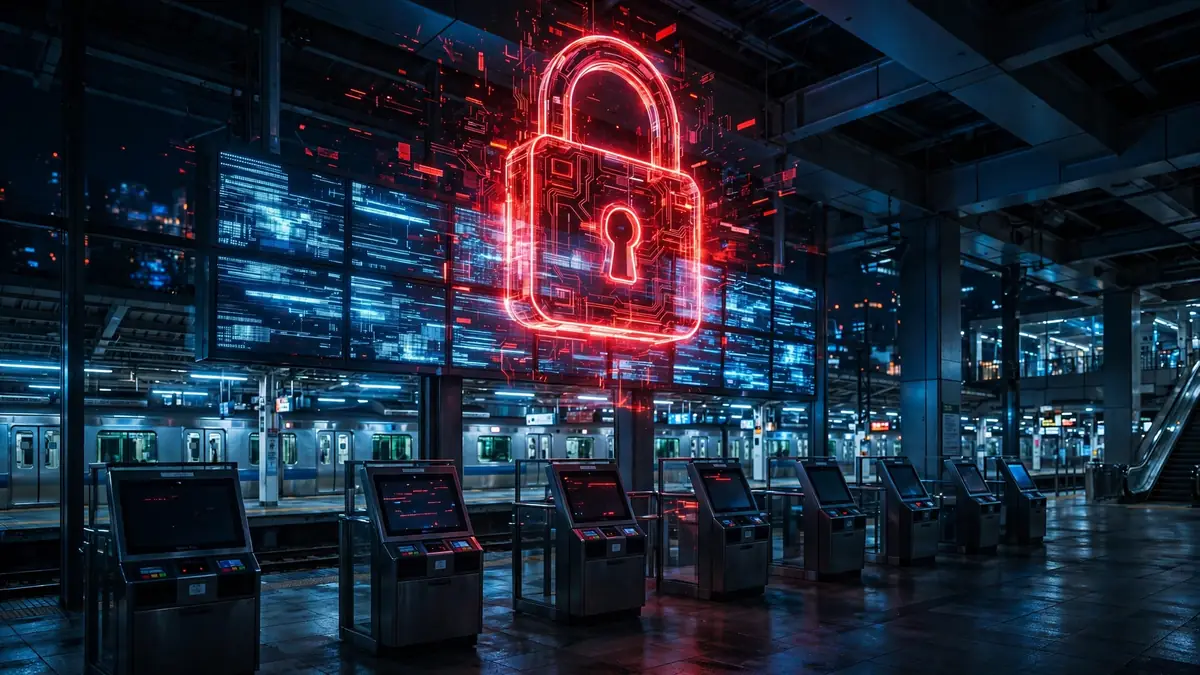
Keio Corporation, one of Japan's major private railway operators, confirmed on September 26, 2026, that its network had been hit by a ransomware attack over the weekend, forcing the company to shut down systems and disrupting payment services across its hospitality business. Trains kept running — but the incident, disclosed alongside a separate cyberattack on Tokyo Metro that exposed 59,000 member email addresses, made for an unsettling weekend for Japanese critical infrastructure.
Keio is a substantial enterprise: 85 kilometers of track, 69 stations, a hospitality business spanning 25 hotels, more than 2,200 employees, and reported annual revenue of about $2.6 billion. The company's statement was direct:
"In the early hours of September 26, 2026, we confirmed a ransomware attack on our group's servers. We have reported the incident to the police and are conducting an investigation into the attack's route and damage with the cooperation of external experts."
Following the detection of a system failure in the early hours of Saturday, the company confirmed the attack and shut down its network to prevent additional damage. It said it is investigating the extent of the impact and whether the attackers accessed any customer or business partner information.
What was hit — and what wasn't
The incident appears to have affected only the hospitality side of Keio's business, not train operations. A separate announcement on the company's Keio Plaza Hotel Tokyo website warned of possible delays to some customer-facing services, and local media outlets reported that the cyberattack disrupted the firm's payment systems.
The most important detail in the reporting is what was not hit. Train operations appear to have kept running while the hospitality side went dark. For a critical-infrastructure operator, that is exactly the outcome network segmentation is designed to produce: a compromise in the corporate or commercial zone does not reach the systems that move people. That separation still needs to be verified — Keio has not published architecture details, and investigators have not finished tracing the attack path — but on the evidence available, the operational core held.
It is worth being precise about what remains unknown. As of September 28, no ransomware group had publicly claimed the attack. Keio has not confirmed whether data was exfiltrated, and its open investigation into whether customer and partner information was accessed fits the pattern of modern double-extortion ransomware, in which attackers steal data before encrypting it and use the stolen files as a second source of pressure. If a group claims the attack, a leak-site listing would normally surface within days to weeks.
Why the weekend timing matters
The attack was detected in the early hours of a Saturday — timing that is unlikely to be coincidental. Ransomware crews routinely begin encryption late on Friday or in the small hours of Saturday. Security teams are thinner, change windows are quieter, and organizing a response takes longer. By the time an incident is confirmed, encryption has often already spread across everything the compromised accounts could reach.
Keio detected the attack within hours and chose a full network shutdown. That is the costly but defensible call: it trades customer-facing uptime — including payments — for a hard stop on lateral movement. The payment disruption and service delays guests are experiencing are the direct cost of that choice, and they are far smaller than the cost of an encrypted operational environment would have been.
Hospitality networks are particularly attractive targets. They are dense with payment terminals, booking platforms, and guest data; they tend to have many third-party connections and shared vendor access; and the pressure to restore guest-facing services quickly gives attackers leverage. Whether the attackers deliberately targeted the hotel systems or simply went for the fastest route to pressure and payment is something the investigation may eventually establish.
Tokyo Metro's separate incident
The Keio attack was not the weekend's only rail-related disclosure. Tokyo Metro separately reported a cyber incident in which attackers gained unauthorized access to its systems and accessed 59,000 member email addresses. Although both Keio and Tokyo Metro are Japanese railway operators, it is unclear whether the two organizations were targeted in a coordinated campaign by the same threat actor or whether the timing is coincidental.
The Tokyo Metro incident, as disclosed, appears more limited in scope — member email addresses rather than operational systems — but 59,000 email addresses in attackers' hands is a ready-made phishing list, and customers of the metro system should treat unsolicited messages referencing their membership with suspicion.
What investigators will be looking for
Several lines of inquiry will shape the coming weeks. First, the attack route: how the attackers gained their initial foothold, whether through phishing, a vulnerable internet-facing system, or a compromised vendor connection. Second, the dwell time: how long the intruders were inside before encryption began, and what they touched along the way. Third, and most consequential for customers, whether data was exfiltrated — the question Keio's investigation into customer and partner information is designed to answer.
Security teams watching the case will also be watching for a claim of responsibility. The absence of a claim as of September 28 leaves open several possibilities: the attackers may still be negotiating privately, the incident may involve a group that does not operate a public leak site, or attribution may simply take time to surface.
The bigger picture for Japanese critical infrastructure
Two rail operators disclosing cyber incidents in a single weekend is a notable cluster, whatever the underlying connection. Japan's rail networks are among the most complex cyber-physical systems in the world, and the Keio case is a live demonstration of both the threat and the defense: attackers reached the commercial IT environment and forced a disruptive shutdown, while — so far as is known — the operational technology that moves trains stayed intact.
The lesson for infrastructure operators everywhere is the one Keio's weekend illustrates in miniature. Segmentation between corporate IT and operational systems is not an architectural nicety; it is the difference between a painful business disruption and a public-safety incident. Assume that ransomware crews will eventually get into the IT environment — the weekend timing, the hospitality attack surface, the vendor connections all favor the attacker — and design so that the blast radius stops at the boundary that matters most. Keio's trains kept running. In 2026, that counts as a defensive success, and as a standard every operator should be held to.
Sources